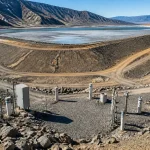
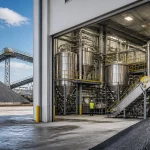
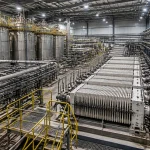
White Mesa Mill is a uranium, vanadium and rare-earth processing facility near Blanding, Utah.

By Charles Pitts
WASHINGTON : President Donald Trump has reduced the boundaries of Utah’s Bears Ears and Grand Staircase-Escalante national monuments by roughly 90%, setting nearly 3 million acres of federal land on a path back to mining, mineral leasing and other forms of development.
The July 13 proclamations reduce Bears Ears from about 1.36 million acres to approximately 121,096 acres, while Grand Staircase-Escalante falls from about 1.87 million acres to roughly 181,541 acres. The excluded acreage is scheduled to reopen at 9 a.m. Eastern time on Sept. 11, subject to existing rights, land withdrawals and other legal requirements.
The decision has already drawn a second layer of scrutiny. House Democrats opened an investigation on Aug. 10 into whether executives at uranium producer Energy Fuels Inc. traded company stock after receiving nonpublic information about the planned reduction of Bears Ears.
The congressional inquiry does not establish that insider trading occurred, and Energy Fuels has denied wrongdoing. But the timing of the trades, the company’s interests in regional uranium processing and the administration’s public-lands policy have intensified questions over who knew about the monument decision and when.

What the proclamations change
The White House described the action as “rightsizing” the monuments and returning the excluded lands to “common sense” multiple-use management.
Under the proclamations, land removed from the monument reservations may become available for entry under public-land laws, mineral and geothermal leasing, and location or patent under the mining laws. The documents also direct federal agencies to maintain protections for selected cultural, historic, paleontological and scientific resources that remain inside the reduced monument boundaries.

| Monument | Area before July action | Area retained | Approximate reduction |
|---|---|---|---|
| Bears Ears | 1.36 million acres | 121,096 acres | 1.24 million acres |
| Grand Staircase-Escalante | 1.87 million acres | 181,541 acres | 1.69 million acres |
| Combined | 3.23 million acres | 302,637 acres | Nearly 2.93 million acres |
The proclamation modifying Bears Ears creates the Shash Jáa and Indian Creek units. It identifies archaeological sites, rock art, paleontological resources and other features that the administration says require continued protection.
The Grand Staircase-Escalante proclamation retains the Canyons of the Escalante and Kaiparowits Horizon units. The White House cited the region’s fossil record, cultural sites and geological features, while also arguing that the wider area contains minerals important to U.S. economic and national security.
The proclamations do not themselves approve a mine or guarantee that exploration will proceed. Companies would still face federal and state permitting, environmental reviews, cultural-resource requirements, water constraints and potential litigation. Mining claims filed before the effective reopening date would not create rights, according to the documents.

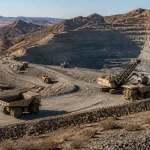
Mining infrastructure in the arid terrain typical of the American Southwest.
Uranium and critical minerals at the center
The policy shift is especially significant around Bears Ears and the San Juan Basin, where historic mining districts contain uranium and vanadium deposits. The Bears Ears proclamation also names silver, copper, molybdenum, lead and zinc among the resources considered relevant to domestic supply security.
Grand Staircase-Escalante has been associated with coal resources on the Kaiparowits Plateau, as well as wider mineral potential. The administration’s rationale links the land opening to a broader strategy of reducing U.S. reliance on foreign sources of minerals used in defense, manufacturing and transportation.
For operators, however, a change in land status is only an early-stage development. Companies will need to establish the location and validity of claims, undertake geological work, secure access and infrastructure, and demonstrate compliance with environmental and cultural-protection laws. The remote terrain also raises practical questions about roads, power, water and processing capacity.
The Bureau of Land Management’s Bears Ears page describes the area as containing rock art, pueblo homes, climbing areas, river access and designated routes. BLM information on Grand Staircase-Escalante highlights its paleontological record, biological diversity and remote terrain.
Those characteristics are likely to make environmental review and tribal consultation central to any future development proposal.
Energy Fuels stock purchases under review
The House investigation is being led by Rep. Jared Huffman, the Natural Resources Committee’s ranking Democrat, and Rep. Maxine Dexter, the ranking Democrat on its Oversight and Investigations Subcommittee.
According to the lawmakers’ Aug. 10 letter to Energy Fuels Chief Executive Ross Bhappu, Bhappu purchased 74,000 shares of the company on July 7. The letter describes the transaction as the largest insider stock purchase in Energy Fuels’ history and says it increased his ownership by about 41%.
Chairman Bruce Hansen purchased 4,000 shares on July 8. Trump announced the monument reductions on July 13.
The lawmakers are seeking communications between Energy Fuels and officials at the Interior, Agriculture and Defense departments, as well as calendars for Bhappu and Hansen, lobbying records and internal projections concerning potential changes to Bears Ears’ boundaries. Their press release said the timing raised the possibility that company executives had access to nonpublic information.
The investigation is a congressional information-gathering exercise, not a criminal finding or an enforcement action by the Securities and Exchange Commission or the Justice Department. Any formal insider-trading case would require evidence that the executives possessed material nonpublic information and traded while violating a duty or other applicable securities law.
Energy Fuels said it was unaware of evidence supporting the allegations and “strongly rejects any suggestion” that the company or its executives engaged in improper conduct. The company also said the White Mesa Mill has never been inside Bears Ears and that it holds no properties, mining claims or economic interests within the monument.
Why the mill matters
Energy Fuels operates the White Mesa Mill near Blanding, Utah, which the company describes as the only fully licensed and operating conventional uranium mill in the United States. The facility has capacity for more than 8 million pounds of uranium per year, according to the company, and also processes vanadium and rare-earth feedstocks.
The mill is outside Bears Ears, but its location makes it relevant to the economics of any future uranium development in the region. The House Democrats’ letter says ore from districts such as White Canyon and Elk Ridge could potentially be transported to White Mesa for processing.
Energy Fuels has also highlighted its growing role in U.S. rare-earth and uranium supply chains. The company said in July that it had begun expanding the mill, using part of a $725 million loan from the Defense Department’s Office of Strategic Capital.
The company’s position is that its mill, properties and mining claims are not located inside the monument. The lawmakers argue that a company can still benefit from wider access to nearby uranium-bearing formations through its regional processing capacity and existing position in the domestic nuclear-fuel chain.
That distinction: between ownership inside the monument and commercial exposure to resources around it: will likely remain central to the investigation.
Litigation and implementation risks
The proclamations are expected to face legal challenges from conservation groups and tribal interests, which have questioned whether the president has authority under the Antiquities Act to substantially reduce monuments created by earlier administrations.
The administration argues that the same law permits a president to alter a monument when protected areas are not confined to the “smallest area compatible” with protecting objects of historic or scientific interest. Opponents are expected to argue that the statute grants authority to create monuments but does not clearly authorize their unilateral dismantling.
For mining companies, the legal dispute creates uncertainty even as the reopening date approaches. Exploration teams may prepare technical and land-status work, but major expenditures could be difficult to justify while the boundaries remain subject to court review.
The outcome will also affect tribal consultation and land-management arrangements. The Bears Ears proclamation disbands the Bears Ears Commission established under earlier proclamations, while directing federal agencies to continue consulting federally recognized tribes under other applicable authorities.
The immediate question is therefore not whether nearly 3 million acres will become active mines. It is whether the proclamations survive judicial review, how the Bureau of Land Management and the U.S. Forest Service implement the new land status, and whether exploration companies can convert newly available acreage into permitted, financeable projects.
For Energy Fuels, the congressional investigation adds a separate risk. The company’s future access to regional mineral supply will depend on geology, permits and infrastructure: but its executives’ stock purchases are now being examined against the timeline of one of the most consequential public-land decisions in the U.S. mining sector in years.
Sources: The White House; House Natural Resources Committee Democrats; KNAU; Energy Fuels.