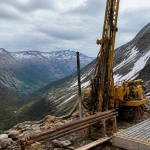
Industrial equipment at a U.S. critical minerals processing facility.

By Charles Pitts
WASHINGTON : The U.S. government will invest about $3 billion in critical-minerals, battery and mining projects as the Trump administration seeks to expand domestic production, rebuild defense supply chains and reduce reliance on China, President Donald Trump said at a State Department roundtable attended by more than 200 mining executives.
The package includes a $1.4 billion conditional Pentagon loan to battery-materials company Sila Nanotechnologies, $400 million for Sunrise Energy Metals’ scandium development and $150 million for Niron Magnetics, which is developing rare-earth-free permanent magnets.
The Export-Import Bank is separately providing $58 million to three U.S. mineral projects: $25 million to Westwater Resources for graphite development in Alabama, $25 million to Global Advanced Metals for tantalum and niobium processing in Pennsylvania, and $8 million to 5E Advanced Materials for a boron project in California.
The White House described the announcement as more than $2 billion in new mining and mining-related projects, alongside more than $180 million in investments for mining education and workforce development. Trump presented the broader effort as a national-security response to constrained weapons inventories and fragile overseas supply chains.

“We’re reclaiming America’s rightful place as the minerals superpower of the world,” Trump said at the roundtable, according to the White House fact sheet.
Funding targets batteries, magnets and specialty metals
The largest commitment is a $1.4 billion conditional loan from the Pentagon’s Office of Strategic Capital to Sila Nanotechnologies. The California-based company plans to expand production of silicon-carbon anodes and build out lithium-ion battery cell manufacturing capacity.

The materials are intended for applications including satellites, unmanned aerial systems and munitions. The administration also pointed to wider industrial uses, including energy storage and other advanced technologies.
The loan remains conditional. Sila must satisfy financial, technical, legal and other requirements before reaching financial close, and the commitment does not mean that the full amount has already been disbursed.

Technician inspecting equipment on a battery-materials production line.
Sunrise Energy Metals will receive a $400 million conditional commitment to develop what the administration described as a full scandium value chain, including a primary scandium mine.
Scandium is used in high-performance aluminium alloys for aerospace and defense applications. The metal can improve strength and heat resistance in alloys used in aircraft, spacecraft and other high-temperature equipment. Sunrise’s proposed development is intended to establish a domestic source for a market that currently depends heavily on limited international production.
Niron Magnetics, a Minnesota-based company, will receive a $150 million conditional commitment to scale production of permanent magnets that do not rely on rare earths. The magnets are used in electric motors, industrial equipment, electronics and defense systems.
The investment reflects Washington’s effort to address a supply-chain vulnerability that extends beyond mining. China dominates much of the global rare-earth mining, separation, refining and magnet-manufacturing chain, leaving manufacturers exposed to export restrictions and geopolitical disruption.
The administration also announced more than $85 million for Standard Bauxite to secure domestic supplies of refractory-grade bauxite, a material used in high-temperature applications and industrial manufacturing.
Export-Import Bank supports graphite, tantalum and boron
The $58 million in Export-Import Bank financing is aimed at projects with a direct connection to battery, electronics and defense manufacturing.
Westwater Resources is receiving $25 million for the Coosa Graphite Deposit and associated processing development in Alabama. Domestic graphite production is strategically important because graphite is a major component of lithium-ion battery anodes, while China remains a leading force in global graphite processing.
Global Advanced Metals will receive $25 million for tantalum and niobium processing in Pennsylvania. The two metals are used across electronics, specialty steels, magnets and other industrial applications. The project is intended to reduce U.S. exposure to overseas sources for materials that are not currently mined domestically at meaningful scale.
5E Advanced Materials will receive $8 million to develop a boron deposit in California. Boron is used in permanent magnets, semiconductors, glass and certain defense-related applications.
The administration’s project list also includes a Development Finance Corporation commitment matching a $4.8 million investment in Harena Rare Earths, which is developing a rare-earth project in Madagascar. That project is intended to supply materials for U.S. manufacturing, including rare-earth elements used in magnets.
The financing announcements underline the administration’s focus on the full supply chain rather than extraction alone. Mining projects must be connected to processing, refining, manufacturing and recycling capacity if they are to provide a reliable alternative to imported materials.
Skillings previously examined a similar policy direction in its analysis of Defense Production Act powers for recovering critical minerals from mine waste, including the growing federal interest in tailings, battery black mass and industrial scrap.
Mining schools receive $180 million workforce push
The package also targets a longstanding constraint on U.S. mineral development: a shortage of mining engineers, geologists, metallurgists and processing specialists.
The Department of Energy will invest $100 million across America’s 14 mining schools, with the goal of doubling the number of graduates holding credentials in mining, minerals and related supply-chain disciplines.
The Pentagon will provide more than $80 million for three university-based programs focused on workforce development and technology innovation. The projects include:
| Institution | Announced investment | Focus |
|---|---|---|
| Colorado School of Mines | $32.7 million | Critical-minerals innovation and commercialization |
| South Dakota School of Mines and Technology, with partner universities | $25 million | Critical-minerals merit scholars and workforce development |
| Johns Hopkins University | $23.6 million | Multi-material recycling innovation hub |
The programs are designed to train students in mining, geology, metallurgy, recycling and mineral processing while connecting universities more directly with defense contractors and mining companies.
The administration said the workforce investment is intended to double mining-related graduates within two years. That target would require a rapid increase in enrollment, scholarships, industry partnerships and access to pilot-scale processing facilities.
The challenge is significant. U.S. mining programs have experienced falling enrollment over the past decade, even as demand has increased for materials used in batteries, electric equipment, aerospace, data centers and weapons systems. The White House has also pointed to an aging mining workforce and an expected wave of retirements.
Iran war adds urgency to supply-chain policy
The administration has linked the new investments to the war with Iran, saying the conflict has depleted U.S. weapons stockpiles and exposed the importance of securing the mineral inputs needed to replenish them.
Critical minerals are used in missile systems, fighter aircraft, armored vehicles, infrared sensors, semiconductors, batteries and other defense equipment. Any disruption in the supply of specialty metals or processed materials can therefore affect production even when the United States has access to raw ore.
That concern has pushed mineral policy closer to the center of defense planning. It also helps explain why the latest commitments combine commercial loans with university grants, recycling programs and supply agreements.
Mining executives at the State Department event included Tom Albanese of American Ocean Minerals, Jim Litinsky of MP Materials, and representatives of Lithium Americas, NioCorp and Energy Fuels.
Lithium Americas is developing the Thacker Pass lithium project in Nevada, while NioCorp is advancing a multi-mineral project in Nebraska that includes scandium. Energy Fuels has also received a separate conditional loan commitment from the Office of Strategic Capital.
The participation of companies across lithium, rare earths, scandium, graphite and uranium-related supply chains reflected the administration’s broader approach: secure multiple mineral pathways rather than focus on a single commodity.
Execution remains the central test
For operators and investors, the immediate significance of the announcement is the scale and strategic direction of federal support. Conditional loans can reduce financing risk and help projects reach construction, but they do not eliminate permitting, engineering, processing or market challenges.
Several of the supported projects still need to demonstrate commercial-scale production, secure downstream customers and complete the conditions required for financial close. The success of the program will depend on whether government commitments translate into operating mines, processing plants and qualified domestic materials.
The policy also creates a stronger link between project development and defense procurement. Developers may face greater scrutiny over production timelines, material specifications, environmental performance and the ability to deliver consistent volumes.
The broader supply-chain objective is visible in the administration’s emphasis on domestic processing and recycling. As Skillings’ analysis of North American lithium supply chains noted, regional infrastructure and midstream capacity are increasingly important to the value of a mineral project.
The Trump administration’s $3 billion announcement therefore represents more than a collection of individual loans and grants. It is an attempt to connect mine development, materials processing, advanced manufacturing and workforce training into a defense-oriented domestic supply chain.
Whether that strategy can deliver at the pace required by national-security planners will depend on execution. For now, Washington is signaling that critical-minerals policy will remain closely tied to defense readiness, industrial capacity and competition with China.