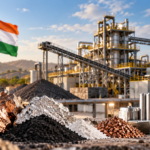
Rare-earth separation equipment at a U.S. processing facility.

By Charles Pitts
The critical minerals supply chain is often described as a race to mine more ore and separate more rare-earth oxides. In 2026, that description is incomplete.
The harder problem begins after separation.
Rare-earth oxides must still be converted into metals, alloyed, formed into magnets, and qualified by manufacturers that supply electric vehicles, robotics, aerospace systems, electronics and defense equipment. A project can produce a high-purity oxide and still remain several industrial steps away from a saleable magnet.
More Read

That gap is becoming more visible as companies such as Energy Fuels and American Rare Earths pursue different routes into the midstream. At the same time, Japanese manufacturers are facing renewed exposure to Chinese supply restrictions, while the United States, Japan and African development institutions are trying to build alternative mineral corridors.

Skillings’ rare-earths coverage has tracked the sector’s shift from geological potential toward processing capacity. The central question for 2026 is no longer simply who has resources. It is who can deliver qualified material to the magnet plant.
The supply chain has four separate proof points
Rare-earth supply chains are commonly reduced to a sequence of mining, separation and magnet manufacturing. For operators and investors, the more useful framework is a four-stage test:
- Can the project produce a consistent concentrate?
- Can it separate individual oxides at commercial purity and scale?
- Can those oxides be converted into metal and alloy feedstock?
- Can a magnet manufacturer qualify the material for a specific product?
Each stage has different technical, financial and geopolitical risks.
| Supply-chain stage | Required output | Main bottleneck in 2026 | What buyers need to see |
|---|---|---|---|
| Mining and beneficiation | Mineral concentrate or mixed rare-earth intermediate | Ore variability, radioactive by-products, logistics and permitting | Reliable feedstock specifications and transport |
| Separation | Individual oxides such as NdPr, Dy and Tb | Solvent-extraction complexity, purity control and waste management | Reproducible purity, quality assurance and volume |
| Metallization and alloying | Rare-earth metals and magnet alloy | Limited non-Chinese conversion capacity, process chemistry and energy intensity | Metal purity, alloy performance and scalable production |
| Magnet manufacturing | Sintered or bonded permanent magnets | China’s downstream dominance, tooling, yield and customer qualification | Validated performance in a commercial application |
The distinction matters because an oxide is not the same product as a metal. Magnet manufacturers generally require metals or alloys that can be blended with iron, boron and other additives. Oxides therefore represent an important midstream milestone, but not the final industrial product.
Energy Fuels shows why qualification matters
Energy Fuels’ August 19 announcement illustrates the value of passing the final customer test. The company said terbium oxide produced at its White Mesa Mill in Utah had passed all qualifications for use by one of the largest rare-earth permanent magnet manufacturers outside China.
The Japanese manufacturer told Energy Fuels that the material met its specifications and was approved for commercial rare-earth permanent magnet production without further qualification or validation, according to the company release.
Terbium is used in small quantities to improve the heat resistance and performance of high-strength neodymium-iron-boron magnets. It is particularly important in demanding applications such as vehicle traction motors and aerospace systems, where magnets must retain performance at elevated temperatures.
Energy Fuels had previously announced qualification of its neodymium-praseodymium and dysprosium oxides for permanent magnet applications. The terbium milestone extends that record from light rare earths into one of the most supply-constrained heavy rare earth elements.
However, qualification should not be confused with commercial production. It confirms that a customer has accepted the material against technical specifications. It does not, by itself, establish the volume that will be purchased, the timing of deliveries, the price, or the operating performance of a full-scale circuit.
That distinction is especially important for terbium. Energy Fuels cited Benchmark Mineral Intelligence data putting terbium oxide at approximately $5.5 million per tonne on a CIF Europe basis. A high unit value can support project economics, but it also reflects a small and specialized market where quality, consistency and customer relationships are critical.

Rare-earth metallization requires specialized electrochemical and thermal processing equipment.
American Rare Earths targets the oxide-to-metal step
American Rare Earths and Novex are approaching the same gap from a different position.
Under an August 17 memorandum of understanding, American Rare Earths’ U.S. subsidiary, Wyoming Rare, agreed to work with Novex on converting separated oxides from the Halleck Creek project in Wyoming into metals for permanent magnets. The partnership initially focuses on neodymium-praseodymium oxide from American Rare Earths’ demonstration plant.
The companies also plan to examine process optimization and qualification for NdPr, terbium, dysprosium, samarium and yttrium. Their stated objective is to design and develop a U.S. rare-earth metal production facility linked to Halleck Creek feedstock.
Reporting by Mining Weekly said the parties were evaluating technologies including fluoride conversion followed by reduction, as well as high-temperature molten-salt electrolysis. American Rare Earths has identified molten-salt electrolysis as its leading development route because it could reduce reliance on anhydrous hydrogen fluoride and avoid consuming saleable rare-earth metal as a reducing agent.
The MoU is non-binding apart from provisions including confidentiality and governing law. The parties intend to negotiate a longer-term supply and collaboration agreement within roughly 12 months, but that commercial agreement is not guaranteed.
The significance is therefore developmental rather than operational. The arrangement acknowledges that a mine and separation plant do not complete a domestic supply chain. Halleck Creek still needs a credible route from oxide to metal, followed by alloying, magnet production and customer qualification.
Japan’s shortage is a midstream warning
Japan’s exposure demonstrates why this stage has become a strategic issue.
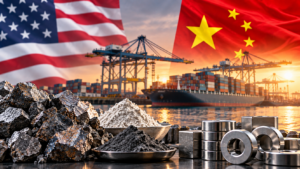
China remains deeply embedded in Japan’s rare-earth supply chain, particularly in processing and magnet-related materials. Market reporting in 2026 described a sharp reduction in Japanese access to some heavy rare-earth oxides following Chinese export controls and licensing restrictions. Industry warnings have focused on dysprosium, terbium and yttrium, which are difficult to replace quickly because alternative separation and metallization capacity remains limited.
The immediate effect has been supply stress rather than a complete shutdown of Japanese manufacturing. Strategic stockpiles, recycling, substitution, alternative suppliers and imports of finished components have provided some protection. But those buffers do not remove the underlying dependence on Chinese midstream and downstream capacity.
Japan’s response has included continued support for Lynas, cooperation with Australia and France, investment in recycling, and exploration of additional supply from Southeast Asia, Africa and other jurisdictions. Japan is also examining deep-sea rare-earth resources near Minamitorishima, although those resources remain a longer-term option rather than an immediate commercial solution.
The U.S.-Japan critical minerals framework places mining, separation, processing, recycling, stockpiling and permanent magnets within the same policy architecture. It also establishes a proposed rapid-response group and calls for coordinated investment in projects capable of supplying the United States, Japan and other aligned markets.
Energy Fuels’ terbium qualification fits this strategy because it provides a demonstrated U.S.-to-Japan route. The route is not yet independent of Asia: the Japanese manufacturer remains a downstream processor and magnet producer. But it shifts the source of the critical oxide away from China and gives the buyer another qualified input.

Magnet qualification requires customer-specific testing and production-line validation.
Africa can supply feedstock, but processing will determine value
Africa is increasingly central to critical-minerals diversification, although its role in rare-earth magnet supply chains is less mature than its position in cobalt, copper, graphite, manganese and platinum-group metals.
The African Development Bank has called for African countries to move beyond raw mineral exports and build regional processing and manufacturing capacity. Its work on the rare-earth-elements value chain examines how the continent could capture more value from extraction, beneficiation and downstream industrialization.
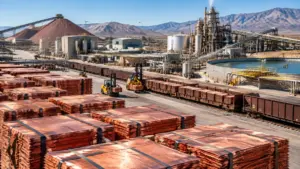
The Lobito Corridor illustrates the infrastructure dimension. Rail and port investment linking Angola, Zambia and the Democratic Republic of Congo is designed to improve the movement of minerals and support broader economic development. It is more immediately associated with copper and cobalt than with separated rare-earth oxides, but the underlying lesson is relevant: mineral diversification requires transport, power, customs coordination and processing capacity as much as it requires deposits.
For U.S., Japanese and European buyers, African supply will be more strategically useful when projects can provide consistent intermediate products rather than unprocessed ore. That will require local beneficiation, technical standards, transparent offtake structures and financing that accounts for infrastructure and country risk.
For African producers, the policy challenge is to avoid replacing one form of dependence with another. Exporting concentrate to a new foreign refinery may diversify the customer base while leaving most of the value chain offshore. Regional separation, metal conversion and component manufacturing would capture more value, but they also require larger capital commitments and specialized technical capabilities.
The geopolitical implication: control is moving downstream
The oxide-to-magnet gap changes how supply-chain security should be measured.
A country may have substantial rare-earth resources and still lack strategic autonomy if it cannot separate the elements, convert them into metal, alloy them and qualify them with magnet customers. Conversely, a processor with limited domestic ore may become strategically important if it can secure feedstock from multiple regions and consistently produce customer-approved materials.
For 2026, the most important indicators are therefore:
- Qualified products, not only laboratory samples.
- Commercial throughput, not only pilot output.
- Metal and alloy capacity, not only separated oxide capacity.
- Customer-specific approvals, not only generic purity claims.
- Multiple feedstock sources, not only one mine.
- Binding offtake and supply agreements, not only non-binding memoranda.
Energy Fuels’ terbium qualification is a meaningful downstream signal. American Rare Earths and Novex are addressing the next conversion step. Japan’s diversification efforts show the demand-side urgency, while African mineral corridors could expand the feedstock base over time.
The strategic contest is no longer simply about who controls the orebody. It is about who can connect every stage: from oxide to qualified magnet: without leaving a critical link dependent on a single country.
Sources and further reading
- Energy Fuels: Heavy rare earths qualified for Japanese magnet production
- American Rare Earths and Novex mine-to-magnet partnership
- U.S.-Japan framework for critical minerals and rare earths
- African Development Bank rare-earth-elements value-chain analysis
- Skillings rare-earths coverage
- Skillings critical-minerals supply-chain analysis