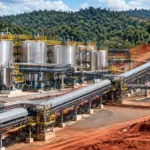
Rare earth separation equipment inside a modern processing facility.

The critical minerals supply chain in 2026 is moving beyond the traditional mine-and-offtake model. Across rare earths and battery materials, governments, trading houses, automakers and industrial manufacturers are increasingly taking positions across several stages of production: from extraction and processing to refining, metal-making and magnet or battery-component manufacturing.
The shift reflects a practical constraint: securing ore is no longer enough when the most strategically important bottlenecks sit in chemical separation and downstream conversion. Recent moves involving Toyota Tsusho and JOGMEC in Namibia, POSCO International and Meteoric Resources in Brazil, Arafura Resources in Australia, and Energy Fuels in the United States show how project developers are attempting to connect those stages into more resilient, non-Chinese supply routes.
This is not yet a fully integrated alternative system. Most of the projects remain exposed to permitting, financing, construction, feedstock and technology risks. But the direction of capital is clear: strategic buyers want greater control over material specifications, processing capacity and delivery schedules.
Why vertical integration is becoming central
Rare earths illustrate the problem most clearly. A mine may produce a concentrate or mixed carbonate, but end users require separated oxides: particularly neodymium-praseodymium (NdPr), dysprosium (Dy) and terbium (Tb): before those materials can enter metal, alloy and permanent-magnet production.
The same principle applies across battery metals. Lithium, nickel, cobalt, manganese and graphite projects increasingly need links to chemical conversion and precursor manufacturing. A low-cost mine without a qualified downstream customer can struggle to secure project finance, while a processor without reliable feedstock faces its own supply risk.

That is why 2026 agreements are being structured around combinations of:
- Equity investment or joint ventures
- Long-term offtake
- Government-backed loans and grants
- Dedicated separation or refining capacity
- Downstream manufacturing partnerships
- Strategic stockpiling and industrial policy support
The result is a gradual redefinition of project ownership. Control of a supply chain can matter as much as control of a deposit.
Project tracker: mine-to-market integration in 2026
| Project or partnership | Commodity focus | Integration strategy | 2026 milestone | Main execution risk |
|---|---|---|---|---|
| Lofdal, Namibia | Heavy rare earths, including Dy and Tb | Japanese-backed mine development linked to downstream separation and industrial demand | Toyota Tsusho established TJ Namibia Rare Earths Corporation; JOGMEC committed up to C$47.668 million | DFS, permitting, infrastructure and final commercialization decision |
| Caldeira, Brazil | Ionic-clay rare earths, including magnet rare earths | Meteoric to produce mixed rare earth carbonate; POSCO International to pursue separation and refining | MOU provides for potential purchase of up to 30% of output for up to seven years | Non-binding terms, financing, permitting and downstream plant delivery |
| Nolans, Australia | NdPr oxide and middle-heavy rare earths | Integrated mine, extraction and separation operation producing separated oxide onsite | Arafura board approved FID on May 21, 2026 | Construction execution, financing, commissioning and ramp-up |
| White Mesa, United States | Tb, Dy, Sm, Eu, Gd and NdPr | Expansion from light rare earth separation toward heavy rare earths, metals, alloys and magnets | Construction began on a planned US$104 million heavy rare earth expansion | Feedstock availability, government funding, technical performance and acquisitions |
| Battery-material projects broadly | Lithium, nickel, cobalt, manganese and graphite | Increasing links between mining, chemical conversion, precursor and component manufacturing | More strategic partnerships and policy-backed financing | Price volatility, processing qualification and technology substitution |
The tracker shows that vertical integration does not follow one template. In Namibia, the emphasis is on securing a heavy rare earth resource. In Brazil, the initial focus is on linking ionic-clay production with Korean separation capacity. In Australia, integration is built into the project flowsheet. In the United States, an existing mill is being expanded into a wider mine-to-magnet platform.
Namibia: Japan builds a heavy rare earth corridor
The Lofdal Heavy Rare Earth Project in Namibia’s Kunene Region is one of the clearest examples of state-backed resource security being translated into a corporate structure.
Toyota Tsusho established TJ Namibia Rare Earths Corporation as a special-purpose company to advance the project, while Japan’s Organization for Metals and Energy Security, or JOGMEC, committed up to C$47.668 million. The initial investment was made on July 23, according to a Toyota Tsusho announcement.
The project was originally launched by JOGMEC and Namibia Critical Metals in 2020. Toyota Tsusho joined as a development partner after a competitive process in March 2026. The partners are now advancing a definitive feasibility study and targeting a commercialization decision during fiscal 2026.
Lofdal’s strategic value comes from its heavy rare earth content. Dysprosium and terbium are used in high-performance neodymium-iron-boron magnets to improve resistance to demagnetization and maintain performance at elevated temperatures. Those characteristics are important for electric-vehicle traction motors, wind turbines and defense applications.
The project is also notable because it is being developed with a downstream customer ecosystem in mind. Japan is simultaneously supporting heavy rare earth separation capacity in Europe, including the Caremag project in France. If the technical and commercial pieces are completed, Lofdal could become part of a broader corridor linking African mining, European separation and Japanese industrial demand.
The immediate question is not whether the resource is strategically attractive. It is whether the partners can convert a remote exploration and development asset into a reliable source of qualified oxide at competitive cost.

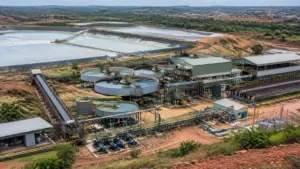
Mine and processing infrastructure in an arid African landscape.
Brazil: POSCO seeks feedstock security at Caldeira
South Korea’s approach is emerging through the relationship between POSCO International and Meteoric Resources’ Caldeira project in Minas Gerais, Brazil.
The companies signed a memorandum of understanding in July covering potential supply of mixed rare earth carbonate from Caldeira. As reported by Reuters, POSCO International may purchase up to 30% of Caldeira’s rare earth output for as long as seven years, subject to due diligence and definitive agreements.
The proposed model separates the roles but links the economics. Meteoric would develop the Brazilian ionic-clay resource and produce an intermediate product. POSCO would then use its own or associated refining capacity to convert that material into separated rare earth oxides for magnet manufacturers.
Meteoric’s Caldeira feasibility study outlines a project with a 151-million-tonne ore reserve and a planned 6-million-tonne-per-year processing facility. The study estimates initial capital expenditure of approximately US$498 million and a post-tax NPV of US$847 million under its spot-price case. Those figures remain project assumptions rather than operating results, and the development still requires financing, permitting and construction.
The MOU is therefore more than a conventional offtake discussion but less than a completed integrated supply chain. Its importance lies in the combination of feedstock access, potential equity participation and possible support from Korean policy lenders such as KEXIM and K-SURE.
For POSCO, the arrangement could provide a new source of rare earth feedstock outside China. For Meteoric, a strategic industrial partner could improve bankability and provide a clearer route to market. The unresolved issue is whether the parties can turn the non-binding framework into binding contracts and fund both the upstream and downstream components.
Australia: Nolans reaches the investment threshold
Arafura Resources’ Nolans project represents a more advanced version of the integrated model. The Australian project is designed to mine phosphate-bearing rare earth ore, process it into rare earth chloride and separate that material into finished products onsite.
Arafura’s board made the final investment decision on May 21, 2026. The project is designed to produce approximately 4,440 tonnes per year of NdPr oxide, alongside phosphoric acid and middle-heavy rare earth products.
The project has a planned 38-year mine life and is located approximately 135 kilometres north of Alice Springs in Australia’s Northern Territory. Construction is scheduled to begin in September 2026, with first production targeted for mid-2029 and commercial ramp-up expected later that year.
Nolans reached FID after a combination of government support and customer commitments. Its offtake book includes automotive, wind-energy and trading counterparties. A proposed 500-tonne-per-year purchase by Export Finance Australia under the country’s Critical Minerals Strategic Reserve helped move contracted demand above the threshold Arafura had identified for investment approval.
That structure matters because the project will not be exporting an unprocessed concentrate that depends on another country’s separation plant. It aims to deliver magnet-ready NdPr oxide directly into international markets.
The remaining challenge is execution. Large chemical-processing projects can experience cost escalation, commissioning delays and recovery shortfalls even after FID. For Nolans, vertical integration reduces one category of geopolitical dependence but increases the importance of technical delivery across the entire site.

Integrated rare earth processing equipment and lined process circuits.
United States: White Mesa expands into heavy rare earths
Energy Fuels is pursuing a different path by expanding an operating processing facility rather than developing a new mine-to-oxide complex from scratch.
The company has begun construction on a heavy rare earth expansion at its White Mesa Mill in Utah. According to the company’s July 29 release, the planned circuits are designed to produce up to approximately 20 tonnes per year of terbium oxide, 120 tonnes of dysprosium oxide, 140 tonnes of samarium oxide, 20 tonnes of europium oxide and 140 tonnes of gadolinium oxide.
The Tb and Dy circuits are targeted for completion by the end of 2027, while the Sm, Eu and Gd circuits are expected by the end of 2028. The expansion carries an estimated capital cost of US$104 million, with government loans and grants expected to support a substantial portion of the funding.
White Mesa already has commercial capacity for up to 1,000 tonnes per year of separated NdPr oxide. Energy Fuels says the expansion will also allow the mill to process mixed rare earth carbonates and produce rare earth oxides alongside uranium.
The company’s longer-term plan extends downstream into rare earth metals, alloys and magnets through its proposed relationships with Australian Strategic Materials and Vacuumschmelze. Those plans remain subject to financing, permitting, market conditions and the completion of proposed transactions.
The operational advantage is flexibility: a processing plant that can accept multiple feedstocks may be less dependent on a single mine. The risk is equally clear. That flexibility only creates value if sufficient qualified material is available and the separation circuits operate at commercial recovery rates.
What operators and investors should watch
The critical minerals supply chain 2026 trend is not simply about building more mines. The decisive milestones are increasingly found between the mine gate and the factory floor.
Decision-makers should track four indicators:
- Intermediate-product quality: Can a project consistently produce carbonate, chloride or oxide that meets downstream specifications?
- Feedstock security: Does a refinery have contracted material, or is it relying on future mines and uncommitted third-party supply?
- Customer integration: Are automotive, wind, defense or battery manufacturers involved beyond a preliminary memorandum?
- Construction evidence: Has capital been committed, equipment ordered and site work started?
The IEA supply concentration analysis has reinforced the economic cost of bottlenecks in critical mineral processing. But diversification will not be achieved by announcements alone. It will depend on whether integrated projects can meet cost, environmental, technical and delivery requirements at commercial scale.
In that sense, 2026 marks an inflection point rather than an endpoint. Japan, South Korea, Australia and the United States are building linked supply-chain positions across different jurisdictions. The companies that succeed will likely be those that manage the interfaces: between geology and chemistry, mining and manufacturing, and public policy and private capital( as carefully as the individual assets themselves.)