Diamond drilling at a remote alpine exploration camp in British Columbia’s Golden Triangle.

By Salini Krishnan
The latest gold mining news 2026 cycle from British Columbia and Yukon is being defined less by a single spectacular assay than by the widening footprint of several mineralized systems.
Juggernaut Exploration’s Big One property in British Columbia’s Golden Triangle has provided the clearest example. The company reported 30.11 metres of quartz-sulphide mineralization in drillhole BO-26-14, while confirming the Big Mack Zone over approximately 450 metres of strike and to a depth of about 500 metres. The zone remains open along strike and at depth.
The results are significant because they extend a mineralized structure through three dimensions. They do not yet establish a resource or a defined economic deposit: the company said assays for the reported drillholes were pending. But the geometry is becoming more important as the 2026 exploration season advances across the Golden Triangle and Yukon.
More Read
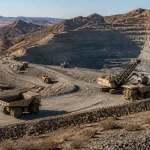
At a time when investors and mining companies are placing greater value on future production pipelines, discoveries that can demonstrate scale, continuity and multiple mineralized zones are receiving closer scrutiny than isolated high-grade samples.

Why district scale matters in current mining news
Early exploration results are often judged through two separate lenses: grade and continuity.
A narrow, high-grade interval can demonstrate that a mineralizing system is capable of concentrating valuable metals. However, a district-scale discovery requires more evidence. Geologists typically look for mineralization that extends across strike and depth, repeats through multiple structures or zones, and is supported by consistent geological, geochemical and geophysical indicators.

This distinction matters operationally. A single high-grade intercept may be difficult to mine if it lacks continuity. A broader system may support multiple extraction areas, phased development, shared infrastructure or a longer exploration runway.
The current exploration activity in BC and Yukon is also benefiting from the seasonal rhythm of northern mineral exploration. Helicopter-supported crews and diamond drills are active during the field season, while assay laboratories continue processing samples from campaigns launched earlier in the year. The result is a steady flow of updates that can change how a project is understood within weeks.
The following tracker compares three discoveries that illustrate different stages of that process.
2026 BC and Yukon discovery tracker
| Company | Project and zone | Reported interval | Grade | Location |
|---|---|---|---|---|
| Juggernaut Exploration | Big One, Big Mack Zone | 30.11 m of quartz-sulphide mineralization | Assays pending | Golden Triangle, British Columbia |
| Goliath Resources | Golddigger, Surebet discovery | 35.7 m | 7.38 g/t AuEq, including 19.51 g/t AuEq over 8.32 m | Golden Triangle, British Columbia |
| Banyan Gold | Nitra, Seattle Creek | 12.1 m, including a 0.5 m high-grade interval | 0.91 g/t Au and 27.01 g/t Ag over 12.1 m; 5.70 g/t Au and 544 g/t Ag over 0.5 m | Mayo Mining District, Yukon |
The tracker separates company-reported assay results from visual or unassayed mineralization. Drill intervals are downhole widths unless otherwise stated.
Juggernaut’s Big Mack Zone moves from showing to system
Juggernaut’s August release on the Big One property describes BO-26-14 as intersecting 30.11 metres from 461.40 metres to 491.51 metres downhole.
The mineralization consists of quartz-sulphide zones separated by pervasively silicified diorite. The company reported sulphides including pyrite, sphalerite, galena and chalcopyrite, along with quartz-sericite alteration. Additional holes intersected quartz-sulphide veins and shear zones over intervals including 11.22 metres, 10.04 metres, 9.12 metres, 6.57 metres and 5.26 metres.
The most important development is the scale of the Big Mack Zone. Juggernaut says drilling has now traced it over approximately 450 metres along strike and to a depth of about 500 metres. That continuity remains open for expansion.

Fresh quartz veins and sulphide-bearing drill core prepared for geological logging.
The company has characterized Big One as a district-scale gold-silver-copper discovery, but the distinction between geological potential and economic definition remains important. The reported intervals are not accompanied by final assay grades, and visual sulphide content alone cannot determine metal value.
The next stage will be to establish grade continuity, true widths, structural orientation and the relationship between the Big Mack and other target areas, including the Whopper area. Juggernaut has said it expanded its 2026 drill program by roughly 30% to approximately 13,000 metres, with two rigs operating across the property.
That program expansion is itself a useful signal of exploration strategy. Rather than treating the initial intercept as a standalone success, the company is using it to test the limits of the broader system.
Goliath’s Surebet results add grade to an established footprint
Goliath Resources’ latest Surebet results offer a different type of exploration signal. At the Golddigger property, hole GD-26-436 returned 7.38 g/t gold equivalent over 35.7 metres. The interval included 19.51 g/t AuEq over 8.32 metres, according to the company’s August release.
The reported mineralization is near surface and hosted in quartz-sulphide stockwork and breccia. Goliath also reported visible gold and native silver associated with galena, sphalerite, pyrrhotite and chalcopyrite. The broader interval was reported at 6.70 g/t AuEq over 39.7 metres.
Surebet is further advanced in geological interpretation than Big Mack. Goliath has spent several exploration seasons defining a stacked system across multiple zones, including Surebet, Bonanza and Golden Gate. Its latest updates said the Golden Gate Zone had expanded from 0.85 square kilometres to 1.17 square kilometres, while the Bonanza Zone grew from 1.27 square kilometres to 1.51 square kilometres.
That history changes how a new intercept is read. The question is no longer simply whether mineralization exists. It is whether a new hole strengthens the continuity, grade distribution and potential development profile of an already broad system.
Goliath’s 2026 campaign is planned at approximately 50,000 metres, with drilling continuing across the Surebet discovery. The system remains open laterally and at depth, leaving room for further expansion but also requiring additional drilling before any definitive economic conclusions can be drawn.
Banyan’s Seattle Creek discovery extends Yukon’s greenfields story
Banyan Gold’s Seattle Creek results illustrate the early-stage discovery end of the spectrum.
At the Nitra Project in Yukon’s Mayo Mining District, drillhole NT-26-006 returned 0.91 g/t gold and 27.01 g/t silver over 12.1 metres from 41.7 metres depth. The interval included 4.04 g/t gold over 1.4 metres and 3.32 g/t gold over 1.4 metres. Within the first interval, 0.5 metres returned 5.70 g/t gold and 544 g/t silver.
Banyan reported the discovery approximately 25 kilometres west of its AurMac deposit. Only the top 95 metres of the 600-metre hole had been assayed when the company issued its August 25 release, leaving results from the lower portion pending.
The geology is also relevant. Banyan described visible gold in extensional quartz veins containing bismuth sulphosalts and arsenopyrite, with mineralization associated with annealed shear zones, brecciated quartz veins and sulphide-rich groundmass. These features can indicate long-lived structures and fluid pathways, although further drilling is needed to confirm the orientation and continuity of the mineralized domains.

Helicopter-supported exploration equipment staged in a remote Yukon mountain valley.
Seattle Creek is part of Banyan’s broader greenfields program across the Nitra and AurMac land packages. The company plans more than 7,500 metres of drilling across 11 regional targets, using helicopter-supported drills. The targets were identified through geophysical surveys, soil geochemistry, prospecting and evidence from historic placer mining.
The discovery therefore matters not only for the reported interval but also for what it says about the underexplored ground surrounding a known Yukon gold district. Banyan has said that more than 95% of its district-scale land package remains untested by drilling.
What separates a discovery from a district-scale opportunity?
The three projects provide a useful framework for evaluating exploration updates.
1. Continuity across dimensions.
Big Mack’s reported 450-metre strike length and 500-metre depth extent are important because they describe a mineralized body in three dimensions. The next question is whether grades persist throughout that volume.
2. Repetition across zones.
Surebet’s significance comes from the presence of multiple zones and stacked mineralized structures. Repeated mineralization can increase the potential scale of a project, although it can also create more complex mine planning and metallurgy.
3. Geological indicators beyond grade.
At Seattle Creek, the combination of visible gold, quartz veins, sulphides, structural reactivation and geochemical anomalies supports a broader exploration thesis. These indicators are encouraging but do not replace systematic drilling and assays.
4. Infrastructure and logistics.
Remote BC and Yukon projects must be assessed in the context of access, power, transportation, camp requirements, permitting and seasonal operating constraints. A large geological system may still face significant development challenges.
5. Assay quality and true width.
Investors and technical teams should distinguish downhole length from true thickness and note whether assays are complete. Nuggety gold can create variability, while visual mineralization can overstate or understate the final grade of an interval.
Implications for explorers and investors
The latest discoveries reinforce the importance of exploration portfolios that can move from isolated showings toward coherent geological models. For explorers, that means using drilling not only to seek high grades but also to test structures, boundaries, parallel zones and depth extensions.
For investors and analysts, the most useful question is often what has changed in the geological model. A long interval with pending assays may expand the target. A high-grade interval within an established footprint may improve confidence in grade distribution. A new Yukon discovery near an existing deposit may increase the strategic importance of the surrounding land package.
None of those developments, on their own, establishes economic viability. Resource definition, metallurgy, engineering, permitting, capital intensity and operating costs remain unresolved at the exploration stage.
Still, the pattern emerging in current mining news is notable. BC’s Golden Triangle is producing exploration results that combine gold with silver and copper, while Yukon programs are testing whether known districts contain additional satellite systems. The coming assay releases and follow-up drilling will determine whether these discoveries become isolated zones or components of larger, mine-scale districts.
For broader market context, see Skillings’ coverage of gold market intelligence, the gold sector and mining market intelligence.
Shareable social snippet
LinkedIn/X: BC’s Golden Triangle and Yukon are producing a new wave of exploration results. Juggernaut’s Big Mack Zone now extends about 450 metres on strike and 500 metres to depth, Goliath’s Surebet returned 7.38 g/t AuEq over 35.7 metres, and Banyan’s Seattle Creek delivered 5.70 g/t Au with 544 g/t Ag over 0.5 metres. The key question is whether these results confirm isolated hits: or larger, district-scale systems.