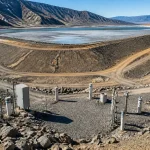
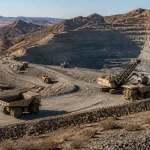
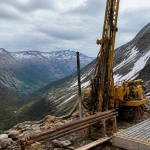
The Monte Muambe project is a multi-commodity critical minerals development in northwestern Mozambique.

By Charles Pitts
NeoTerra Group has reported 85% gallium extraction from initial acid-route hydrometallurgy testing at its Monte Muambe project in northwestern Mozambique, while X-ray transmission (XRT) trials identified a potential physical pre-concentration pathway for the semiconductor metal.
The results give the London-listed exploration company an early process route for recovering gallium from a carbonatite-hosted resource. However, NeoTerra said further work is required to confirm the technical and commercial viability of the flowsheet.
The company reported the results through a regulatory announcement carried by Investegate. The testing was conducted by Comex and SGS Lakefield, with XRT and short-wave infrared (SWIR) sorting assessed for pre-concentration and hydrometallurgical work focused on gallium extraction.
Key numbers from the Monte Muambe testing
| Metric | Reported result | Why it matters |
|---|---|---|
| Gallium extraction | 85% | Provides an initial recovery benchmark for the acid leach route |
| Gallium-bearing feldspar | About 30% of rock mass | Defines a potential physical pre-concentration target |
| Gallium resource | 11.73 million tonnes at 54.7 g/t Ga₂O₃ | Establishes the current inferred resource base |
| Approximate contained Ga₂O₃ | About 642 tonnes | Illustrates the scale of the published resource, before recovery losses |
| Resource expansion target | 50 million tonnes or more | Requires further drilling and successful metallurgy |
Source: NeoTerra regulatory announcement. Contained Ga₂O₃ is an approximate calculation based on the reported tonnage and grade; it is not a production estimate.

XRT identifies the gallium-bearing mineral phase
The first part of the emerging flowsheet is physical separation.
Comex tested whether SWIR and XRT sensors could distinguish gallium-bearing feldspar from other minerals in Monte Muambe material. NeoTerra said the XRT work successfully identified and separated the feldspar phase, which carries gallium and represents about 30% of the rock mass.

That result is significant because pre-concentration can reduce the volume of material sent to chemical treatment. In principle, removing barren or less valuable material before leaching may reduce reagent consumption, equipment size, water demand and downstream residue volumes.
XRT sorting works by measuring how X-rays pass through different materials. The response varies with density and composition, allowing a sorter to separate particles with different characteristics on a conveyor. The process is not the same as chemical recovery: it creates a more concentrated feed, but the gallium must still be dissolved and recovered through a subsequent treatment stage.
NeoTerra plans additional work to quantify the upgrade that can be achieved in a full-scale or representative ore-sorting system. The company also intends to assess whether XRF sensors could further separate gallium-bearing feldspar from barren feldspar.

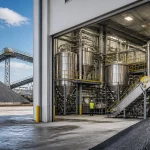
XRT sorting could reduce the volume of material entering the downstream gallium circuit.
Acid leaching delivers 85% extraction
SGS conducted initial gallium extraction tests using acid and caustic leaching routes. The acid route delivered 85% gallium extraction into the leachate, according to NeoTerra.
The company also reported good selectivity against silica. That is an important process consideration because silica-rich gangue can increase acid consumption, complicate filtration and create impurity-management challenges in downstream recovery.
In a conceptual flowsheet, XRT would first separate or upgrade the gallium-bearing feldspar. The pre-concentrated material would then move into an acid leach circuit, where gallium is transferred into solution. Additional steps would be needed to recover gallium from the leachate as a saleable product or intermediate.
The reported 85% figure is therefore an extraction result rather than an overall project recovery rate. It does not yet account for losses during ore sorting, crushing, leachate treatment, purification, precipitation, refining or handling. NeoTerra has described the work as initial testing and said further programmes will focus on defining leaching conditions and options for recovery from the leachate.

Initial acid-route testing achieved 85% gallium extraction into the leachate.
A new type of gallium resource
Monte Muambe is unusual because it is being advanced as a primary, carbonatite-hosted gallium resource rather than as a conventional by-product opportunity.
NeoTerra’s published JORC mineral resource estimates for the project include:
- 13.6 million tonnes at 2.42% total rare earth oxides (TREO);
- 3.48 million tonnes at 20.6% calcium fluoride (CaF₂); and
- 11.73 million tonnes at 54.7 grams per tonne gallium oxide (Ga₂O₃).
The gallium resource is classified as inferred, meaning that additional drilling and analysis are required before a higher level of geological confidence can be established. Based on the reported tonnage and grade, it contains approximately 642 tonnes of Ga₂O₃ before processing recoveries.
NeoTerra has set an objective of expanding the gallium resource to 50 million tonnes or more. The company said the target is supported by the extent of documented gallium soil anomalies, but achieving it will depend on drilling results, geological continuity and further resource modelling.
The project is held under a 25-year mining licence, according to the company’s announcement. NeoTerra is also advancing rare earths and fluorspar workstreams at Monte Muambe, with the company saying that gallium metallurgy will proceed in parallel with a US-funded rare earths programme and fluorspar mine development.
Why gallium matters to semiconductor supply chains
Gallium is used to manufacture compound semiconductors, including gallium arsenide (GaAs) and gallium nitride (GaN).
GaAs is used in high-frequency electronics, radio-frequency components, optoelectronics and some communications equipment. GaN is important in high-power and high-frequency applications, including power converters, radar, telecommunications infrastructure, electric vehicles and fast-charging systems.
These applications mean that a relatively small volume of gallium can have an outsized strategic importance. The metal is also difficult to replace in some high-performance applications without sacrificing efficiency, power density or operating frequency.
Supply concentration has increased that importance. China dominates global gallium production, with much of the metal recovered as a by-product of bauxite and zinc processing. The concentration has made gallium a focus of government efforts to diversify critical mineral supply chains.
The Center for Strategic and International Studies has described gallium as a strategic supply-chain vulnerability, particularly because China’s position extends beyond mining into processing and refining. Export controls introduced by Beijing have also shown how policy decisions can affect access to strategically important materials even when physical inventories remain available.
For potential producers such as NeoTerra, that creates a market opportunity but not a guaranteed commercial advantage. A new primary source would still need to meet the quality specifications of semiconductor customers, demonstrate reliable refining, secure logistics and compete with established by-product supply.
What comes next for NeoTerra
NeoTerra’s next stage of work will focus on turning the initial results into an integrated flowsheet.
The company plans to:
- Conduct further XRT and SWIR testing using representative ore-sorting equipment.
- Assess XRF as a possible additional separation technology.
- Define acid-leaching conditions and reagent requirements.
- Develop a method to recover gallium from the leachate.
- Test how the gallium circuit could operate alongside rare earths and fluorspar recovery.
- Use the technical results to support future drilling and resource expansion.
The main questions for investors and project developers will be whether the 85% extraction rate can be repeated across variable ore types, how much gallium can be upgraded through sorting, and what level of impurity control is required before refining.
The economics will also depend on the scale and continuity of the resource. A high extraction result from laboratory samples is an important technical signal, but it does not by itself establish project-level recovery, capital costs, operating costs or product specifications.
For mining professionals tracking the development of alternative critical-mineral supply, Monte Muambe is therefore a project to watch for its combination of rare earths, fluorspar and gallium. NeoTerra’s latest results have moved gallium from a geological occurrence toward a testable processing concept. The next phase will determine whether that concept can support a larger resource and a viable development plan.
Related Skillings coverage
- Critical minerals supply chain: recovering strategic metals from mine waste
- Skillings rare earths and critical minerals coverage