Here's what nobody wants to admit: The United States has been flying blind on critical minerals for decades. That changed on February 2, 2026, when the Trump administration announced Project Vault: a $12 billion strategic minerals reserve designed to prevent the kind of supply chain collapse that could cripple American manufacturing.

This isn't a theoretical exercise. The U.S. is currently 100% import-dependent for 12 critical minerals and relies on imports for more than half its consumption of 29 additional minerals. That's not a vulnerability. That's a national security emergency dressed up as trade policy.

The Structure: Public Money, Private Execution
Project Vault combines $10 billion in financing from the U.S. Export-Import Bank with $2 billion in private sector capital. It's structured as a public-private partnership, allowing manufacturers, trading firms, and private capital providers to jointly participate in the stockpile.
The mechanics matter here. This isn't the government buying minerals and storing them in a warehouse. It's a financing mechanism that enables private industry to hold strategic inventory while reducing their capital risk. Smart structure. The question is whether $12 billion is remotely adequate for the scale of the problem.

What's Actually Going Into the Vault
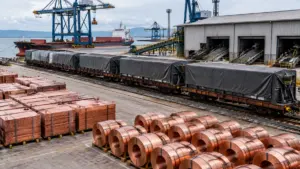
The reserve will stockpile rare earths, copper, lithium, titanium, scandium, gallium, germanium, cobalt, and potentially nickel. These materials power everything that matters in the modern economy: aerospace, defense systems, semiconductors, advanced manufacturing, renewable energy infrastructure, and electric vehicles.

President Trump framed the initiative as ensuring "American businesses and workers are never harmed by any shortage." That's the political messaging. The strategic reality is simpler: China controls too much of the global critical minerals supply chain, and the U.S. just realized it needs insurance.

Following Australia's Playbook
The U.S. is explicitly following Australia's lead here, which established its own critical minerals stockpile as China's dominance over rare earth processing became impossible to ignore. Australia produces massive quantities of raw materials but recognized that access to processing capacity: overwhelmingly located in China: represents the real chokepoint.
The Americans are learning the same lesson, just later. You can mine lithium in Nevada, but if you need to ship it to China for processing, you haven't actually secured your supply chain. You've just moved the vulnerability one step up the value chain.
The Bigger Picture: Negotiated Supply Chains
Project Vault doesn't exist in isolation. It's paired with an executive order signed January 15, 2026, directing the Secretary of Commerce to negotiate agreements with foreign partners to secure processed minerals and downstream capacity. The target list includes Central Asian countries like Kazakhstan and Uzbekistan: nations that have raw materials but lack the capital and technology to build processing infrastructure.
The strategic calculus here isn't subtle. The U.S. is attempting to construct an alternative supply chain architecture that bypasses Chinese processing dominance. That requires financing mining projects, building processing facilities, and establishing long-term offtake agreements. It requires exactly the kind of patient capital and diplomatic coordination that hasn't been a hallmark of American industrial policy for the past 40 years.

What This Means for Rare Earths and Lithium
For the rare earth sector, Project Vault provides a potential offtake backstop for domestic producers who've struggled to compete with subsidized Chinese supply. It signals that the U.S. government is finally willing to pay the premium necessary to build redundancy into critical supply chains.
For lithium, the timing is pointed. Global lithium supply growth is accelerating just as EV demand moderates, creating the first meaningful oversupply conditions since 2020. A strategic reserve offers a mechanism to support prices during this transition while building long-term supply security.
The Uncomfortable Question
Is $12 billion enough? Probably not. The scale of mineral demand driven by electrification, digitization, and defense modernization suggests the U.S. needs to secure access to substantially more supply than a $12 billion reserve can provide. But it's a start.
More critically, it represents a philosophical shift. For decades, the U.S. treated critical minerals as just another commodity: fungible, globally traded, efficiently allocated by market forces. Project Vault acknowledges what mining industry veterans have known for years: some materials are too strategically important to leave entirely to market dynamics.
The clock is already ticking on implementation. The question isn't whether the U.S. needs a strategic minerals reserve. The question is whether this one is big enough, fast enough, and comprehensive enough to matter when the next supply shock hits.