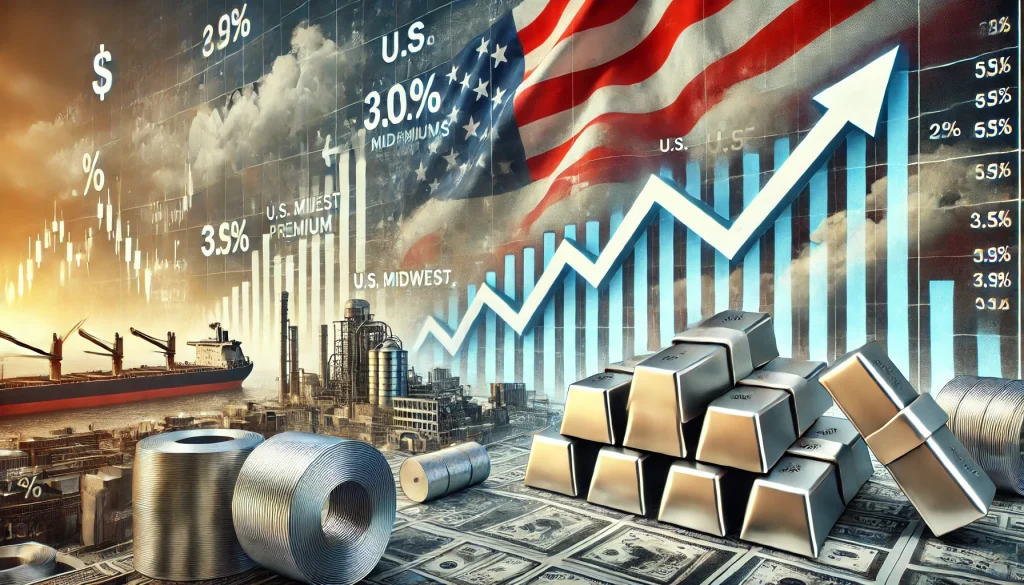
Aluminum prices have begun to show signs of strain as tariff pressures and geopolitical developments introduce volatility across global markets. The Aluminum Monthly Metals Index (MMI) ticked up 1.16% from February to March, supported by moderate gains in global aluminum prices. However, the recent surge in U.S. Midwest Premiums has plateaued, reflecting market fatigue and a wait-and-see approach as tariffs weigh heavily on future demand expectations.

Tariff Uncertainty Dampens Market Momentum
After a sharp rally beginning in Q4 2024, the Midwest aluminum premium and its three-month futures contract soared by 107% and 90%, respectively. The spike was initially fueled by anticipation of Donald Trump’s reelection and escalated further after the White House formally reinstated 25% tariffs on steel and aluminum imports—coupled with an additional 25% duty targeting Canadian aluminum.
Buyers scrambled to secure duty-free inventory ahead of the tariffs’ implementation, leading to a brief surge in spot aluminum prices. But by mid-February, futures began losing steam, peaking at $0.40/lb in March before reversing course. The market structure shifted from contango to backwardation—a sign of reduced forward confidence.
“Backwardation signals a short-term imbalance, where spot aluminum prices outpace future expectations,” said a senior analyst at MetalMiner. “It suggests the market doesn’t expect these higher prices to last unless demand picks up.”
More Read
Related News
- Silver Prices Surge Amid Strong Industrial Demand and Investor Interest
- Arizona Lithium Targets $2M Raise for Prairie Direct Extraction Project
- Antares Identifies New Copper Targets at Conglomerate Creek
- Woods Creek Exploration: Integral Metals Partners with Big Rock Exploration for Initial Survey
Demand vs. Duties: A Tense Tug-of-War

The effectiveness of tariffs as a long-term price driver is being tested. In 2018, following the imposition of Section 232 tariffs, aluminum prices eventually peaked and corrected as supply chains adjusted. Market observers are watching to see if a similar pattern will unfold in 2025.
With fewer carveouts expected this time around, the market faces sustained price support from tariffs—albeit against a backdrop of potentially weakening demand. President Trump confirmed on March 16 there will be “no intention” to grant tariff exemptions, signaling a firmer stance than during his first term.
More Read

That message was further underscored by a Truth Social post threatening 50% tariffs on Canada, following its (since-retracted) plan to impose a 25% electricity tariff on U.S. imports. Although the added aluminum duty didn’t materialize, the rhetoric injected fresh volatility into aluminum prices, briefly lifting Midwest futures.
Sticky Tariffs, Sticky Prices
Market participants now see tariffs as a persistent feature rather than a temporary policy tool. Their “stickiness,” as analysts describe it, is likely to offer a price floor. But without strong end-user demand to match, premiums may find it difficult to climb much higher.
“Prices have room to correct unless consumption data turns meaningfully positive,” said a trading desk executive at a U.S.-based aluminum distributor. “Inventory buildup is real, and tariffs alone can’t justify sustained premiums if orders aren’t there.”
Ukraine-Russia Ceasefire Adds a New Layer of Complexity
While tariff policy continues to dominate headlines, geopolitics is adding another variable to the outlook for aluminum prices. On March 18, Presidents Trump and Putin reportedly agreed to a limited ceasefire involving Russian strikes on Ukraine’s energy infrastructure. Though preliminary, the announcement prompted speculation about a potential stabilization of supply chains.
The 2022 invasion disrupted the global aluminum market, with both Russia and Ukraine playing key roles in the supply of raw materials and finished metal. A broader ceasefire or resolution could normalize trade routes, potentially pushing aluminum prices lower by easing supply constraints.
However, this bearish pressure may be partially offset by post-conflict reconstruction demand and renewed investor confidence. Analysts caution that the outcome is still highly uncertain, but volatility remains a constant factor for pricing.
Global Price Trends: India and China Lead Gains
Regional aluminum prices continue to exhibit divergent trends. India’s primary cash aluminum price led gains for the second consecutive month, rising 2.79% to $2.97/kg. In China, primary cash aluminum increased 1.81% to $2,828/mt, while billet prices rose 1.72% to $2,980/mt. The London Metal Exchange’s three-month aluminum contract posted a more modest gain of 0.82%, closing at $2,643/mt.
These modest increases reflect steady—but not explosive—demand in Asia, even as the West wrestles with policy-driven volatility.
Watching the Horizon
Despite the recent uptick, aluminum prices remain in a precarious position. Tariffs are offering support, but fading momentum in futures markets and unpredictable geopolitical shifts are casting doubt on the sustainability of current price levels. As with 2018, the long-term trajectory will likely hinge on how supply chains evolve, whether demand recovers, and how governments choose to wield tariff policy in an increasingly volatile global economy.