LONDON— Altona Rare Earths PLC has reported high-grade gallium mineralisation at its Monte Muambe project in Mozambique, a discovery that could significantly alter the site’s economic potential as gallium prices remain elevated amid ongoing geopolitical tensions.

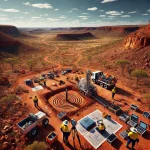
Drill hole MM039 delivered standout results: gallium concentrations averaged 77 grams per tonne (g/t) from surface to 100 meters, with a peak of 232 g/t. The hole also intersected rare earths and fluorspar, pointing to a potentially valuable co-product scenario.
Gallium is a soft, silvery metal used in semiconductors, LEDs, and radar systems. Its strategic value has surged due to China’s near-monopoly on production and the recent export ban targeting the United States. As of December 2024, gallium price peaked at $585/kg, its highest since 2011. Prices have since stabilized near $250/kg, still significantly above historical norms.
“Monte Muambe is no stranger to multi-mineral systems,” said Altona CEO Cedric Simonet. “The gallium intercepts reinforce our belief that this project holds untapped value beyond rare earths.”
Gallium Price Surge Highlights Supply Chain Fragility
Gallium is typically extracted as a by-product from bauxite or zinc processing, and China controls over 90% of global output. The July 2023 decision by Beijing to curb exports of gallium and germanium triggered a spike in prices and forced Western economies to scramble for alternative sources.
The gallium price increase has prompted exploration companies like Altona to reassess previously overlooked data for indications of the metal. In this case, gallium was detected during rare earths sampling conducted by Intertek Laboratories, with follow-up analysis revealing promising intercepts in two zones—Fluorite Zone and Target 6.
More Read

Peter Mallin-Jones, an analyst at Peel Hunt, said: “These kinds of secondary discoveries can transform project economics if recovery is feasible. Investors and governments alike are watching these developments closely.”

Potential Game-Changer at Monte Muambe
Target 6, where one of the highest gallium readings was found, has seen limited drilling compared to other zones. The continuous mineralisation noted in Hole MM039 further suggests that gallium may be more widespread than initially thought.
Altona stated that the next phase of work will focus on determining gallium’s mineralogical composition and evaluating recovery potential. The company will also review its soil sampling database for gallium anomalies.

“We’ll be investigating whether gallium can be viably recovered as a by-product of rare earths or fluorspar,” said Simonet. “It could unlock previously uneconomic sections of the deposit.”
Still, analysts caution that gallium recovery is technically complex and often capital-intensive. The metal’s low natural abundance means that even in high-grade intercepts, processing efficiency and scale are crucial to making production commercially viable.
Testing and Timeline
Altona has resumed metallurgical testing after post-election instability delayed shipments within Mozambique. Fluorspar samples have now been delivered to Peacocke & Simpson Laboratories in Zimbabwe, with gravity separation and flotation tests underway. Results are expected in April.
The company also plans a more comprehensive field campaign later this year to assess the lateral extent of the gallium mineralisation.
Gallium’s Rise May Redefine Critical Mineral Strategy
Altona’s gallium discovery comes as Western nations seek to diversify supply chains for critical minerals, particularly those essential to defense and high-tech applications. If Monte Muambe can deliver commercial quantities of both rare earths and gallium, it could position Mozambique as a new node in the global strategic minerals map.
As the gallium price remains volatile and politically sensitive, new sources outside China are likely to gain heightened interest from both investors and policymakers.