The United States is negotiating the creation of a multibillion-dollar mining fund with New York–based Orion Resource Partners, a move designed to strengthen American access to critical minerals and reduce reliance on Chinese supply chains. According to people familiar with the talks, the US International Development Finance Corporation (DFC) and Orion would each commit at least $600 million, with the possibility of additional contributions from other sovereign investors and US agencies.

If finalised, the partnership would represent the largest single mining-focused initiative in DFC’s history, eclipsing earlier investments in start-ups such as TechMet and rare earth projects in Africa.
Critical Minerals at the Heart of US Strategy
The proposed fund would target overseas mining projects extracting copper, rare earth elements, and other materials essential to both defence applications and high-tech manufacturing. These minerals underpin everything from fighter jets and missile systems to electric vehicles and renewable energy technologies.
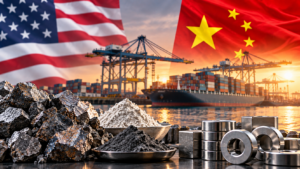
Washington has made supply chain diversification a central plank of its economic and security policy, especially as Beijing’s dominance of global rare earths and battery metals supply continues to raise alarms in industry and government circles. China currently processes more than 70% of the world’s rare earths, and its export curbs in recent years have demonstrated the strategic leverage that control affords.
Structuring the Fund: Equity and Debt
Sources close to the negotiations said the US contribution would be structured as $100 million in equity stakes and $500 million in debt. While the DFC is authorised only to invest outside US borders, restrictions on its equity participation have shaped the mechanics of the deal. Still, Orion’s deep mining portfolio and experience with hybrid financing structures are expected to bridge gaps.
More Read

This mirrors Orion’s earlier work: in 2024, the investor established a $1.2 billion joint venture with Abu Dhabi’s ADQ, each side contributing $600 million. That model could serve as a template for the US collaboration.

Policy Alignment and Leadership
The talks, which began last year, were initially delayed by board-level questions from Commerce Secretary Howard Lutnick but have since gained momentum. The White House has consistently signalled that bolstering critical mineral security is a top priority.
“The Trump administration is trying to align its financial tools with its broader mineral ambitions,” said Gracelin Baskaran, director of the critical minerals security programme at the Center for Strategic and International Studies in Washington. “This public-private partnership stands to catalyse a significant amount of capital.”

Under its incoming head Ben Black, pending Senate confirmation, the DFC is expected to take a more aggressive stance in mobilising private sector participation in mining projects.
Building on Existing DFC Investments
The DFC already has a track record in mining and infrastructure finance. Notably, it provided $105 million to TechMet, a company investing in critical mineral projects across the globe, and committed $50 million to a rare earths development in South Africa. Beyond mining, the agency has pledged $550 million to the Lobito Atlantic Railway, a logistics corridor in Angola and Zambia that could accelerate copper exports from the African Copperbelt.
The Orion partnership, if completed, would mark a significant scale-up, signalling Washington’s willingness to engage with larger, more complex mining projects than previously attempted.
Industry Implications
For mining companies, the potential fund signals an infusion of patient capital at a time when project financing has grown more difficult. Equity markets remain cautious about greenfield projects, while debt terms have tightened amid higher interest rates. Sovereign-backed partnerships of this size could ease bottlenecks for developers in copper, lithium, and rare earths—particularly in Africa and Latin America, where resource potential is high but financing remains scarce.
Skillings analysis
This development should be closely watched by mining executives and investors alike. First, the scale of the fund would directly shift capital availability for mid-tier developers. Second, Orion’s involvement provides credibility and expertise, suggesting the fund will favour commercially viable projects rather than purely strategic ones. Finally, Washington’s growing willingness to underwrite overseas mining underscores the geopolitical weight now attached to critical minerals—a factor likely to shape deal-making for years.
What’s Next?
If negotiations conclude successfully, the fund could begin deploying capital as early as 2026, with initial commitments likely targeting copper and rare earth ventures in Africa and South America. Mining executives preparing feasibility studies or seeking project finance may find opportunities to align with US-backed strategic goals.
As the Christmas quarter approaches and global demand forecasts for EVs and defence equipment remain strong, attention will focus on whether Washington can move from strategy to execution—turning policy ambition into actual mined tonnage.