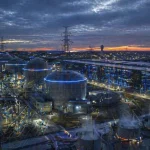
Caption: A nuclear power facility integrated with a modern AI data center industrial complex.

By Penny Langford
The narrative surrounding uranium has undergone a fundamental transformation. In early 2026, recent industry chatter around the “AI-Energy Nexus” has moved to the center of the debate, with market participants increasingly framing it as the primary driver of a new uranium supercycle. The commodity is no longer viewed merely through the lens of traditional utility baseload power. Instead, it has emerged as a critical strategic asset at the center of the global artificial intelligence (AI) expansion. As tech giants like Microsoft and Amazon move to secure multi-decade power purchase agreements (PPAs) with nuclear operators, the uranium market is facing a structural supply shock that analysts believe could push prices toward $150 per pound by year-end.
This “AI-Nuclear Nexus” represents a permanent shift in demand elasticity. Unlike traditional utilities that can occasionally defer fuel purchases, the hyperscale data center industry operates on a non-negotiable requirement for 24/7 carbon-free power. This demand is colliding with a supply side constrained by decade-long production lead times and significant operational hurdles in major producing regions like Kazakhstan.
The Big Tech Power Grab: A New Source of Demand
The primary catalyst for the 2026 uranium bull case is the aggressive entry of Big Tech into the nuclear sector. In late 2024 and throughout 2025, the industry witnessed unprecedented deals that have fundamentally altered the long-term demand curve.
More Read

Microsoft’s landmark agreement with Constellation Energy to restart Unit 1 of the Three Mile Island facility: now renamed the Crane Clean Energy Center: stands as a prime example. This 20-year PPA will provide 835 megawatts (MW) of carbon-free energy dedicated solely to Microsoft’s AI infrastructure. With a project cost of $1.6 billion and an expected restart in 2028, the deal signals that tech companies are willing to pay a significant premium: estimated at $110 to $115 per megawatt-hour: to ensure energy security.

Similarly, Amazon’s $650 million acquisition of a data center campus from Talen Energy, located adjacent to the Susquehanna Nuclear Station, includes a restructured $18 billion PPA. This agreement will eventually supply up to 1,920 MW of power through 2042. These are not isolated incidents; they are the blueprint for the next decade of data center development.
For the uranium market, these deals represent “locked-in” demand that removes significant volumes of future supply from the spot market. As data centers scale, the requirement for uranium-backed energy is becoming as essential as the silicon chips that drive the AI models.
More Read
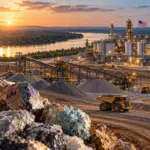

Caption: Heavy uranium mining equipment operating at a high-altitude plateau site.
The Supply Deficit: Kazatomprom and the Production Wall
While demand is surging, the supply side is struggling to keep pace. Kazatomprom, the world’s largest uranium producer, recently announced a 10% production cut for 2026. The company adjusted its guidance from 32,777 tonnes down to 29,697 tonnes of U3O8, citing market conditions and persistent operational constraints.
The most significant bottleneck remains the availability of sulphuric acid, a critical component in the in-situ recovery (ISR) mining method used across Kazakhstan’s fields. Without adequate acid supplies, even the most prolific mines cannot reach nameplate capacity. This 3,000-tonne reduction represents approximately 5% of global primary uranium supply, further tightening a market already in deficit.
Analysts now forecast a structural supply gap of roughly 20 million pounds in 2025, a figure expected to balloon to over 130 million pounds by 2040. Current primary production from existing mines like McArthur River and Cigar Lake is insufficient to meet the projected requirements of the growing global reactor fleet, let alone the specialized needs of the AI energy nexus.
| Market Indicator | 2025 Actual (Estimated) | 2026 Forecast (Base Case) | 2026 Bull Case ($150/lb) |
|---|---|---|---|
| Spot Price (Avg) | $82/lb | $95/lb | $150/lb |
| Global Deficit | 20M lbs | 28M lbs | 35M lbs+ |
| Contracting Volume | 160M lbs | 185M lbs | 210M lbs+ |
| Secondary Supply | 12M lbs | 10M lbs | 8M lbs |
Price Analysis: The Path to $150 per Pound
As of April 2026, uranium spot prices have stabilized near $87/lb after a volatile first quarter that saw prices peak at $101.55/lb. However, the bull case for $150/lb is built on the exhaustion of available “mobile” supply.
In previous cycles, secondary supplies from decommissioned weapons or underfeeding provided a buffer. Today, those buffers are largely gone. The “carry trade” has vanished, and financial vehicles like the Sprott Physical Uranium Trust (SPUT) have sequestered millions of pounds of material.
The $150/lb target is increasingly viewed not as a speculative peak, but as the “replacement rate” required to incentivize the next generation of greenfield mining projects. Mines currently in development, particularly those in higher-cost jurisdictions like Australia and North America, require sustained prices above $90/lb just to reach a final investment decision (FID). To actually close the 130-million-pound gap by 2040, the market requires a price signal that reflects the extreme scarcity of the resource.

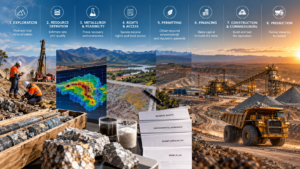
Caption: Mining professionals in high-visibility gear reviewing industrial site plans.
The Geopolitical Multiplier
Geopolitics continues to play a decisive role in the 2026 outlook. The U.S. ban on Russian uranium imports, signed into law in 2024, has fundamentally bifurcated the market. Western utilities are now locked in a race to secure “Western-origin” material, leading to a premium on production from Tier-1 jurisdictions like Canada and Australia.
Furthermore, the shift toward Small Modular Reactors (SMRs) is beginning to manifest in long-term planning. While large-scale restarts like Three Mile Island dominate current headlines, the 2026-2030 window will see the first commercial deployments of SMR technology. These reactors, which can be co-located directly with industrial hubs, represent a modular, scalable demand source that traditional miners have yet to fully account for in their production schedules.
Conclusion: A Decisive Year for Uranium
The 2026 uranium market is no longer a story of slow utility procurement. It is a high-stakes competition between the traditional energy sector and the burgeoning AI industry for a finite, diminishing resource. With Kazatomprom’s production cuts and the persistent demand from tech titans, the structural deficit is the defining feature of the year.
Investors and operators should monitor two key metrics in the coming months: the acceleration of long-term utility contracting and the progress of the Western enrichment and conversion build-out. If utilities enter the spot market en masse to cover uncovered 2027-2028 requirements, the $150/lb bull case could transition from a forecast to a reality before the year is out.
For a deeper look at the interplay between critical minerals and modern technology, see our analysis on copper and the data center boom or catch up on the latest Skillings Mining Intelligence.

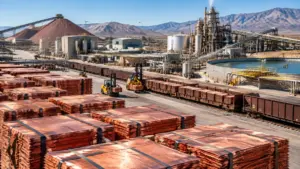
Caption: Interior of a modern mineral processing plant with advanced piping systems.