By Charles Pitts
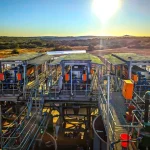
BEE COUNTY, Texas : Uranium Energy Corp (UEC) has officially commenced production at its Burke Hollow In-Situ Recovery (ISR) project in South Texas, marking the first time a new uranium extraction facility has come online in the United States in over a decade.
The startup, which followed final approval from the Texas Commission on Environmental Quality (TCEQ) in late April 2026, represents a critical pivot point for the domestic nuclear fuel industry. As the U.S. seeks to decouple its energy supply chain from foreign adversaries and satisfy the surging electricity demands of artificial intelligence and heavy industry, the activation of Burke Hollow provides a tangible boost to domestic U₃O₈ inventory.
The Burke Hollow project is the newest ISR uranium mine in the world and serves as a primary “spoke” in UEC’s established hub-and-spoke production model in the Texas Uranium Belt. The move follows a 14-year development journey for the site, which was first discovered by UEC in 2012.
More Read

The Hub-and-Spoke Strategy in South Texas
At the center of UEC’s Texas operations is the Hobson Central Processing Plant. Located in Karnes County, the Hobson facility is a fully licensed and operational processing hub with a physical capacity of approximately 4 million pounds of uranium per year.

Under the hub-and-spoke model, uranium is extracted from satellite wellfields: like Burke Hollow: using the ISR method. The resulting uranium-laden resin is then transported to the Hobson plant to be processed into “yellowcake” (U₃O₈) for eventual enrichment and use in nuclear reactors.
Burke Hollow is situated approximately 50 miles from the Hobson plant. The project site encompasses 20,000 acres, though current production is concentrated on just half of the explored acreage. According to recent technical reports, the project hosts 6.15 million pounds of U₃O₈ in measured and indicated resources, with an additional 4.88 million pounds in the inferred category.
More Read


Geopolitical Drivers and Energy Security
The startup of Burke Hollow arrives amid a broader push for U.S. energy independence. For years, the domestic nuclear industry relied heavily on imports from Kazakhstan, Russia, and Uzbekistan. However, recent geopolitical shifts and the 2024 ban on Russian uranium imports have forced a rapid re-evaluation of the American fuel cycle.
The Trump administration has signaled strong support for the revitalization of the domestic uranium sector. U.S. Energy Secretary Chris Wright recently emphasized that securing the nuclear fuel supply chain is a matter of national security, particularly as the U.S. looks to expand its fleet of small modular reactors (SMRs) and maintain its traditional base-load capacity.
“The activation of Burke Hollow is not just a corporate milestone; it is a signal to the global market that the United States is capable of restarting its primary production capacity,” noted a senior analyst in a recent uranium forecast 2026 update.
Texas Governor Greg Abbott also lauded the production start, framing it as a continuation of the state’s dominance in the energy sector. Texas remains a premier jurisdiction for mining due to its streamlined regulatory environment and the presence of the South Texas Uranium Belt, which has a long history of ISR production.
Understanding In-Situ Recovery (ISR) Technology
Unlike traditional open-pit or underground mining, ISR (In-Situ Recovery) is a non-invasive extraction method. It involves circulating oxygenated groundwater through the ore body via injection wells. The oxygen dissolves the uranium from the sandstone, and the resulting “pregnant” solution is pumped to the surface via extraction wells.
This method is preferred for its lower capital costs and minimal environmental footprint. There is no large-scale excavation, no tailings piles, and the groundwater is restored to its baseline state once mining is complete.
For operators, the scalability of ISR is a major advantage. Wellfields can be brought online in stages, allowing for precise control over production volumes based on market conditions. This operational flexibility is often managed through a mining tech stack for remote operations, utilizing real-time sensors to monitor pressure and flow across thousands of wellheads.

UEC’s Expanding US Footprint
With Burke Hollow now active, Uranium Energy Corp has become the only company in the United States operating two distinct ISR production platforms. In addition to its Texas hub, UEC maintains an active production center at Christensen Ranch in Wyoming.
The company’s growth strategy remains aggressive. In its latest operational update, UEC confirmed that the Ludeman ISR project in Wyoming is on track for a 2027 startup. This multi-state production profile positions the company to capitalize on the critical minerals demand surge currently being driven by data centers and the global energy transition.
Table: UEC Texas Hub-and-Spoke Pipeline (May 2026)
| Project Name | Status | Distance to Hobson | Estimated Resource (M lbs) |
|---|---|---|---|
| Burke Hollow | Producing | 50 miles | 11.03 (M&I + Inf) |
| Palangana | On Standby | 25 miles | 1.06 (M&I) |
| Goliad | Permitted | 45 miles | 2.09 (M&I) |
| Salvo | Exploration | 60 miles | 6.10 (Inf) |
| Longhorn | Exploration | 55 miles | TBD |
Source: Uranium Energy Corp (UEC) Technical Reports.
Market Outlook and Operational Impact
The timing of the Burke Hollow startup coincides with a period of sustained price strength for U₃O₈. After years of stagnation, uranium prices have remained elevated in 2026, driven by a structural deficit in primary supply and the “AI energy nexus,” where massive tech firms are seeking long-term power purchase agreements (PPAs) with nuclear utilities.
For Bee County and the surrounding South Texas region, the project provides a significant economic infusion. UEC has invested heavily in local infrastructure and has created dozens of high-skilled technical roles to manage the wellfield and the Hobson plant.
The successful 14-year development of Burke Hollow: from its initial discovery in 2012 through the rigorous TCEQ permitting process: serves as a blueprint for other junior and mid-tier miners. It highlights the patience required to navigate the modern regulatory landscape and the technical expertise needed to execute a successful production restart.

Future Outlook
Looking ahead, UEC plans to continue exploration across the remaining 10,000 acres of the Burke Hollow property. Initial results from step-out drilling suggest that the ore body may extend significantly beyond current estimates, providing potential for resource expansion in the coming years.
As the United States accelerates its efforts to secure its nuclear fuel supply, projects like Burke Hollow will be central to the conversation. By combining domestic assets with proven ISR technology, companies like UEC are effectively ending a decade-long drought in American uranium mining and setting the stage for a new era of energy security.