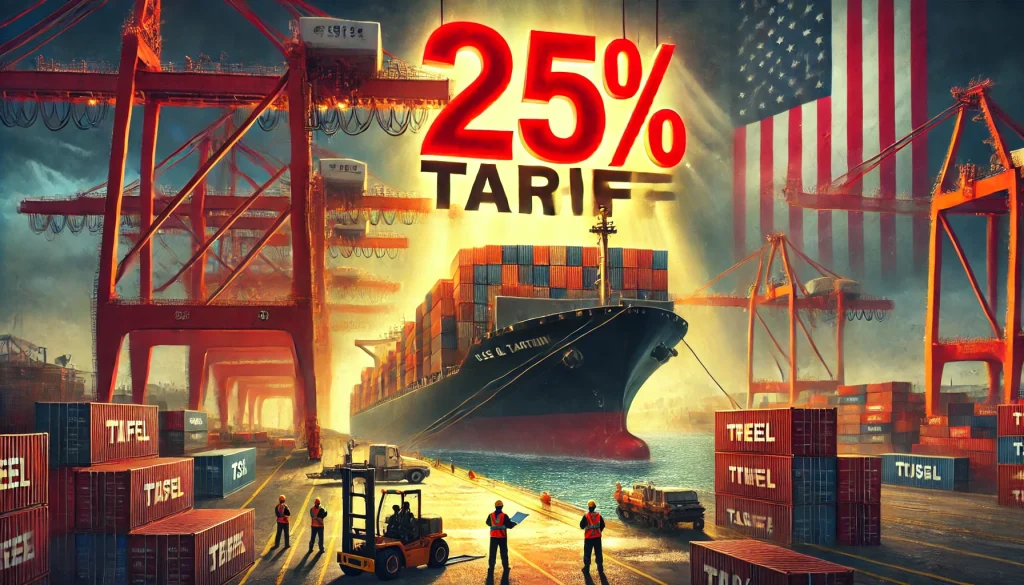
In a major shift in trade policy, President Donald Trump has announced a 25% tariff on all steel and aluminium imports into the United States. This latest move, set to be officially declared on Monday, builds on existing duties and marks a significant escalation in the administration’s trade strategy.

Speaking aboard Air Force One en route to the Super Bowl in New Orleans, Trump explained his plan to impose reciprocal tariffs, aiming to match the rates imposed by other nations on U.S. exports.
“And very simply, it’s, if they charge us, we charge them,” he stated, underscoring a tit-for-tat approach to international trade imbalances.
Related News
- US Steel Decision Escalates Geopolitical Risks for Iron Ore and Steel
- Can Tata Steel’s Electric Arc Furnaces Revive the UK Steel Industry? The High-Stakes Bet on Port Talbot
- China Steel Industry 2025: Facing Uncertainty Amid Declining Output and Rising Trade Barriers
- Hot Rolled Coil (HRC): Key to Europe’s Industrial Transformation
Historical Context of Trump Aluminium and Steel Tariff Policies
During his first term, Trump enacted a 25% tariff on steel and a 10% tariff on aluminium. Over time, certain trading partners, including Canada, Mexico, and Brazil, were granted duty-free quotas. The Biden administration later extended these exemptions to the United Kingdom, Japan, and the European Union. Despite these measures, U.S. steel mill capacity utilization has declined in recent years.
Data from the American Iron and Steel Institute shows that the top sources of U.S. steel imports include Canada, Brazil, and Mexico, followed by South Korea and Vietnam. Additionally, Canada supplies 79% of primary aluminium imports, while Mexico is a major supplier of aluminium scrap and alloy.
Economic Impact of the Trump Aluminium and Steel Tariff
Industry analysts warn that the new Trump aluminium and steel tariff will increase costs for U.S. manufacturers.

Daniel Hynes, Senior Commodity Strategist at ANZ in Sydney, noted:

“I suspect U.S. manufacturers will have to wear higher prices as a result of these 25% tariffs. Its import reliance is high—around 40%-45% for aluminium and 12%-15% for steel.”
He added that U.S. metal prices are likely to rise as traders rush to secure supplies before the tariffs take effect.
Historically, such tariffs have led to higher domestic production. A 2024 analysis by the Tax Foundation found that previous tariffs resulted in a 1.9% increase in steel production and a 3.6% rise in aluminium production. However, these gains came at the cost of higher prices for consumers and downstream industries.

Global Trade Relations and Possible Retaliation
The announcement of the Trump aluminium and steel tariff has raised concerns over potential retaliatory actions from key trading partners. The European Union has previously challenged U.S. tariffs at the World Trade Organization and may take similar action in response to the new levies.
This move also casts doubt on the future of international trade agreements. As the U.S. pursues a more protectionist stance, other nations may follow suit, triggering a cycle of trade disputes that could disrupt global supply chains.
What’s Next for the Trump Aluminium and Steel Tariff?
President Trump is expected to provide further details on his reciprocal tariff plan in a press conference scheduled for Tuesday or Wednesday. His administration’s approach signals a broader effort to address trade imbalances and protect domestic industries.
As the situation develops, businesses and consumers will be watching closely to assess the impact of the Trump aluminium and steel tariff on prices, supply chains, and international trade relations.