By Penny Langford

The geopolitical scramble for critical minerals has entered a new, more aggressive phase. For years, the Western strategy for rare earth elements (REE) was fragmented: focused on opening mines without a clear path to the finished products that actually drive modern technology. That era of fragmentation effectively ended with the $1.9 billion acquisition of German magnet giant Vacuumschmelze (VAC) by Energy Fuels Inc. (NYSE: UUUU).
This deal is not merely an expansion of a corporate balance sheet; it is a structural realignment of the North American and European industrial base. By integrating VAC’s world-class magnet manufacturing with Energy Fuels' existing processing capabilities at the White Mesa Mill in Utah, the company is attempting to build the first comprehensive "mine-to-magnet" vertical in the West.
As we look toward the 2026 market landscape, this integration serves as a blueprint for how Western firms can decouple from Chinese dominance.
The Vertical Integration Mandate
In the mining industry, "vertical integration" is often a buzzword used to justify mid-tier M&A. However, in the context of rare earths, it is an existential requirement. China currently controls roughly 60% of global rare earth mining but, more critically, over 90% of the refining and magnet-making capacity.
More Read
For an electric vehicle (EV) manufacturer or a defense contractor, owning the ore is useless if that ore must be shipped to Baotou for processing. The Energy Fuels-VAC deal addresses this "midstream gap" by securing the entire value chain.

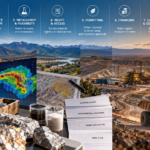
- Feedstock (Mining): Energy Fuels is sourcing monazite sand from heavy mineral sand operations and has moved to acquire Australian Strategic Materials (ASM) to bolster upstream supply.
- Separation (Chemical Processing): The White Mesa Mill has already successfully produced "on-spec" rare earth carbonate and is ramping up to produce separated NdPr (neodymium-praseodymium) oxides.
- Metals and Alloys: Through the ASM acquisition, the company gains a bridge into the high-purity metals required for magnet production.
- Magnets (Finished Product): VAC provides the industrial end-state: producing the permanent magnets essential for EV motors, wind turbines, and precision-guided munitions.
Rare Earth Market Share: The 2026 Shift
The strategic goal of these moves is to carve out a permanent, non-Chinese market share that can withstand the pricing volatility often induced by the China Northern Rare Earth Group.

Note: Image placeholder for data visualization. Actual 2026 projections suggest a doubling of ex-China magnet capacity as integrated verticals come online.
More Read
Energy Fuels’ Transformation: Beyond Uranium
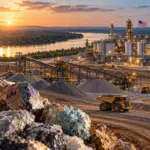
Energy Fuels has long been a staple of the American uranium sector. However, the decision to pivot toward rare earths was a calculated move to utilize the White Mesa Mill’s unique licensing. White Mesa is the only facility in the United States currently capable of processing monazite: a mineral that is rich in rare earths but also contains radioactive thorium and uranium.
By extracting both the rare earths and the uranium from the same feedstock, Energy Fuels effectively lowers its cost basis for both commodities. This dual-stream revenue model is what makes the company a formidable competitor against Chinese state-backed entities that often benefit from hidden subsidies.
The Pentagon’s recent $725 million bet on Energy Fuels underscores the strategic importance of this facility. It is no longer just a mill; it is a node of national security.

The VAC Connection: Why German Engineering Matters
While Energy Fuels understands the chemistry of separation, Vacuumschmelze (VAC) understands the physics of magnetism. VAC is a century-old leader in magnetic materials, holding over 1,000 patents.
Acquiring VAC gives Energy Fuels an immediate "shortcut" to technical maturity. Building a magnet plant from scratch is a decade-long endeavor fraught with qualification hurdles. VAC already has long-term contracts with European automotive OEMs and aerospace giants.
By feeding American-processed NdPr into VAC’s European and North American production lines, Energy Fuels bypasses the "Valley of Death" that many junior miners face when trying to move downstream. They aren't just selling a commodity; they are selling a high-margin, engineered component.
De-risking from China: The 2026 Pricing Environment
The market for rare earths in 2026 will likely be defined by "policy-driven pricing." We are moving away from a global spot price toward a bifurcated market: a "China-price" and a "Western-security-premium-price."
As Western governments implement stricter rules of origin for EV subsidies (such as the U.S. Inflation Reduction Act's Section 30D), the demand for non-Chinese magnets will decouple from the standard commodity cycle. Analysts expect NdPr prices to stabilize around $130/kg by 2026, supported by this "security premium."
However, risks remain. China’s ability to "flood the zone" with cheap supply remains a potent weapon. To counter this, integrated players must achieve operational efficiencies that allow them to remain profitable even during price troughs.

Operational Realities: The Integration Challenge
The Energy Fuels-VAC deal is a massive undertaking. Integrating three distinct corporate cultures: an American mining firm, a German engineering specialist, and an Australian upstream developer (ASM): will be the primary challenge for management through 2026.
There are also physical logistics to consider. Moving material from mines in Australia or Brazil to Utah for separation, then to VAC’s facilities in Germany or its new plant in South Carolina, requires a highly optimized "rare earth corridor."
| Segment | Primary Asset | Status for 2026 |
|---|---|---|
| Upstream | Bahia Project (Brazil) / ASM (Australia) | Ramping Production |
| Midstream | White Mesa Mill (Utah, USA) | Commercial Separation Online |
| Downstream | VAC South Carolina / Hanau (Germany) | Fully Operational |
| End Market | EV/Defense/Wind | Long-term Offtake Active |
The 2026 Outlook: A New Playbook
The Energy Fuels-VAC deal marks the end of the "hope-based" supply chain strategy. No longer is the West hoping that a junior miner will eventually build a processing plant. Instead, we are seeing the emergence of "Heavy Verticals": companies with the capital and the technical pedigree to compete on a global scale.
For investors and industry operators, the takeaway is clear: the value in the 2026 rare earth market is moving downstream. Those who control the magnet control the market. As Energy Fuels completes this transformation, it sets a standard that other players, including MP Materials and various copper-gold majors, will likely be forced to follow.
The Western supply chain playbook has been rewritten. The era of the "rare earth vertical" has arrived.

High-precision manufacturing will be the final link in the Western mine-to-magnet strategy.