The mid-tier gold miner is a dying breed. For decades, these companies represented the “sweet spot” for investors: large enough to offer liquidity and stability, yet small enough to provide explosive growth through the drill bit. That era ended in early 2026. What we are witnessing now isn’t just a trend; it is a structural liquidation of the middle market.

By the time gold hit its record high of $5,602 per ounce in January, the writing was already on the wall. The subsequent gold price crash and current consolidation around the $5,000 mark have only accelerated the inevitable. If you aren’t a massive, diversified major or a lean, high-grade junior with a “For Sale” sign on the front gate, you are essentially a target.
The industry is being hollowed out. That’s not a hyperbolic statement. It’s the new math of 2026 mining finance.
The $3.9 Billion Signal: Zijin’s Unrelenting Expansion
The recent $3.9 billion acquisition by Zijin Mining serves as the definitive signal for this cycle. While Western majors have spent the last three years obsessing over ESG scores and “disciplined capital allocation,” Zijin has been quietly: and now loudly: buying the future.
Zijin isn’t just buying ounces in the ground. They are buying scale. In a world where geopolitical jitters drive central bank demand to record highs of 1,100 tonnes annually, the ability to move massive amounts of earth is the only competitive advantage that matters. Zijin’s aggressive move highlights a uncomfortable truth for Western operators: the cost of capital is no longer the primary hurdle; the hurdle is the speed of execution.
More Read

Zijin operates with a different clock. While a mid-tier Canadian miner might spend five years in permitting purgatory, Zijin is already pouring first gold. This disparity in operational velocity is forcing the hand of every other player in the gold sector.


Coeur Mining and New Gold: A Marriage of Necessity
If Zijin represents the global land grab, the acquisition of New Gold by Coeur Mining represents the “hunker down” strategy. This isn’t a merger of equals or a growth play in the traditional sense. It is a consolidation of overhead and a desperate search for jurisdictional safety.
More Read
For New Gold, the math simply stopped working. Despite owning quality assets, the cost of maintaining a corporate structure, a separate board, and an independent technical team in a 2026 inflationary environment became a terminal drag on the share price. Coeur, by absorbing them, isn’t just getting the Rainy River or New Afton production; they are getting a survival buffer.
Scale is now a defensive mechanism. In 2026, the mid-tier is too big to be nimble and too small to be influential. They are caught in a “no-man’s land” where they lack the balance sheet to develop the massive, low-grade deposits that remain, yet they carry too much debt to pivot to the high-grade, high-risk “frontier” plays.
Why Mid-Tiers are Disappearing: The 2026 Operating Reality
The disappearance of the mid-tier is driven by three grim realities that the industry’s marketing departments won’t admit in public.
1. The Capex Stranglehold
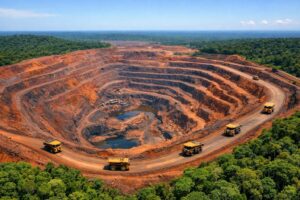
Building a mine in 2026 isn’t just more expensive; it’s a different order of magnitude. Between labor shortages, the “shiny AI revolution” in equipment, and the skyrocketing cost of energy, a project that cost $800 million in 2022 now carries a $2.5 billion price tag. Mid-tiers cannot fund these projects without diluting their shareholders into oblivion.
2. The Personnel Crisis
There isn’t enough talent to go around. Per facility. That’s not a typo. The 10 titans defining the 2026 resource realignment are vacuuming up every competent mining engineer, geologist, and ESG specialist in the market. A mid-tier company trying to compete for talent against the likes of Rio Tinto or Newmont is like a high school team trying to sign a first-round NFL draft pick.
3. The Passive Investing Trap
Institutional money has moved. In 2026, the big ETFs and pension funds only want the top five names. If you aren’t in the top tier of liquidity, you don’t exist for the people who actually move the needle on share prices. This creates a feedback loop: lower valuation leads to higher cost of capital, which leads to lower growth, which leads to being an M&A target.

Diversification and the New Scale Paradigm
The narrative used to be “pure play.” Investors wanted gold, and they wanted it pure. In 2026, that strategy is dead. The most successful “gold” companies are now looking more like diversified miners. They are adding copper, silver, and even strategic metals to their portfolios to smooth out the volatility.
Look at the Freeport expansion in Chile. That $7.5 billion project is as much about the gold by-product as it is about the copper. The majors are using their massive diversified cash flows to build gold mines that mid-tiers could only dream of.
Scale isn’t just about having more mines; it’s about having the technical infrastructure to deploy AI-powered mining gear across a dozen sites simultaneously. It’s about having the political weight to negotiate directly with governments. In 2026, if you aren’t at the table, you’re on the menu.

What This Means for Investors: The End of the Middle
For investors, the 2026 consolidation wave is a double-edged sword. On one hand, the M&A premiums are providing nice exits for those holding the right mid-tier stocks. On the other hand, the “growth engine” of the sector is being dismantled.
Once these mid-tiers are absorbed into the majors, their individual stories are lost. They become just another rounding error in a quarterly report. The “alpha” that investors used to find in the mid-tier is migrating to the high-risk explorers. But as we’ve seen with the Denison Mines ISR update, technical risks in the junior sector remain punishing.
The strategic calculus here isn’t subtle: Buy the majors for the dividend and the safety of the $5,000 gold floor, or buy the juniors and hope they get bought by Zijin or Coeur. There is no middle ground left.
The Inflection Point: 2026 and Beyond
2026 marks the inflection point where the gold sector finally admits that size is the only sustainable moat. The “Gold Consolidation Wave” isn’t a temporary spike in mining finance news; it is the final act of a decade-long consolidation.
The mid-tier companies that survived the downturns of the 2010s and early 2020s are being harvested. They did the hard work of discovering and de-risking the assets, but they won’t be the ones to reap the rewards of the $5,000+ gold environment.

As the majors grow larger and more powerful, the barrier to entry for a new mid-tier player becomes almost insurmountable. The capital requirements are too high. The permitting is too slow. The talent is too scarce.
The gold market is becoming a game for the giants. Whether you’re an operator or an investor, you need to decide which giant you’re betting on. Because the mid-tier isn’t coming back.