The China lithium price surge gained momentum after local authorities in one of the country’s most important lithium-producing regions announced plans to revoke dozens of mining licences, triggering fresh concerns over future supply and pushing lithium futures sharply higher on domestic exchanges. Although officials clarified that the move would not immediately disrupt production, the announcement underscored China’s tightening regulatory stance and reignited investor sensitivity to policy signals in the battery metals market.

Lithium carbonate prices jumped after the Bureau of Natural Resources in Yichun, Jiangxi province, said it would revoke 27 mining licences, prompting market participants to reassess supply risks in the world’s largest lithium processing hub. Yichun plays a central role in China’s lithium supply chain, making regulatory developments in the region particularly influential for price formation.
China Lithium Price Surge Driven by Licence Revocation Announcement
The China lithium price surge followed confirmation that the licences targeted for cancellation had already expired, in some cases for more than a decade. Most of the permits were originally issued for ceramic clay or limestone operations, rather than active lithium mining. Despite this, the announcement unsettled markets by highlighting a firmer approach to mining compliance and licence management.
Traders interpreted the move as a signal that authorities are accelerating efforts to clean up dormant or non-compliant permits, reinforcing expectations of tighter oversight in strategic minerals. Even administrative actions, market analysts noted, can have outsized effects when they reinforce broader regulatory trends.
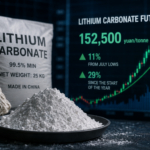
The most-active lithium carbonate futures contract on the Guangzhou Futures Exchange climbed to its highest level since June 2024, reflecting heightened investor sensitivity to any developments affecting China’s lithium supply chain.
Although authorities indicated that current mining operations would not be immediately disrupted, traders focused on the long-term implications for future supply growth in the world’s largest battery metals market.

Market Reaction Lifts Lithium Futures
On the Guangzhou exchange, lithium carbonate futures surged to an intraday high of 109,860 yuan ($15,592) per metric ton, before settling at 108,620 yuan, marking a daily gain of more than 7%. The sharp move underscored how quickly regulatory signals can translate into price volatility, even in the absence of physical supply cuts.
Analysts said the rally was driven less by immediate production losses and more by anticipatory positioning, as traders priced in the risk of stricter regulation and potential future constraints on output expansion. Regulatory uncertainty, rather than changes in consumption patterns, was the dominant factor behind the price jump.
Market participants remain cautious following recent disruptions in Yichun, including the suspension of mining at CATL’s Jianxiawo lithium mine after its permit expired. That episode had already heightened awareness of licensing risks, making the market particularly reactive to further regulatory developments.
Supply Concerns Extend Beyond Near-Term Output
While the revoked licences were not linked to operating lithium mines, the announcement revived concerns about the pace at which new projects can be approved and developed. China’s lithium industry has expanded rapidly in recent years, but regulators have increasingly emphasised environmental compliance, safety standards, and orderly development.
Lithium prices in China have been trending higher since August, supported by improving downstream demand from battery manufacturers and continued investment in electric vehicles and energy storage systems. Against this backdrop, any policy action perceived as limiting future supply growth can amplify bullish sentiment.
China dominates global lithium refining and processing, meaning that even marginal policy changes can have ripple effects across international markets. As a result, traders closely monitor developments in key producing regions such as Yichun.
Regulation Adds Uncertainty to Lithium Outlook
China’s central role in global lithium supply means that changes to its domestic licensing regime can have outsized effects beyond its borders. Analysts said that while the licence revocations are unlikely to materially affect near-term output, they reinforce uncertainty at a time when demand from electric vehicles, battery storage, and renewable energy sectors remains strong.
The regulatory move follows similar licence clean-up actions in Yichun in recent months, including additional permit cancellations announced in late November. Together, these steps suggest local authorities are stepping up oversight to eliminate dormant licences and improve governance in the mining sector.
Such actions align with broader national objectives to tighten environmental enforcement, reduce illegal mining activity, and ensure sustainable development of strategic resources.
Broader Implications for Battery Metals Markets
The China lithium price surge highlights wider structural shifts underway in global critical minerals markets. As governments seek greater control over strategic resources, regulatory actions are increasingly influencing price dynamics alongside traditional supply and demand fundamentals.
For battery metals such as lithium, policy signals have become a key driver of investor sentiment. Traders are now weighing licensing decisions, environmental enforcement, and regional compliance trends as closely as production data and demand forecasts.
For producers, the evolving regulatory environment underscores the importance of compliance and long-term planning, while for investors, it reinforces the inherent volatility of markets tied to critical minerals.
Outlook
As demand for lithium continues to grow alongside global electrification and clean energy deployment, regulatory developments in China are likely to remain a focal point for markets. Any perceived threat to future supply—whether from licence revocations, mine suspensions, or tighter environmental standards—can quickly translate into price swings.
The latest China lithium price surge serves as a reminder that in today’s critical minerals landscape, policy decisions can be just as influential as physical supply and demand in shaping market outcomes.