By Charles Pitts

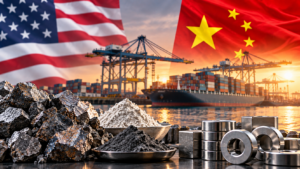
The era of “hands-off” industrial policy in Washington is officially over. In a move that signals the most aggressive shift in American resource strategy since the mid-20th century, the White House: under the direction of the National Energy Dominance Council (NEDC): has launched a $1 billion equity-based offensive aimed at dismantling China’s stranglehold on the critical minerals supply chain.
This is not a traditional grant program or a low-interest loan package. It is a direct equity play. By taking preferred stock positions and warrants in domestic champions like MP Materials and Lithium Americas, the U.S. government is effectively becoming a strategic partner in the mining and processing sector. The objective is clear: decouple the midstream processing of rare earths and battery metals from Beijing’s orbit and insulate domestic operators from the predatory price-dumping that has historically crushed Western competition.
The New State Capitalism: Why Washington is Taking Stakes
For decades, the U.S. approach to critical minerals was reactionary. When prices spiked or supply chains tightened, the Department of Energy (DOE) would issue grants to support R&D or pilot plants. However, these “capital-light” interventions often failed to protect companies from the boom-and-bust cycles orchestrated by state-backed competitors in the East.
The NEDC’s new $1 billion mandate represents a pivot toward what some analysts are calling “state-directed capitalism.” By taking equity, the government is providing more than just cash; it is providing a floor of stability.
More Read

“Grants don’t stop a competitor from flooding the market and driving prices below the cost of production,” notes one senior policy advisor. “Equity, coupled with the price floors we are seeing in recent DoD contracts, creates a structural barrier. It tells the market that these projects are too important to the national interest to be allowed to fail.”

This strategy aligns with broader efforts to combat China’s dominance in critical minerals, where the focus has shifted from mere extraction to the far more lucrative and strategically sensitive “midstream” processing phase.
MP Materials and Lithium Americas: The Anchor Tenants
The $1 billion pool is being deployed with surgical precision, targeting assets that are already at or near production but require massive capital to scale their refining capabilities.
More Read
MP Materials (NYSE: MP)
The Pentagon had already laid the groundwork with a $400 million investment in preferred stock for MP Materials, the operator of the Mountain Pass mine in California. The new NEDC-led strategy expands upon this, securing the domestic production of NdPr (neodymium-praseodymium) and rare earth magnets.
The investment is tied to specific output commitments at MP’s planned “10X Facility.” By taking a stake, the U.S. ensures that these magnets: essential for everything from F-35 fighter jets to electric vehicle motors: stay within a secure, allied loop. This move is a direct response to how the U.S. ramps pressure on foreign dependencies.

Lithium Americas (NYSE: LAC)
While Lithium Americas has long been a candidate for DOE loans for its massive Thacker Pass project in Nevada, the NEDC’s involvement introduces an equity component aimed at the lithium carbonate and hydroxide processing units.
The goal here is to ensure that the lithium mined in Nevada doesn’t have to be shipped to China for refining: the current industry bottleneck. By injecting equity into the midstream infrastructure, the White House is betting that it can shorten the supply chain and reduce the carbon footprint of the domestic battery industry simultaneously.
Decoupling the Midstream: The Real Battleground
The global mining industry understands a fundamental truth that the general public often misses: the “bottleneck” isn’t the ore in the ground; it’s the chemistry in the refinery. China currently controls roughly 85% of global rare earth processing and a dominant share of lithium, cobalt, and graphite refining.
The $1 billion equity play is specifically designed to fund the “unsexy” but vital parts of the mine site: separation circuits, hydrometallurgical plants, and calcination kilns.
“If you control the processing, you control the price,” says Charles Pitts, Chief Automation Officer. “The NEDC is essentially buying a seat at the table to ensure that American companies can survive a price war. We’ve seen Trump administration proclamations regarding national energy security before, but this is the first time the checkbook has been used to buy actual ownership in the solutions.”
National Security as the Primary P&L Driver
From an investor’s perspective, the entry of the U.S. government into the equity structure of a mining company changes the risk profile significantly. Traditional mining finance has always struggled with the long lead times and high capital intensity of processing facilities, especially in the digital age of mining finance.
The NEDC’s priority isn’t a 20% IRR for the Treasury; it is “Supply Security.” This means the government is willing to accept longer payback periods and lower financial returns in exchange for the strategic certainty of a domestic supply of magnets or battery-grade lithium.
For operators, this provides a “super-sponsor” that can assist with permitting, off-take agreements with the Department of Defense, and diplomatic support for securing “allied” ore from jurisdictions like Australia or Kazakhstan.

Market Snapshot: Critical Minerals Funding 2026
| Program / Vehicle | Estimated Allocation | Primary Objective | Key Beneficiaries (Confirmed/Prospective) |
|---|---|---|---|
| NEDC Equity Pool | $1.0 Billion | Direct Equity/Preferred Stock | MP Materials, Lithium Americas |
| DOE Critical Minerals Fund | $950 Million | Grants & Processing Loans | ReElement, Vulcan Elements |
| DoD Office of Strategic Capital | $500 Million | Price Floors & Loan Guarantees | USA Rare Earth, Atlantic Alina |
| US-Australia Framework | $1.0 Billion | Joint Allied Infrastructure | Lynas Rare Earths, Iluka |
The 2026-2027 Outlook: What’s Next?
As this $1 billion is deployed, expect to see a “crowding-in” effect. Private equity and institutional investors, who have been hesitant to compete with Chinese state-backed firms, are likely to follow Washington’s lead. If the U.S. government is willing to take the first-loss position or the junior equity stake, the senior debt becomes much easier to syndicate.
However, challenges remain. The “Equity Play” is a double-edged sword. Increased government oversight can lead to slower decision-making and “national security” restrictions on who these companies can sell to in the future. Furthermore, if the political winds shift in Washington, the permanence of these stakes could be called into question, though the bipartisan nature of the anti-China sentiment suggests this policy has long-term legs.
For now, the message to the mining industry is clear: the United States is no longer content to be a mere consumer of critical minerals. It is becoming an owner of the supply chain.