By Salini Krishnan

The long-anticipated strategic pivot at Barrick Gold has finally been codified. In a landmark shareholder letter released this week, Chairman John Thornton outlined a fundamental “reset” for the world’s second-largest gold producer, signaling a decisive retreat from the high-risk, frontier-market strategy that defined the previous half-decade.
After years of prioritizing organic growth in challenging jurisdictions under former CEO Mark Bristow, Barrick is shifting its gaze back to North American stability and a renewed appetite for major mergers and acquisitions (M&A). The centerpiece of this transformation is the planned 2026 listing of “North American Barrick,” a move designed to decouple the company’s most valuable, low-risk assets from the geopolitical volatility that has recently weighed on its valuation.
The Catalyst: A 25-Year Production Low
The strategic shift comes at a critical juncture for the mining giant. Barrick’s operational data for 2025 revealed a stark reality: gold output fell 17% to 3.26 million ounces, the company’s lowest production level in a quarter-century. While high gold prices have provided a financial cushion, the shrinking production profile has become impossible for the board to ignore.
Thornton’s letter identifies a “deterioration of operational predictability” in key regions as the primary driver for the pivot. Most notably, the seizure of the Loulo-Gounkoto complex by Mali’s military government and the escalating costs and security risks at the Reko Diq copper-gold project in Pakistan have served as a wake-up call. The era of “anywhere, anytime” exploration, which prioritized geologically superior assets regardless of regional stability, appears to be over.
More Read


Caption: A map outlining Barrick’s global portfolio shift, highlighting the move from West African and South Asian frontier markets toward North American core assets.

The “North American Barrick” IPO: Unlocking Tier-One Value
The most significant structural change announced is the plan to list a new vehicle by the end of 2026. This entity, tentatively named North American Barrick, will house the company’s premier assets, including:
- Nevada Gold Mines (NGM): The massive joint venture with Newmont.
- Fourmile: The high-grade discovery in Nevada that Barrick owns 100%.
- Pueblo Viejo: The tier-one gold mine in the Dominican Republic.
By ring-fencing these assets, Thornton aims to address the persistent “conglomerate discount” that has plagued Barrick’s share price. Investors seeking exposure to top-tier jurisdictions often hesitate to buy into a portfolio that includes significant exposure to resource nationalism, as recently seen in West Africa.
More Read

“North American Barrick will be the most attractive pure gold company in the world,” Thornton stated in his letter. “It will be located in the most attractive jurisdiction, with the strongest proven growth pipeline.”
A Departure from the Bristow Era
The reset marks a clear departure from the strategy of Mark Bristow, who left the company abruptly in September 2025. Bristow, the architect of the 2019 Randgold Resources merger, was known for his “boots-on-the-ground” approach and his comfort operating in complex political environments across Africa and the Middle East.
While Bristow successfully integrated Randgold and Barrick, the increasing difficulty of operating in jurisdictions like Mali has made his strategy harder to sustain. The appointment of Mark Hill as CEO in February 2026 has accelerated this transition. Hill has spent his first months overhauling the senior leadership team and dismantling the regional management structures that were central to Bristow’s decentralized model.
The new focus is on “tier-one” assets: defined as mines that produce more than 500,000 ounces of gold per year, have a mine life of at least 10 years, and sit in the bottom half of the industry cost curve.

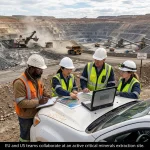
Caption: The strategic reset requires a closer integration of technical expertise and geopolitical risk assessment at Barrick’s corporate headquarters.
The Return to Big-Ticket M&A
Perhaps the most aggressive part of Thornton’s plan is the return to large-scale acquisitions. Since the Randgold merger in 2019, Barrick has largely stayed on the sidelines of major deal-making, even as competitors like Newmont engaged in massive consolidations (such as the Newcrest acquisition).
The industry has watched Barrick circle targets like First Quantum Minerals for years, but no deal materialized. Now, with a cleaner balance sheet and a mandate for growth in stable regions, Barrick is expected to be a primary mover in the 2026-2027 M&A cycle.
Analysts suggest that Barrick’s targets will likely be large-scale copper-gold producers or high-quality gold juniors with projects in Canada, the United States, or Australia. The goal is to replace the ounces lost to geopolitical “retreat” with stable, long-term production. This move aligns with broader industry trends where efficiency over scale is becoming the new mantra for major miners.
Geopolitical Pressures and the Copper Nexus
While the focus is shifting to North America, Barrick cannot entirely abandon its copper ambitions. Copper remains the “bridge” to the energy transition, and projects like Reko Diq were intended to make Barrick a top-tier copper producer. However, the 2026 outlook for copper is increasingly tied to digital integration and operational safety rather than just raw volume.
Thornton’s letter suggests that while Barrick will continue to advance Reko Diq, it will seek to bring in additional partners to de-risk the capital expenditure and security overhead. This “partner-first” model for high-risk regions marks a shift from the “operator-owner” pride that characterized the company’s previous stance.

Caption: An infographic comparing the cost-of-capital and geopolitical risk profiles of Barrick’s current portfolio versus the proposed 2026 North American split.
The Path Forward: 2026-2027 Timeline
The roadmap for Barrick’s reset is ambitious:
- Q3 2026: Completion of the internal restructuring and cost-cutting program led by Mark Hill.
- Q4 2026: The IPO of North American Barrick.
- 2027: Active pursuit of “Tier One” M&A targets to replenish the production pipeline.
The success of this strategy hinges on the market’s appetite for the North American spin-off. If the new entity achieves the premium valuation Thornton expects, it will provide the “currency” (in the form of highly valued shares) needed to execute major acquisitions without over-leveraging the balance sheet.
Market Implications
For the broader mining industry, Barrick’s retreat from high-risk regions is a significant signal. It suggests that even the world’s most experienced operators are finding the current wave of resource nationalism and geopolitical instability too costly to manage. This could lead to a further concentration of capital in “safe” jurisdictions, potentially leaving frontier markets struggling to attract the investment needed to develop their resources.
As gold prices remain volatile: influenced by everything from geopolitical pauses to central bank activity: Barrick’s move toward quality and stability is a defensive play intended to create an offensive platform.

Caption: Advanced processing technology at assets like Pueblo Viejo remains core to Barrick’s ability to maintain “Tier One” status in a high-cost environment.
Skillings Mining Review is the leading source for news and analysis on the global mining industry. For more deep dives into the strategies of the world’s largest miners, visit skillings.net.