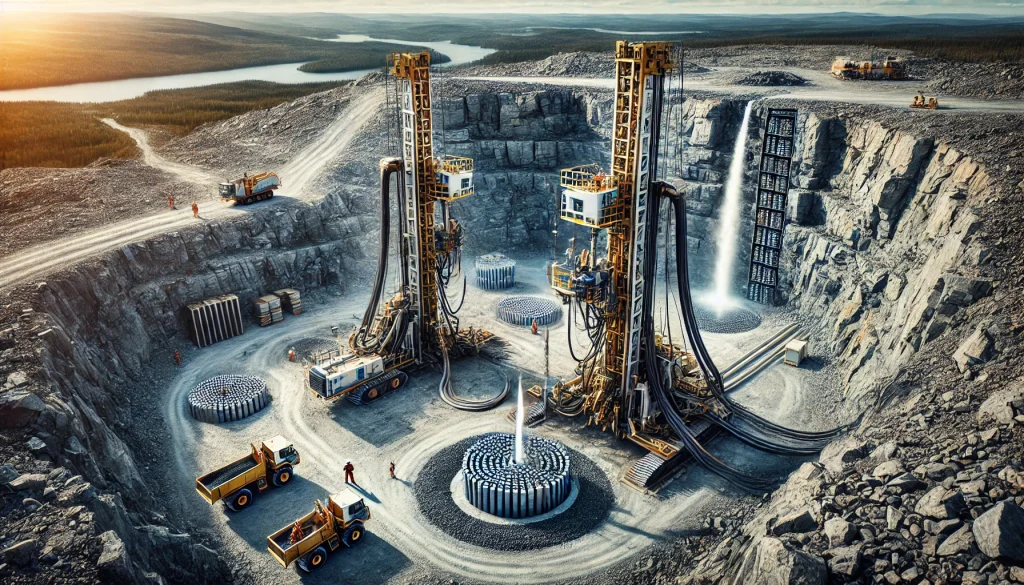
Abitibi Metals (CSE) has announced a major advancement in its Phase II drilling program at the B26 polymetallic deposit, located in Quebec, Canada. With the addition of a second drill rig, the company plans to accelerate its efforts, targeting a total of 16,500 metres of drilling by the end of 2024. This expansion marks a pivotal moment for Abitibi as it continues to explore two high-priority targets within the deposit, showing promising signs of copper and polymetallic mineralization.

Second Drill Rig Boosts Exploration Efforts
In a press release, Jonathon Deluce, CEO and President of Abitibi Metals, expressed enthusiasm for the project’s progression:
“We are excited to announce the arrival of a second drill for our Phase II drill program at the B26 Deposit. The addition of this drill underscores our commitment to accelerating the exploration process and building credibility for our target size of 30 – 50 million tonnes at B26.”
This second drill will focus on two key targets—the Western Plunge and the Mid-Level Resource Growth Target. The company aims to further define mineralization across these areas and establish a robust resource base. The drilling efforts are crucial in expanding the deposit’s potential, with the first drill currently testing a 400-metre step-out hole in the Western Plunge, an area known for high copper equivalent intercepts.
Significant Mineralization in Phase II Drilling
Since the start of Phase II, Abitibi has completed three drill holes and a wedge, totaling 3,385 metres, targeting both the Western Plunge and Mid-Level Resource areas. Core samples have shown strong signs of chalcopyrite stringer mineralization, particularly in drill hole 1274-23-338 and its wedge, 1274-23-338-W1. Chalcopyrite concentrations ranged from 2% to 20% over intervals of several metres, further validating the mineralization potential within the Western Plunge.
One of the most notable outcomes so far has been the interception of a mineralized zone between 1,159 and 1,230 metres in depth, with significant chalcopyrite content over a stretch of 71 metres. These findings are particularly encouraging as Abitibi looks to expand the resource estimate for B26, which already hosts a historical resource of 7 million tonnes at 2.94% Cu Eq in the indicated category, with an additional 4.4 million tonnes at 2.97% Cu Eq in the inferred category.
More Read

B26 Deposit: Strategic Partnership and Resource Goals
Abitibi Metals entered into an option agreement with SOQUEM Inc. in November 2023, giving the company the option to earn an 80% interest in the B26 deposit over a seven-year period. SOQUEM, a subsidiary of Investissement Québec, plays a crucial role in advancing mining exploration in Quebec. The partnership aims to promote local economic development through resource exploration and innovation.

The current focus on the Western Plunge and Mid-Level Resource Growth Targets is integral to achieving Abitibi’s vision of defining a 30 to 50 million tonne resource. The ongoing drilling efforts will provide valuable data to further delineate the extent of mineralization at these critical targets.
Future Prospects: Deep Drilling for Expanded Resource Potential
The depth of the current drilling phase has raised some questions, but according to CEO Jonathon Deluce, this depth is still considered shallow for a potential underground mine. Comparing B26’s alteration signatures to other significant deposits in the Abitibi region suggests the possibility of a much deeper system. With this second drill rig, Abitibi aims to gather the necessary data to fully understand the scale and potential of the B26 polymetallic deposit.
More Read

Abitibi Metals’ commitment to expanding the B26 polymetallic deposit is underscored by the addition of a second drill rig and the company’s aggressive drilling goals for 2024. The ongoing exploration at the Western Plunge and Mid-Level Resource Growth Targets holds significant promise for further resource expansion, as Abitibi continues its journey toward establishing a large, high-grade deposit in Quebec.