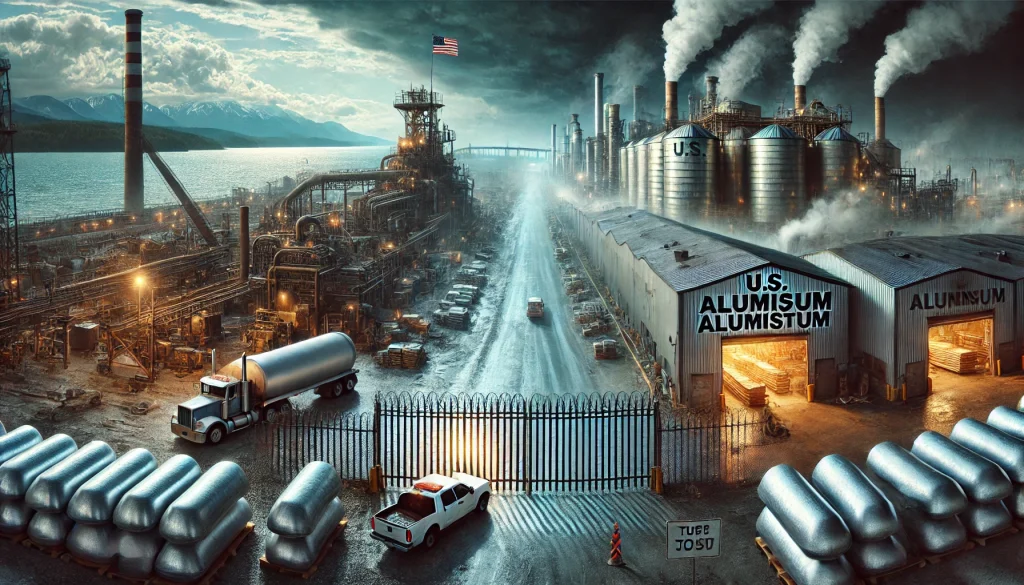
Once the dominant producer of aluminum globally, today the U.S. produces only 1.2% of the world’s supply, highlighting its growing dependence on international sources, particularly Canada.”
– Alastair Neill, Director, Critical Minerals Institute (CMI)
The U.S. Aluminum Industry Faces a Crisis
The U.S. aluminum industry is at a turning point. Once a global leader, the nation has seen its domestic production decline sharply, making it increasingly dependent on foreign suppliers. Today, over 80% of U.S. aluminum consumption comes from imports, with Canada supplying more than half of that total.

As demand for aluminum surges—particularly for electric vehicles (EVs), renewable energy, and defense applications—one pressing question emerges: Can the U.S. afford to lose its Canadian aluminum supply?
Related News
- Ottawa Moves to Reduce Trade Barriers, but Challenges Remain for Canada’s Resource Sectors
- Yukon Metals Expands Exploration at AZ Project, Targeting High-Grade Copper in 2025
- Anglo American Sells Nickel Business to MMG Subsidiary in $500 Million Deal
- Seabridge Gold to Raise $100M for B.C. Projects, Bankable Feasibility Study at KSM
U.S. Aluminum Production: A Declining Industry
The numbers reveal a stark reality:
- Total U.S. primary aluminum production capacity (2024): 1.36 million tonnes
- Actual U.S. production due to high costs and outdated infrastructure: 680,000 tonnes (50% capacity)
- Total U.S. aluminum imports (2024): 4.8 million tonnes
- Aluminum imported from Canada: 2.6 million tonnes (54% of total imports)
Why Is U.S. Aluminum Production Struggling?
The biggest obstacle for U.S. aluminum smelters is high electricity costs, which account for up to 50% of production expenses.
In contrast, Canada benefits from abundant hydroelectric power, providing low-cost and sustainable energy. U.S. smelters, on the other hand, operate in regions where electricity costs are up to three times higher, making domestic production uncompetitive.
This cost disparity has forced several U.S. smelters to shut down. In 2024, Century Aluminum closed its Hawesville smelter in Kentucky, citing skyrocketing energy prices, resulting in 600 lost jobs.

While initiatives like the Inflation Reduction Act (IRA) aim to lower energy costs, they are not yet enough to revive U.S. aluminum production.
Canada’s Competitive Advantage in Aluminum Production
While U.S. production struggles, Canada’s aluminum industry is thriving due to:

✅ Low-cost hydroelectric power: Provides a major cost advantage over U.S. producers.
✅ Strong environmental policies: Canada is a leader in low-carbon aluminum production.
✅ Advanced technology: Canadian smelters invest in carbon capture, recycling, and green manufacturing processes.
For example, a single smelter in Sept-Îles, Quebec, produces 628,000 tonnes of aluminum annually—almost equal to the entire U.S. output in 2024.
Why the U.S. Needs Canada’s Aluminum Supply
Without a stable Canadian aluminum supply, the U.S. faces several risks:
1. Cost-Effectiveness
Canadian aluminum is significantly cheaper due to its low-cost hydroelectric power. Losing this supply would drive higher costs for U.S. manufacturers.
2. Sustainability
As industries move toward low-carbon materials, Canadian aluminum—produced with clean energy instead of coal-based power—is in high demand for EVs, aerospace, and renewable energy.
3. Supply Chain Stability
The U.S. imports more aluminum from Canada than any other country. Any disruption in this supply could:
- Increase costs for manufacturers
- Weaken U.S. industrial competitiveness
- Slow down the clean energy transition
Would Tariffs Help U.S. Aluminum Production?
Some U.S. policymakers suggest imposing tariffs on Canadian aluminum to protect domestic producers. However, tariffs won’t solve the underlying problem—high production costs in the U.S.
Instead, tariffs would:
❌ Increase prices for American consumers
❌ Hurt manufacturers who rely on affordable aluminum
❌ Make U.S. exports less competitive in global markets
Reality Check:
The U.S. cannot meet its own aluminum demand without Canada. Imposing tariffs would only worsen the situation.
Aluminum’s Role in the Green Energy Transition
With the world shifting toward clean energy and electrification, aluminum is more critical than ever.
The Biden administration’s push for green energy will increase demand for aluminum in:
- EV manufacturing (lighter, more efficient batteries)
- Solar panels (structural components)
- Wind turbines (lightweight, durable materials)
Canada: The Key to a Sustainable Future
As global demand for sustainable aluminum skyrockets, Canada’s role in the North American supply chain will only grow.
U.S. Government Grants: A Step in the Right Direction
Recognizing the crisis, the U.S. Department of Energy (DOE) recently announced $650 million in grants to boost domestic aluminum production and recycling efforts.
Key Funding Recipients:
? Century Aluminum – Up to $500 million to build a new U.S. smelter
? Constellium – Up to $75 million for a zero-carbon aluminum casting plant
♻️ Real Alloy – Up to $67.3 million for a zero-waste aluminum recycling facility
The Reality?
While these investments are promising, challenges remain:
- New smelters take 2–5 years to build.
- Electricity costs are still too high for competitiveness.
- Recycling is a great alternative but the U.S. lacks enough scrap aluminum to scale up significantly.
The U.S. Needs Canadian Aluminum More Than Ever
The U.S. aluminum industry is at a crossroads. While government funding may help long-term, the reality is clear: Canada’s aluminum supply is essential for U.S. manufacturing and energy security.
Without Canadian aluminum, the U.S. risks:
❌ Higher production costs
❌ Supply chain instability
❌ Falling behind in the clean energy transition
The Best Solution?
Rather than imposing tariffs, the U.S. should strengthen its trade partnership with Canada, ensuring a stable, cost-effective, and sustainable aluminum supply for the future.
In the global aluminum market, Canada is not just an option—it is a necessity for the U.S.