



The U.S. Department of Energy (DOE) has unveiled a landmark initiative called “Mine of the Future,” a national plan to modernize America’s mining base through cutting-edge AI, robotics, and low-impact extraction technologies. Backed by $80 million in new funding, the program aims to secure domestic mineral supply chains, reduce environmental impact, and position the United States as a global leader in sustainable resource development.

DOE’s Vision: Technology Meets Sustainability
The initiative, announced by DOE’s Office of Fossil Energy and Carbon Management (FECM), is more than an R&D project—it’s a strategic pivot to rebuild U.S. mining competitiveness after decades of offshoring and import dependency.
DOE’s funding includes:
- $80 million to establish Mining Technology Proving Grounds—real-world sites for testing new extraction and processing technologies.
- $15 million for National Laboratory R&D, accelerating advanced mining research and pilot projects.
According to the DOE, the “Mine of the Future” will focus on integrating autonomous operations, sensor-based ore sorting, AI-driven mine planning, and zero-waste beneficiation systems. The goal: smarter, safer, and cleaner mines that can thrive amid growing demand for critical minerals such as lithium, cobalt, nickel, and rare earth elements.
“America’s energy transition depends on critical minerals. The Mine of the Future will ensure those materials are sourced responsibly—right here at home,”
— Dr. Jennifer Wilcox, Principal Deputy Assistant Secretary, DOE-FECM
Why It Matters: Global Supply Chain Security
The timing is strategic. With China controlling over 70% of rare earth refining, the United States faces mounting pressure to develop a resilient domestic mining ecosystem.
More Read

DOE’s initiative directly supports the Biden Administration’s Critical Minerals Strategy, which targets mineral independence for the defense, energy, and manufacturing sectors by 2035. By investing in mine modernization, Washington aims to create a vertically integrated supply chain—from exploration to finished products—reducing reliance on foreign imports.

The effort also complements U.S. partnerships with Canada, Australia, and the European Union under the Minerals Security Partnership (MSP), strengthening the global network of transparent, environmentally responsible mining.
“We’re witnessing a paradigm shift—where policy, technology, and geology converge to redefine national security,” said a DOE analyst. “Critical minerals are no longer just resources; they’re strategic assets.”
Inside the Mine of the Future: AI, Automation, and Real-Time Intelligence
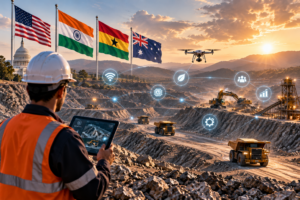
At the heart of this initiative is data—how mines collect it, process it, and act on it in real time.
More Read

- AI-powered digital twins will model entire mine systems to predict equipment wear, optimize energy usage, and prevent accidents.
- Autonomous haulage and drilling systems will reduce workforce risk and improve precision.
- Geospatial analytics and advanced sensors will enable in-situ mineral mapping, minimizing waste and improving recovery rates.
- Sustainable processing technologies, including bio-leaching and closed-loop water systems, will drastically reduce environmental footprints.
Industry observers note that this fusion of AI and geoscience could reduce energy consumption in mining operations by up to 40% and lower greenhouse gas emissions across the sector.
Industry Collaboration: From Labs to the Field
DOE plans to work closely with private partners, universities, and state agencies to fast-track innovation from concept to commercial deployment. Mining giants and technology developers like Caterpillar, Sandvik, and Rio Tinto—already leaders in autonomous mining—are expected to collaborate with DOE test sites to pilot scalable models.
The program will also prioritize workforce development, offering training for “next-generation miners” skilled in robotics, software analytics, and environmental stewardship.
“This isn’t about replacing workers—it’s about retooling America’s mining workforce for a data-driven century,” said an FECM spokesperson.
The Bigger Picture: Mining at the Center of the Energy Transition
As electric vehicles, batteries, and renewable power systems dominate industrial demand, the mining industry sits at the intersection of clean energy and national policy.
By 2035, U.S. demand for battery metals could quadruple. The DOE’s initiative signals a proactive move to ensure that the materials powering the green economy are mined responsibly, domestically, and efficiently.
The “Mine of the Future” program could spark a new era of industrial self-reliance, bringing high-tech jobs to rural mining regions while advancing net-zero carbon goals.
Skillings Analysis: America’s Mining Moment
This initiative represents more than funding—it’s a recalibration of national priorities. The U.S. mining sector, long considered a relic of the past, is being reimagined as a driver of innovation, sustainability, and strategic autonomy.
If executed effectively, the DOE’s “Mine of the Future” could redefine what mining means in the 21st century—an industry that digs deeper not just into the earth, but into data, design, and discipline.
For investors and industry professionals alike, this is a signal:
The future of mining will be written not by shovels, but by sensors, algorithms, and intent.





Interesting read?