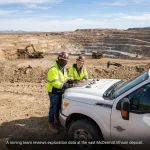
Paladin Energy is moving toward a definitive turning point for its North American ambitions, targeting a Final Investment Decision (FID) by the end of 2027 for the Patterson Lake South (PLS) project in Saskatchewan’s Athabasca Basin. This timeline positions the company to capitalize on a widening global supply-demand gap, fueled by a resurgence in nuclear energy adoption and the structural shift toward carbon-neutral baseload power.

As the industry moves deeper into 2026, the PLS project stands as one of the most significant undeveloped uranium assets globally. Following Paladin’s strategic acquisition of Fission Uranium in late 2024, the company has consolidated its grip on the high-grade Triple R deposit. However, the path to production in 2031 remains paved with both exceptional economic promise and complex regulatory hurdles, including a high-stakes judicial review that tests the limits of provincial consultation frameworks.
The Triple R Deposit: Economics of a Tier-One Asset
The core value proposition of the PLS project lies in the Triple R deposit. According to the most recent feasibility studies, the deposit contains roughly 93.7 million pounds of uranium oxide ($U_3O_8$) in probable reserves, boasting an impressive average grade of 1.41%. What distinguishes Triple R from many of its Athabasca peers is its accessibility; the mineralization begins just 50 meters below the surface, which significantly lowers the technical complexity and initial cost of extraction compared to deeper, unconformity-style deposits.
From an investor perspective, the operating margins are the primary draw. Paladin has projected an operating cash cost of just $11.70 per pound. Even when accounting for all-in sustaining costs (AISC) estimated at $15.20 per pound, the project remains highly resilient to price volatility. With uranium spot prices maintaining strength amid global supply constraints, these margins position PLS in the lowest quartile of the global cost curve.
Key Project Metrics: Patterson Lake South (PLS)
More Read

| Metric | Value |
|---|---|
| Probable Reserves | 93.7 million lb $U_3O_8$ |
| Average Grade | 1.41% $U_3O_8$ |
| Target Annual Production | 9.1 million lb $U_3O_8$ |
| Operating Cash Cost | $11.7/lb |
| AISC | $15.2/lb |
| Pre-production CAPEX | $1.2 Billion |
| Target First Production | 2031 |
Paladin’s strategy involves completing the front-end engineering and design (FEED) study by 2026, which will refine these capital expenditure estimates and solidify the technical path forward before the 2027 FID. This development is part of a broader trend of consolidation and expansion in the sector, as detailed in recent reports on the Skillings Mining Intelligence M&A surge.

Market Context: The Looming Supply Gap
The decision to push toward an FID comes at a time when the fundamental case for uranium has never been stronger. Currently, there are 438 nuclear reactors operating worldwide, with another 79 under construction. The shift toward Small Modular Reactors (SMRs) is further accelerating demand, particularly for remote industrial applications and decentralized grids.

Caption: Advanced mineral processing units at sunrise represent the next generation of efficient, high-grade uranium extraction technology.
More Read

The “supply gap” is no longer a theoretical forecast; it is a present reality for utilities seeking long-term contracts. Traditional production from Kazakhstan and existing mines in Africa cannot alone meet the projected demand for the 2030s. Paladin’s move to diversify its production base: moving beyond its flagship Langer Heinrich mine in Namibia: is a calculated hedge against jurisdictional risk and a play for high-grade Canadian pounds that command a premium in Western markets.
Geopolitical and Regulatory Risks: The Judicial Review
Despite the project’s robust economics, Paladin faces a significant regulatory challenge in Saskatchewan. On March 31, 2025, the Métis Nation–Saskatchewan (MN–S) filed a judicial review challenging the provincial environmental approval granted to the PLS project. The filing alleges that the provincial government failed in its duty to consult and accommodate the Métis community adequately before greenlighting the development.
Paladin has stated its intention to defend its position in the Saskatchewan Court of King’s Bench, maintaining that the consultation process was thorough and met all statutory requirements. For investors, this judicial review represents the primary “above-ground” risk for the project. While the company remains confident, a protracted legal battle could potentially shift the 2027 FID timeline or impose additional “social license” costs that were not initially factored into the AISC.
This situation highlights a growing trend in the mining industry where geopolitical and community risks often outweigh geological risks. The outcome of this review will likely set a precedent for other major developments in the Athabasca Basin.
Competitive Landscape: How PLS Compares to Peers
The Patterson Lake corridor has become the most watched exploration and development district in the uranium world. Paladin is not alone in its quest to bring high-grade Saskatchewan ore to market. To understand the 2027 FID significance, one must look at how PLS stacks up against its immediate neighbors: NexGen Energy’s Rook I and Denison Mines’ Wheeler River.
- NexGen Energy (Rook I): Located adjacent to PLS, the Rook I project is often considered the “gold standard” of the basin due to its massive Arrow deposit. NexGen is further along in the permitting process, but Paladin’s PLS offers a comparable grade profile with a potentially simpler open-pit or shallow underground mining method at the start, whereas Arrow is a larger, deeper underground undertaking.
- Denison Mines (Wheeler River): Denison is pioneering the use of In-Situ Recovery (ISR) mining in the Athabasca, which offers significantly lower CAPEX than traditional methods. While Denison may beat Paladin to first production, Paladin’s conventional mining approach at PLS is viewed by some as a lower-risk technical execution in the specific rock conditions of the Patterson Lake corridor.
The race for the “next big mine” in the Athabasca is essential for global energy security. As the U.S. and Europe look to decouple from Russian nuclear fuel supply chains, projects like PLS are increasingly viewed through a lens of strategic necessity rather than just commercial viability.
The Path to 2027: Milestones to Watch
Between now and the year-end 2027 FID, several critical milestones will dictate Paladin’s success:
- FEED Study Completion (2026): This will provide the finalized engineering blueprints and a “bankable” capital cost estimate.
- CNSC Construction Licence: Navigating the Canadian Nuclear Safety Commission’s rigorous licensing process is the final regulatory hurdle after the provincial judicial review is settled.
- Expansion Drilling: Paladin continues to explore the Patterson Lake corridor, seeking to extend the life of the Triple R deposit or discover satellite zones that could further enhance project economics.

Caption: Mining professionals collaborate at a site briefing, emphasizing the strategic importance of domestic uranium supply chains.
Strategic Outlook: A Diversified Paladin
The 2027 decision on Patterson Lake South will ultimately transform Paladin Energy from a single-asset producer in Namibia to a multi-jurisdictional major. This diversification is critical. While Langer Heinrich provides steady cash flow, the high-grade nature of the Athabasca Basin provides the “torque” that investors seek in a rising uranium price environment.
The transition to a production-heavy portfolio comes at a time when the mining industry is grappling with rising costs and the need for innovation. Similar to how OEM parts optimize performance in heavy machinery, Paladin is looking to optimize its project pipeline by integrating Fission’s technical data into its global operational framework.
Summary
The Patterson Lake South project represents a high-conviction bet on the future of nuclear energy. With a targeted FID in 2027 and production in 2031, Paladin Energy is positioning itself to be a cornerstone supplier for the next generation of reactors. While the judicial review by the Métis Nation–Saskatchewan introduces a layer of uncertainty, the underlying deposit economics: characterized by a $15.20/lb AISC and near-surface high-grade ore: remain some of the most compelling in the mining industry today.
For operators and investors, the next 18 months of engineering studies and legal proceedings will define whether PLS becomes the Athabasca’s next great success story or a cautionary tale of regulatory complexity.