By Charles Pitts

The global energy transition is a geology problem. Period.
For the last decade, Western policymakers have been screaming about “de-risking” and “de-coupling” from the Chinese rare earth supply chain. They’ve written the checks. They’ve held the summits. They’ve issued the press releases. But here is the uncomfortable truth as we navigate 2026: You can’t legislatively override a billion years of tectonic activity.
The map of the world’s largest rare earth mines has shifted, sure. We have new players in Texas, expanded pits in California, and a desperate scramble for projects in the Arctic. But the center of gravity remains stubbornly fixed. In 2026, global production is hitting roughly 390,000 tonnes, and while the “China-plus-one” strategy is finally showing teeth, the “plus-one” part is still doing a lot of heavy lifting.
If you’re looking for a comfortable narrative about Western independence, look elsewhere. If you want the brutal numbers on where the magnets for your EV motors and defense systems actually come from, let’s look at the map.
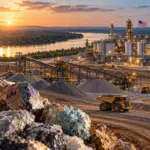
Bayan Obo (China): Still the Sun in the Solar System
Bayan Obo is not just a mine. It’s a geopolitical leverage point masquerading as a hole in the ground. Located in Inner Mongolia, this site remains the largest rare earth deposit on the planet by an order of magnitude.

In 2026, Bayan Obo continues to account for nearly half of all global rare earth production. It’s a massive polymetallic operation where rare earths are essentially a byproduct of iron ore mining. This gives China a cost advantage that is mathematically impossible for Western mines to match. They aren’t just digging; they’re dominating the economics of the entire periodic table.

More Read

The strategic calculus here isn’t subtle: China has integrated the upstream (mining) with the downstream (processing). While the rest of the world celebrates opening a new pit, the Baogang Group at Bayan Obo is already miles ahead in separation and metal making. That’s not a rounding error. That’s a stranglehold.
Mountain Pass (USA): The Resurgent Anchor
If Bayan Obo is the king, Mountain Pass is the challenger that refused to stay dead. Located in San Bernardino County, California, this mine has become the poster child for the American critical minerals resurrection.
By 2026, MP Materials has moved well beyond just shipping “bastnasite” concentrate to China. The facility has successfully scaled its Stage II separation capabilities and Stage III magnet production. It is the only fully integrated rare earth mining and processing site in North America.
Mountain Pass is currently hammering out approximately 42,000 tonnes of rare earth oxide equivalent annually. That’s a significant chunk of the global market. But there’s a catch. Mountain Pass is primarily a source of “light” rare earths: specifically Neodymium and Praseodymium (NdPr). While these are essential for permanent magnets, the mine lacks the “heavy” rare earths like Dysprosium and Terbium that keep those magnets from demagnetizing at high temperatures.
For those heavier elements, the U.S. is still looking elsewhere. This is why industry conferences flag a critical moment for mining’s transformation; the industry has realized that mining the rock is the easy part. Separating it is where the war is won or lost.
Mount Weld (Australia): The Strategic Pivot
Halfway across the world in Western Australia, Lynas Rare Earths continues to operate Mount Weld. It is widely considered the highest-grade rare earth deposit currently in production.
In 2026, Mount Weld is more important than ever. Following the expansion of its Kalgoorlie processing plant and the operational maturity of its Texas-based separation facility (built in partnership with the DoD), Lynas has become the indispensable alternative to Chinese supply.
Mount Weld’s ore is clean, high-grade, and: crucially: outside of China’s direct influence. However, Australia faces its own set of “nasty” ESG and regulatory hurdles that make expansion a slow, painful process. It’s a recurring theme: the deposits exist, but the “Permitting-to-Production” pipeline is a needle that’s almost impossible to thread quickly.
Round Top (Texas): The Heavy Hitter
The most significant shift in the 2026 map isn’t a massive expansion of an old mine, but the emergence of the Round Top project in Hudspeth County, Texas. This is the project the defense industry has been waiting for.
Unlike Mountain Pass, Round Top is rich in “heavy” rare earths. It’s a rhyolite-hosted deposit, which means the grades are lower than Mount Weld, but the sheer volume and the diversity of the mineral suite are staggering. We’re talking about 15 of the 17 rare earth elements, plus lithium, gallium, and beryllium.

Round Top represents the strengthening of the North American critical minerals corridor. It’s not just about volume; it’s about the specific “flavors” of rare earths that are required for high-tech guidance systems and advanced robotics. If Mountain Pass is the bread and butter of the US supply chain, Round Top is the specialized medicine.
The Greenland and Nordic Question
We can’t talk about the 2026 map without looking North. For years, Greenland was touted as the next frontier for rare earth mining. The Kvanefjeld and Tanbreez projects promised to dwarf almost everything outside of China.
But as of 2026, Greenland’s mining industry continues to struggle to take off. Political shifts, uranium bans, and the brutal reality of Arctic logistics have turned what looked like a “sure thing” into a cautionary tale. You can have the best geology in the world, but if you can’t get a social license or a shipping lane, the minerals might as well be on the moon.
Meanwhile, Sweden’s Per Geijer deposit near Kiruna is finally moving toward feasibility. It’s hailed as a linchpin for Europe’s green transition, but even with the EU’s “Critical Raw Materials Act” providing a tailwind, production is still years away. The Europeans are discovering what the Americans learned at Mountain Pass: mining is a game of decades, not fiscal quarters.
The Shifting Production Landscape: 2026 Metrics
To understand the scale of the “Global Map,” you need to look at the numbers. Total world production is up, but the concentration remains alarming.
| Mine/Region | 2026 Estimated Output (tonnes REO) | Primary Type |
|---|---|---|
| Bayan Obo (China) | 185,000 | Mixed (Light/Heavy) |
| Mountain Pass (USA) | 42,000 | Light |
| Mount Weld (Australia) | 25,000 | Light/Medium |
| Myanmar (Adsorption Clays) | 35,000 | Heavy |
| Round Top (USA) | 3,000 (Ramping) | Heavy/Mixed |
| Rest of World (Brazil, SE Asia) | 100,000 | Various |
Note: Myanmar remains a “black box” of production, often serving as a proxy for Chinese interests, despite ongoing regional instability.
The “Nasty” Reality of Processing
Here’s the kicker: Mining the ore is only 20% of the battle. The real “map” that matters is the map of separation plants.
As of 2026, China still controls roughly 90% of the world’s rare earth refining capacity. You can dig up all the rock you want in Australia or Texas, but if you have to ship it to Baotou or Ganzhou to turn it into a usable oxide, you haven’t actually de-risked anything. You’ve just added a shipping cost to your dependency.
We are seeing the first real attempts to break this cycle. The Lynas plant in Texas and MP Materials’ downstream integration are starts. But building a chemical separation plant is a nasty, complex, and environmentally sensitive endeavor.

Conclusion: The Map is Written in Stone (Literally)
So, where does that leave us in 2026?
The map has more dots on it than it did in 2020. That’s progress. We have a domestic U.S. supply chain that is finally functional. We have an Australian powerhouse that is expanding into global processing. We have “heavy” rare earth projects in Texas and discoveries in Sweden that offer a glimmer of hope.
But don’t let the shiny AI-driven demand forecasts fool you. China’s “stranglehold” isn’t a result of luck; it’s a result of forty years of consistent industrial policy. While the West was focused on the “service economy,” China was focusing on the “periodic table economy.”
2026 marks the inflection point where the West has finally stopped talking and started digging. But geology is a patient master. Those two clocks: the clock of political urgency and the clock of geological development: do not sync. There is not enough to go around, and for the next five years, the largest mines on this map will continue to dictate the terms of the global energy transition.
Welcome to the new reality. It’s dusty, it’s expensive, and it’s buried in the ground.