By Penny Langford

The high-altitude deserts of the Andes, straddling the border between Chile and Argentina, have long been the backbone of global copper supply. However, a new geological frontier known as the Vicuña District is rapidly emerging as the industry’s next "super-cluster." At the center of this transformation is Lundin Mining, which recently finalized a US$215 million transaction to consolidate its footprint in the region.
This strategic maneuver is not merely a play for volume; it is a calculated bet on the copper price forecast 2026, where structural deficits are expected to drive valuations to new heights. By increasing its stake in the operating Caserones mine and securing a significant interest in the Los Helados project, Lundin Mining is positioning itself as the dominant operator in a district that could eventually rival the legendary porphyry belts of northern Chile.
The $215 Million Transaction: Consolidating the Base
In a move that underscores the accelerating pace of mining M&A deals 2026, Lundin Mining agreed to pay US$215 million (approximately C$292 million) to increase its exposure to the Vicuña District. The deal, completed with JX Advanced Metals, is twofold. First, Lundin is acquiring an additional 5% stake in SCM Minera Lumina Copper Chile, the owner of the Caserones copper-gold mine. This brings Lundin’s majority ownership to 56%, further solidifying its operational control over one of the region’s most consistent producers.
Second, and perhaps more significantly for long-term growth, the transaction includes a 30.9% interest in the Los Helados copper-gold project. Located in the heart of the Vicuña District, Los Helados is a massive porphyry deposit that sits in close proximity to Lundin’s other flagship assets, Filo del Sol and Josemaria.

The rationale behind the US$215 million price tag is clear: Caserones provides the immediate cash flow and operational infrastructure, while Los Helados offers the "blue sky" potential required to sustain a multi-decade production profile. As the industry looks toward the late 2020s, the ability to leverage existing infrastructure at Caserones for nearby exploration targets is a significant de-risking factor.


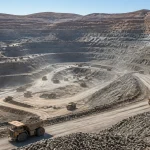
Operational infrastructure in high-altitude mining environments requires significant capital investment and logistical precision.
Creating the Vicuña Copper Cluster
The Vicuña District is unique because it represents a rare "blind" discovery: a massive mineralized system that does not outcrop on the surface in a traditional way. It is a series of giant porphyry copper-gold-silver deposits including Josemaria, Filo del Sol, Los Helados, and Lunahuasi.

Lundin Mining’s strategy is built on the concept of a "cluster." Rather than developing these assets as isolated mines, the company: often in partnership with majors like BHP: is looking at a district-wide development plan. Earlier in 2026, Lundin and BHP formed a 50/50 joint venture, Vicuña Corp., to advance the Filo del Sol and Josemaria projects. A Technical Report filed in March 2026 outlined a US$9.5 billion development concept for this combined venture, emphasizing the sheer scale of the hardware and capital required.
By adding Los Helados to this mix, Lundin is effectively surrounding the core of the district. The synergy between these assets is expected to reduce the "cost per pound" through shared power lines, water pipelines, and transport corridors. This cluster-based approach is a hallmark of modern mining M&A deals 2026, where companies prioritize regional dominance to manage the rising costs of remote operations.
Copper Price Forecast 2026: The Economic Engine
The timing of Lundin’s expansion is tethered to a bullish copper price forecast 2026. Industry analysts and financial institutions have pointed to a "perfect storm" of supply constraints and demand surges that are expected to hit a critical juncture within the next 24 months.
- Supply Deficits: Traditional Chilean mines are facing declining ore grades and water scarcity. Furthermore, the lack of Tier-1 discoveries over the last decade means that very few new "mega-mines" are ready to come online.
- Energy Transition: The electrification of the global economy, from EV batteries to massive grid upgrades, continues to consume copper at rates that exceed current mine production growth.
- Inflationary Pressures: While capital expenditures for projects like the Vicuña complex are high, the expected price floor for copper is also rising.
Most pre-2026 projections suggested average copper prices in the range of US$4.50 to US$5.50 per pound. However, with the current pace of M&A and the slow permitting processes globally, some "bull case" scenarios now see the potential for spikes toward US$6.00/lb by the end of 2026. For an operator like Lundin, which reported a Q1 2026 revenue of US$1.16 billion and free cash flow of US$380 million, these price levels turn the Vicuña District from a high-risk exploration play into a generational profit machine.

Exploration and development at Los Helados and Filo del Sol involve advanced deep-drilling technology to delineate the extent of the porphyry systems.
Geopolitical Dynamics: Argentina’s Rising Star
While Caserones and Los Helados are on the Chilean side of the border, the broader Vicuña District relies heavily on the opening of the Argentine mining sector. The Josemaria project is located in San Juan Province, Argentina, a jurisdiction that has become increasingly attractive to foreign investors.
The RIGI (Incentive Regime for Large Investments) framework in Argentina has played a pivotal role in de-risking the multibillion-dollar investments required for the Vicuña cluster. By providing tax stability and eased capital controls, Argentina is positioning itself as a more competitive alternative to the increasingly complex regulatory environment in Chile. Lundin’s ability to operate seamlessly across this border: essentially treating the district as a single geological unit: is a major competitive advantage.
This cross-border integration is also a key theme in Skillings’ analysis of the 2026 P-NAV gap, where the valuation of copper assets is increasingly tied to their geopolitical security and infrastructure access.
The Broader Context of Mining M&A Deals 2026
Lundin Mining’s US$215 million deal is part of a wider trend of consolidation in the copper sector. We are seeing a shift away from "hostile" takeovers of entire companies toward "surgical" acquisitions of minority stakes and joint ventures. This allows majors and mid-tiers to share the massive capital requirements (CapEx) of new projects while still gaining the necessary exposure to the metal.
Other notable mining M&A deals 2026 have followed this pattern, with companies like Rio Tinto and Glencore seeking out partnerships in the Central African Copperbelt and the American Southwest. The Lundin-BHP partnership in the Vicuña District is perhaps the most significant example of this "mega-JV" trend. It combines Lundin’s entrepreneurial agility and district knowledge with BHP’s balance sheet and experience in large-scale logistics.

Modern mining control rooms integrate real-time data to optimize haulage and processing efficiency, critical for maintaining low cash costs in large districts.
Looking Ahead: The Path to Top-Ten Global Status
Lundin Mining has stated its ambition to become a top-ten global copper producer. To achieve this, the company must execute flawlessly on the Vicuña development timeline. With the expansion of its unsecured revolving credit facility to US$4.5 billion, the financial runway is in place.
The integration of Caserones, Los Helados, Filo del Sol, and Josemaria creates a production profile that could eventually exceed 500,000 tonnes of copper equivalent per year. In a world starved for "green metals," such a profile would make Lundin an indispensable player in the global supply chain.
As we move through 2026, the industry will be watching the Vicuña District closely. If Lundin can prove that these high-altitude giants can be developed efficiently and sustainably, it will set a new blueprint for the future of Andean mining.
For more insights on the evolving copper landscape and the financial frameworks supporting these massive projects, explore our analysis on royalty revolutions and the latest gold price forecast 2026 affecting poly-metallic deposits.
LinkedIn Social Media Snippet
Lundin Mining is doubling down on the Andes. With a fresh US$215 million deal, the company has increased its stake in the Caserones mine and secured a major interest in the Los Helados project. This isn't just an acquisition; it’s the consolidation of the Vicuña District: the industry's next copper "super-cluster."
As the copper price forecast for 2026 points toward a structural supply deficit, Lundin is positioning itself to be a top-ten global producer. By partnering with BHP and leveraging the new pro-investment climate in Argentina, the "Vicuña Cluster" is set to become a generational asset for the energy transition.
Read the full analysis on the strategic importance of the Vicuña District: [Link] #Mining #Copper #M&A #LundinMining #EnergyTransition #VicuñaDistrict