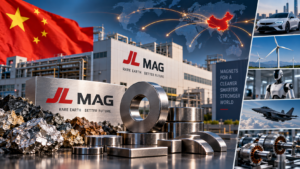
In the escalating standoff between Washington and Beijing, China has chosen its most strategic pressure point: rare earth minerals. This month, the Chinese government announced new export controls on seven rare earth minerals critical to both civilian industries and national defense systems in the United States. While obscure to most consumers, these elements are essential to technologies ranging from MRI scanners and wind turbines to fighter jets and precision missiles.

With China controlling the majority of global refining capacity for these minerals, the move is more than symbolic. It is a calculated act of economic statecraft, turning supply chain dominance into geopolitical leverage.
What Are the Seven Rare Earth Minerals?
The seven rare earth minerals now restricted by China are:
- Terbium
- Yttrium
- Dysprosium
- Gadolinium
- Lutetium
- Samarium
- Scandium
Each serves a specific, high-value role in the U.S. economy—and many are classified as “critical minerals” by the Department of Defense.
1. Terbium: For Defense and Display Technologies
Used in high-performance magnets, terbium is crucial for military applications including missiles, submarines, and aircraft. It also enhances the brightness of smartphone screens and energy-efficient lighting. According to the U.S. Department of Defense, terbium is one of the hardest elements to secure, making up less than 1% of total rare earth content in typical ore deposits.

China currently exports 85% of its terbium to Japan and only 5% to the U.S., highlighting America’s acute supply risk.

2. Yttrium: Medical Lasers and Superconductors
Yttrium is widely used in cancer treatments, medical lasers, and high-temperature superconductors. It also improves the strength of metal alloys, making it indispensable to aerospace and energy sectors. Although found in California’s Mountain Pass mine, the U.S. lacks domestic processing capacity and imported 93% of its yttrium compounds from China between 2020 and 2023.
3. Dysprosium: Powering the Clean Energy Transition
Dysprosium strengthens magnets used in electric vehicle motors and wind turbines—technologies vital to decarbonization. The metal also appears in nuclear reactor control rods due to its neutron-absorbing properties. China sends the bulk of its dysprosium to Japan and South Korea. The U.S. receives just 0.1% of Chinese exports.
More Read

Lynas Rare Earths, based in Australia, is expanding its Malaysian plant to process terbium and dysprosium, but new capacity won’t come online until mid-2025.
4. Gadolinium: Medical Imaging and Nuclear Applications
Best known for enhancing MRI scan clarity, gadolinium also strengthens industrial alloys and is a neutron absorber used in nuclear reactor cores. Its use straddles civilian medicine and military-grade materials—making its supply politically sensitive.
5. Lutetium: Oil Refining’s Hidden Catalyst
Lutetium, one of the densest and least abundant rare earth elements, is used primarily as a chemical catalyst in oil refining. The U.S. imports virtually all of its lutetium from China, leaving domestic refiners exposed as trade tensions flare.
6. Samarium: From Smart Weapons to Satellites
Samarium is the key ingredient in samarium-cobalt magnets, which retain magnetism at high temperatures—a requirement for many aerospace and defense applications. It also appears in lasers and nuclear reactors. The Pentagon has flagged samarium for potential strategic stockpiling.
7. Scandium: Lightweight Strength for Aerospace
Scandium is used in fighter jet components, aluminum alloys, and as a radioactive tracer in oil and gas pipelines. The U.S. hasn’t produced scandium in over 50 years. As of now, China supplies a large portion of global scandium exports—with the U.S. and Japan as major buyers.
Why Now? The Strategic Timing Behind Export Controls
China’s move follows a new round of U.S. tariffs on Chinese imports. By targeting minerals vital to American industry—but too niche to immediately disrupt Chinese supply chains—Beijing is asserting its dominance without overplaying its hand.
“These minerals are dual-use, so by restricting them, China is asserting control over both economic and national security levers,” said David Merriman, research director at Project Blue. “It also sends a strong message to countries trying to decouple from Chinese supply chains.”
A Cautionary Exclusion: Neodymium and Praseodymium
Notably, neodymium and praseodymium, which are widely used in EV motors and wind turbines, were left off the list. Analysts say Beijing is keeping its most powerful cards close, preserving stability in the broader rare earth market—at least for now.
The U.S. Response: Playing Catch-Up
Despite years of warnings from industry and national security officials, the U.S. remains ill-prepared to offset these restrictions. Mountain Pass remains the only operating rare earth mine in the U.S., and its refining capability is limited. Federal efforts to rebuild a domestic supply chain have been slow-moving, hampered by permitting delays and cost hurdles.
Meanwhile, allied countries like Australia and Canada are ramping up production, but will need years—and significant capital—to become viable alternatives.
Minerals as Leverage
The seven rare earth minerals at the heart of China’s export controls reveal more than just the fragility of U.S. supply chains—they underscore how far Beijing is willing to go to assert influence in a new era of resource-based diplomacy.
If rare earths were once the invisible force behind modern technology, they are now at the center of one of the most visible power struggles in global trade.