By Charles Pitts

The global mining industry has moved beyond the pilot phase of automation. In 2026, Autonomous Haulage Systems (AHS) are no longer a “future technology” reserved for experimental sites; they are the baseline for Tier-1 competitiveness. As operational costs fluctuate and the push for decarbonization intensifies, the financial case for autonomy has shifted from simple labor savings to a complex, multi-layered Return on Investment (ROI) model.
Current data from the Pilbara, the Atacama, and the Canadian oil sands suggests that AHS-enabled sites are outperforming manual operations across every key metric, including productivity, maintenance cycles, and fuel efficiency. For operators and investors, understanding the specific ROI drivers: and how they differ between traditional diesel and emerging electric fleets: is essential for navigating the next decade of mineral extraction.
Productivity Gains: The 24/7 Operational Reality
The primary driver of ROI in autonomous operations remains the dramatic uplift in equipment utilization. Conventional manned fleets are subject to shift changes, meal breaks, and human fatigue: variables that typically result in several hours of downtime per truck every day.
In contrast, Tier-1 operators like Rio Tinto and BHP are reporting that autonomous trucks are running approximately 700 extra hours per year compared to their manned counterparts. This 15–20% increase in annual operating hours allows companies to move significantly more material with the same number of assets.
More Read



Case Study: Pilbara Iron Ore Operations
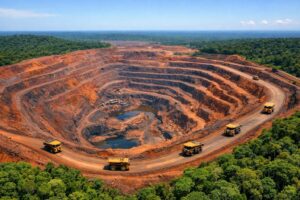
In the Pilbara region of Western Australia, Komatsu AHS deployments have consistently delivered productivity gains of up to 34% compared to conventional haulage. Rio Tinto, an early adopter of the technology, has reported a 37% increase in per-person productivity across its autonomous hubs.
These gains are not solely a result of “always-on” operation. AHS provides a level of consistency that human operators cannot match. Autonomous trucks follow optimized haul paths with surgical precision, maintaining constant speeds and ideal spacing. This reduces traffic congestion and “wait-at-loader” times, creating a steady, predictable flow of material that maximizes the throughput of the primary crusher.
More Read
Maintenance Savings: The Hidden Value of Precision
While productivity often takes the spotlight, the impact of autonomy on maintenance budgets is proving to be a critical component of the 2026 ROI story. High-fidelity telemetry and the removal of human driving variability have extended the life of high-wear components and reduced unplanned downtime.
Reduced Wear and Tear
Autonomous systems eliminate “aggressive” driving behaviors such as harsh braking, over-speeding on declines, and jerky steering. By operating within strict mechanical parameters, AHS-enabled fleets experience:
- 10–15% extension in tire life: Precision steering and speed control prevent excessive heat buildup and sidewall damage.
- Reduced drivetrain stress: Smooth acceleration and braking profiles reduce the frequency of transmission and engine overhauls.
- Lower brake maintenance: Optimized retarder usage on descents preserves braking systems.

Predictive Maintenance Integration
Autonomous trucks are essentially mobile data centers. In 2026, the integration of AHS with AI-driven predictive maintenance platforms allows teams to identify potential failures before they occur. Sensor data: ranging from oil temperature to vibration analysis: is transmitted in real-time to centralized control rooms. This shift from “run-to-fail” or “fixed-interval” maintenance to “condition-based” maintenance is helping Tier-1 operations reduce their load-and-haul maintenance costs by an estimated 15-20%.
For a deep dive into how these technological shifts are impacting broader project economics, see our analysis on mine electrification and 2026 ROI.
Diesel Displacement and Fuel Efficiency
Fuel remains one of the largest Opex items for any open-pit mine. Autonomous fleets offer a dual benefit: they reduce the fuel consumed per tonne hauled and significantly decrease total idle time.
Data from recent operations indicates that autonomous diesel trucks reduce idle time by 25–50%. When a manned truck waits at a shovel or a dump point, the engine often remains running. AHS optimizes these cycles to ensure trucks arrive exactly when the shovel is ready, or it manages engine states more efficiently during unavoidable delays.

On a per-tonne basis, autonomous diesel fleets are achieving a 4% improvement in fuel economy. While this may seem modest, across a fleet of 50 to 100 ultra-class trucks, the cumulative savings represent millions of dollars in annual fuel costs and a measurable reduction in the operation’s carbon footprint.
Comparison: Diesel vs. Electric Autonomous Fleets
As we move through 2026, the industry is witnessing the first true comparison between diesel-autonomous and electric-autonomous (BEV) fleets. While diesel AHS focuses on efficiency, electric AHS focuses on total energy transformation.
| Metric | Diesel Autonomous (2026) | Electric Autonomous (2026) |
|---|---|---|
| Energy Cost | High (Subject to market volatility) | Low (Site-generated renewables) |
| CO2 Emissions | Moderate (Reduced via efficiency) | Near Zero (Scope 1) |
| Maintenance | High (Internal combustion complexity) | Low (Fewer moving parts) |
| Infrastructure | Standard (Fuel farms) | High (Charging/Trolley/Grid) |
| Payback Period | 2–4 Years | 5–8 Years (Estimated) |
The ROI for electric autonomous fleets is currently driven by “Diesel Displacement”: the complete removal of liquid fuel costs. However, the capital expenditure (Capex) for electric infrastructure, such as high-power charging stations and grid upgrades, is significantly higher.
Operators are increasingly looking at Zijin Mining’s electric fleet updates as a benchmark for how to balance the high initial investment with the long-term Opex benefits of zero-fuel operations.

The 2026 ROI Outlook: A Strategic Necessity
For Tier-1 operations, the decision to implement AHS is no longer just about the “next quarterly report.” It is a strategic necessity for maintaining a position on the lower half of the cost curve. The cumulative effect of a 30% reduction in load-and-haul costs, a 34% increase in productivity, and extended equipment life provides a massive competitive advantage during commodity price downturns.
As the industry transitions toward more remote and autonomous mining, the focus is shifting toward “System-Wide Autonomy”: integrating autonomous haulage with autonomous drilling, blasting, and processing.
The “Autonomous Edge” in 2026 is defined by those who can successfully integrate these disparate data streams into a single, cohesive ROI model. For investors, the presence of a mature AHS program is increasingly viewed as a proxy for operational excellence and a derisking factor for long-life assets.