By Charles Pitts

The global copper market entered 2026 facing a fundamental shift in its demand curve, one that has decoupled the red metal from its traditional role as a mere barometer of construction and manufacturing health. In January 2026, London Metal Exchange (LME) cash copper touched an all-time peak of $14,527 per tonne, a figure that many analysts initially dismissed as a speculative spike. However, as the mid-year point approaches, a consensus is forming among mining executives, institutional investors, and digital infrastructure planners: $15,000/t is no longer an outlier: it is the functional price floor required to sustain the artificial intelligence (AI) revolution.
This structural “squeeze” is driven by the unprecedented, inelastic demand for power and cooling infrastructure within AI-centric data centers. Unlike traditional cloud facilities, AI training centers are high-density environments where the requirement for copper: the literal nervous system of the digital age: has tripled.
The Inelasticity of AI Infrastructure
In the world of commodity markets, “inelastic demand” refers to a scenario where price increases have little to no impact on the quantity consumed. AI infrastructure is emerging as the ultimate example of this phenomenon.
When a technology giant commits $10 billion to a single data center project: roughly 80% of which is allocated to high-performance GPUs and specialized networking hardware: the cost of the copper wiring becomes a negligible fraction of the total capital expenditure (CAPEX). Even as copper prices surged 50% year-on-year, the decision to halt or scale back these projects is non-existent. The strategic race for AI supremacy dictates that these facilities must be built, regardless of whether copper trades at $9,000/t or $15,000/t.
More Read

According to current estimates, a single large-scale AI training facility can require up to 50,000 tonnes of copper. This is roughly 3–4 times the intensity of a conventional data center. This surge is not limited to the server racks themselves; it extends to the specialized transformers, high-capacity busbars, and the extensive grid upgrades necessary to feed these power-hungry “compute farms.”


The 2026 Deficit: Navigating the “Copper Cliff”
The supply-side response to this demand has been characterized by chronic underinvestment and operational hurdles. As noted in recent analysis on copper demand and data centers, the reversal of key mining permits and the exhaustion of brownfield expansions have created a “Copper Cliff.”
More Read
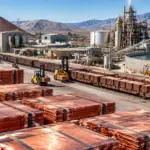
The International Copper Study Group (ICSG) currently projects a 150,000-tonne refined copper deficit for 2026. J.P. Morgan’s outlook is even more constrained, estimating a shortfall of 330,000 tonnes. This deficit is emerging at a time when the secondary supply: recycling: is failing to bridge the gap, as much of the copper currently in the system is “trapped” in long-life infrastructure that is not due for decommissioning for decades.
| Institution | 2026 Deficit Projection (Tonnes) | 2026 Price Target (Base Case) |
|---|---|---|
| ICSG | 150,000 | N/A |
| J.P. Morgan | 330,000 | $12,500/t |
| Goldman Sachs | 210,000 | $11,500/t |
| Citi | 280,000 | $15,000/t |
The Incentive Price and the $15,000 Threshold
Mining veteran Robert Friedland has long argued that the industry requires a stable price of $15,000/t to justify the astronomical costs and decade-long timelines of building “mega-mines.” Traditional large-scale projects now cost between $5 billion and $20 billion to bring online. At $9,000/t, the internal rate of return (IRR) for many of these projects fails to meet the hurdle rate for major institutional financiers.
Consequently, $15,000/t is becoming a self-fulfilling prophecy. If the market does not sustain this price level, the supply needed to power the 2030 AI roadmap simply will not exist. We are seeing a shift where investors are prioritizing quality juniors and project valuations that can demonstrate a clear path to production within this high-price environment.

Grid Modernization: The Second Front
While data centers are the primary catalyst, the modernization of the global electrical grid acts as a massive secondary driver. China’s reported $500 billion annual spend on grid upgrades, alongside the U.S. and European push for energy transition, has created a permanent baseline of demand.
As AI facilities increasingly look to co-locate with reliable power sources: including Small Modular Reactors (SMRs): the complexity and copper-intensity of these connections grow. The interplay between uranium demand for AI power and the copper needed to transmit that power is a critical pillar of the current market structure.
Supply Constraints: The “Invisible Mine” and Permitting Bottlenecks
The difficulty in bringing new supply to market is not just a matter of geology; it is a matter of geography and regulation. From the “Minnesota Shield” permitting debates to the logistical challenges of the Lobito Corridor in Africa, the path to new copper is fraught with friction.
Strategic partnerships, such as the Anglo American and Codelco “Invisible Mine” initiative, aim to unlock additional tonnage through technological efficiency rather than new excavations. However, these innovations take years to scale, leaving the 2026–2028 window vulnerable to extreme price volatility and the potential for $15,000/t to become the new baseline for industrial planning.

2026 Outlook: Bull vs. Bear Case
In a bull case, continued algorithmic trading momentum and a faster-than-expected rollout of AI hardware push copper past the $16,000/t mark by Q4 2026. In this scenario, demand remains entirely unresponsive to price, and supply remains hampered by labor strikes and geopolitical disruptions in key producing regions like Peru and Chile.
In a bear case (or “stabilization” case), a broader global economic slowdown might dampen traditional construction demand, offsetting some of the AI growth. In this scenario, copper could retraced to the $10,000–$11,500/t range. However, the “AI floor” suggests that the sub-$8,000 prices of the early 2020s are a relic of the past.
Conclusion: A Structural Reset
The “AI Copper Squeeze” represents more than a cyclical rally; it is a structural reset of the copper market’s floor. As the backbone of data center infrastructure and the wider energy transition, copper has attained a strategic status that transcends its historical industrial use. For operators and investors, the current environment demands a focus on secure, long-term supply chains and a recognition that the cost of power and connectivity is fundamentally tied to the price of the red metal.