By Charles Pitts

PERTH, Australia : St George Mining (ASX: SGQ) has reported a record-breaking rare earth intercept at its flagship Araxá Project in Minas Gerais, Brazil, underscoring the site’s potential to become a significant contributor to the global rare earths supply chain 2026. The latest assay results from diamond drill hole AXDD086 returned a massive 178.7-meter intercept from surface, grading 4.34% Total Rare Earth Oxides (TREO) and 0.75% Niobium (Nb₂O₅).
The results represent the best intercept to date for the Perth-based explorer, confirming the presence of high-grade mineralization that remains open at depth. As the industry looks toward a more diversified mining news landscape in 2026, the Araxá Project is emerging as a critical western-aligned source of magnet rare earths and niobium, located within a world-class mining jurisdiction.
Technical Analysis: Breaking Down the Record Intercept
The flagship intercept in hole AXDD086 is characterized by its high-grade continuity and the presence of significant high-value magnet rare earth oxides (NdPr). Within the broader 178.7-meter interval, several ultra-high-grade zones were identified, including:
- 55.7m at 6.16% TREO and 0.95% Nb₂O₅ from 14 meters.
- 3.15m at 12.27% TREO and 1.61% Nb₂O₅ from 8.05 meters.
A second notable hole, AXDD092, further validated the scale of the deposit, returning 165.3 meters at 4.28% TREO and 0.61% Nb₂O₅ from surface. This included a high-grade core of 110.5 meters at 5.29% TREO and 0.75% Nb₂O₅ from 32 meters.
More Read

These intercepts are part of a broader carbonatite-hosted system, a geological setting shared by some of the world’s most significant rare earth mines, including Mountain Pass in the United States and Mt Weld in Australia. The fact that mineralization starts from the surface is a critical operational advantage, potentially allowing for low strip ratios and simplified open-pit mining methods.


Strategic Positioning in a Tier-1 Hub
The Araxá Project is located in a pre-eminent mining hub in Minas Gerais, directly adjacent to CBMM’s world-leading niobium operation and Mosaic’s massive phosphate mine. This proximity provides St George Mining with access to established infrastructure, including power, water, and road networks, as well as a highly skilled local mining workforce.
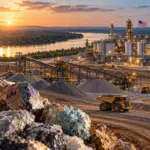
Brazil has moved aggressively to position itself as a reliable alternative to traditional supply chains. With rare earth reserves estimated at 11 million tonnes, the country is becoming a focal point for Western investors seeking to mitigate geopolitical risks. The Araxá Project’s location in a mature industrial zone significantly de-risks the development timeline as the company moves toward feasibility studies.
Table: Key Drill Results from the 2026 Exploration Program
| Hole ID | From (m) | To (m) | Width (m) | TREO (%) | Nb₂O₅ (%) |
|---|---|---|---|---|---|
| AXDD086 | 0.0 | 178.7 | 178.7 | 4.34 | 0.75 |
| including | 14.0 | 69.7 | 55.7 | 6.16 | 0.95 |
| AXDD092 | 0.0 | 165.3 | 165.3 | 4.28 | 0.61 |
| including | 32.0 | 142.5 | 110.5 | 5.29 | 0.75 |
| AXDD051 | 0.0 | 164.4 | 164.4 | 2.93 | 0.39 |
| AXDD031 | 0.0 | 81.5 | 81.5 | 1.15 | 1.27 |
The 2026 Rare Earths Supply Chain Landscape
The global market for rare earths is undergoing a structural shift. According to recent market analysis, the demand for magnet rare earths (NdPr, Dy, and Tb) is expected to grow significantly through 2026, driven by the proliferation of electric vehicle (EV) traction motors, wind turbines, and advanced defense technologies.
However, the supply side remains heavily concentrated. As of early 2026, China continues to control the majority of midstream separation and refining capacity. This has prompted a wave of “friend-shoring” initiatives, such as the U.S.–Australia Critical Minerals Framework, which aims to build integrated supply chains independent of Chinese processing.
Brazil’s emergence as a major player is bolstered by projects like Araxá and Serra Verde, the latter of which began commercial production of heavy rare earths in 2024. For St George Mining, the high-grade nature of the Araxá mineralization: exceeding 4% TREO: places it in the upper quartile of global projects, making it an attractive candidate for future offtake agreements with Western OEMs.

Niobium: The High-Value Credit
While the rare earth profile at Araxá is the primary driver, the niobium credits represent a significant economic “kicker.” Niobium is a critical metal used in the production of high-strength, low-alloy (HSLA) steel, which is essential for the automotive, construction, and aerospace industries. It is also increasingly used in the anodes of next-generation fast-charging batteries.
With niobium grades consistently above 0.5% in these record intercepts, St George is looking at a dual-commodity project that could offer diverse revenue streams. The 75% increase in the Mineral Resource Estimate (MRE) announced in March 2026 brought the total inventory to 70.91 million tonnes at 4.06% TREO and 0.62% Nb₂O₅. When utilizing a lower niobium cut-off, the total niobium-bearing material expands to over 95 million tonnes, highlighting the immense scale of the carbonatite complex.
Operational Outlook and Next Steps
St George Mining is currently accelerating its 2026 work program, which includes further infill and step-out drilling to test the limits of the mineralization. Metallurgical testing is also underway to determine the optimal processing route for the Araxá ores. The company is evaluating the potential for a localized processing facility that could produce a high-grade concentrate for export to separation plants in the United States or Europe.
“The scale and grade we are seeing at Araxá are truly exceptional,” said John Prineas, Executive Chairman of St George Mining, in a recent statement. “These results confirm that we are dealing with a world-class system that has the potential to become a cornerstone of the non-Chinese rare earth supply chain.”
As the mining M&A deals for 2026 continue to heat up, high-quality critical mineral assets like Araxá are likely to remain in the crosshairs of both major producers and strategic government funds.

Summary of Impact
The record intercepts at Araxá mark a pivotal moment for St George Mining. By delivering thick, high-grade intervals from surface, the company has demonstrated the technical viability of a large-scale mining operation. In the context of the broader rare earths supply chain 2026, this project serves as a bellwether for the industry’s ability to develop new, high-grade resources in Tier-1 jurisdictions.
For investors and decision-makers, the Araxá project represents a rare combination of high-grade NdPr, significant niobium credits, and superior infrastructure access. As the global energy transition accelerates, the race to secure these critical minerals will only intensify, placing St George Mining at the forefront of the next generation of primary producers.