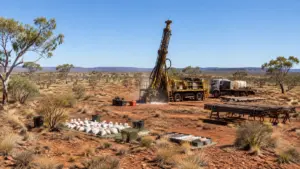
Purepoint Uranium Group Inc. (TSXV: PTU; OTCQB: PTUUF) has identified high-priority drill targets at its Smart Lake uranium project, following recent ground electromagnetic (EM) surveys. The company, which holds a 27% stake in the joint venture (JV) alongside Cameco Corp. (NYSE: CCJ; TSX: CCO), plans to commence drilling in mid-March in the southwestern Athabasca Basin, Saskatchewan—one of the world’s richest uranium-producing regions.

Refined Exploration Strategy at Smart Lake Uranium Project
Purepoint Uranium’s November–December 2024 survey campaign utilized stepwise moving-loop time-domain electromagnetic (SWMLTEM) and fixed-loop time-domain electromagnetic (FLTEM) techniques to enhance drill target accuracy. Spanning 31.5 line-km across 19 loops and 12 lines, the surveys were conducted with 600-meter spacing to map subsurface conductive structures critical for uranium exploration.
The survey identified three distinct parallel EM conductors, each roughly 100 meters apart and extending over 2.2 kilometers. These conductors align with known uranium-bearing structures, indicating a high potential for significant mineralization.
Scott Frostad, Vice President of Exploration at Purepoint Uranium, highlighted the importance of these findings:
“The new electromagnetic survey has provided high-resolution targets within an area of Smart Lake that remains largely untested by historical drilling. Given the basement-hosted uranium mineralization we encountered in our initial drill program, we’re excited to return and test these newly identified conductors next month.”
Building on Proven Mineralization
The upcoming Smart Lake uranium project drill program builds on promising results from Purepoint Uranium’s 2008 drilling campaign, which intersected uranium mineralization in faulted and altered basement rock. A standout result from drill hole SMT08-05 yielded 147 ppm uranium over 15.4 meters (153.0m–168.4m), within a hematite breccia and sheared fault zone—a promising geological setting for uranium deposition.

While exploration at Smart Lake was previously paused as Purepoint Uranium prioritized the Hook Lake project along the Patterson Corridor, the site has remained a top-tier asset within the company’s portfolio.

Strategic Location & Exploration Potential
The Smart Lake uranium project spans 9,860 hectares and is strategically located 60 km south of the historic Cluff Lake uranium mine and 18 km west-northwest of the Hook Lake JV project. The property is characterized by:
- Graphitic shear zones
- Hydrothermal alteration
- Anomalous radioactivity
These geological features are consistent with high-grade uranium deposits found elsewhere in the Athabasca Basin, reinforcing the project’s exploration potential.
More Read

Targeting the Northern Groomes Lake Area
The upcoming drill program will specifically focus on the northern Groomes Lake area, where geophysical data indicate:
- Multiple strong EM conductors
- Structurally complex uranium-bearing systems
Despite these promising indicators, the conductive package remains largely untested, presenting a significant discovery opportunity for Purepoint Uranium and its JV partner, Cameco Corp.
A NI 43-101 compliant technical report detailing Smart Lake’s exploration progress is available on Purepoint Uranium’s website.
Beyond Smart Lake: Additional Exploration Ventures
While uranium remains Purepoint Uranium’s primary focus, the company also holds a volcanogenic massive sulphide (VMS) project, which is optioned to and strategically positioned near Foran Corp.’s McIlvena Bay project. This diversified exploration portfolio enhances Purepoint’s overall growth potential.
Uranium Market Outlook & Investment Potential
With uranium prices rising amid increasing global demand for clean energy, the Smart Lake uranium project has the potential to become a major exploration success in the Athabasca Basin. As Purepoint Uranium prepares for drilling in mid-March, investors and industry watchers will closely monitor the program for further evidence of the site’s mineralization potential.