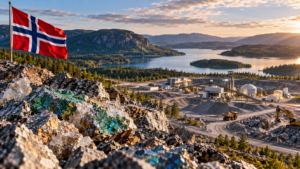
In a vote with cross-party support earlier this month, Norway’s parliament voted 80 to 20 to approve a government proposal to open large swathes of the ocean to commercial-scale deep-sea mining.

This makes the Nordic country the first in the world to advance the process of extracting minerals from the seafloor.
The Norwegian government said the practice could be a way to ease the global transition away from fossil fuels, adding that every country should look for ways to sustainably collect usable metals and minerals.
Environmental impact of deep-sea mining
But scientists have warned that the full environmental impact of deep-sea mining is difficult to predict, while environmental groups have criticized approval of what they call a “highly destructive” process that sends a “terrible signal” to the rest of the world.
Related News
- Early blow to SA coal exports this year following TFR train collision
- Leadership Upheaval at Endeavour Mining: CEO Dismissal Shakes Up Corporate Governance and Market Confidence
- Greenfield Starts Mining Exploration in Central Corridor, Tanzania
- Uganda: Is it worth the salt? Despite health concerns, artisanal miners continue to work
- Creating a minerals ‘super region’ could make Africa, the Middle East and South Asia global leaders in the energy transition
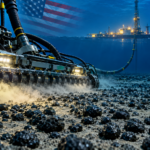
Important metals such as cobalt, nickel, copper and manganese have been found in potato-sized nodules on the seafloor. These metals, along with other strategic minerals and rare earth elements, have a variety of end uses, including electric vehicle batteries, wind turbines and solar panels.
More Read

Therefore, demand is growing rapidly. The IEA expects this trend to continue as the clean energy transition gains momentum, noting that demand for cobalt and nickel will grow by 70% and 40% respectively between 2017 and 2022.

“Today we are almost dependent on Russia and China and need to diversify the global supply chain for global mineral production,” said Norwegian Energy Minister Terje Aslan.
“We have been looking at the possibilities of seabed minerals for a long time. We have a proven tradition of exploiting the resources of the Norwegian continental shelf. We are doing it in a sustainable way and we are doing it step by step.”
Given the rapidly increasing demand for critical minerals, the International Energy Agency has warned that current supplies are not enough to transform the energy sector. This is because the production of many elements of the energy transition is relatively concentrated geographically.
For example, most rare earth reserves are located in China, while Vietnam, Brazil and Russia are also important countries with rare earth reserves.
knowledge gap
The decision by the Norwegian parliament paves the way for companies to bid for mining in national waters near the Svalbard archipelago. The area is part of the vast Norwegian undersea continental shelf, estimated to be larger than the United Kingdom at around 280,000 square kilometers (108,108 square miles).
The Norwegian government does not plan to start drilling for the minerals immediately. Instead, companies must submit license proposals and vote on a case-by-case basis in parliament.
Osland said the first commercial licenses for seafloor exploration would be available “maybe next year”, but licenses to mine the minerals were unlikely to be available within a decade.
Approving deep-sea mining puts Norway at odds with Britain and the EU’s executive arm, the European Commission, which pushed for a temporary ban on environmental grounds.
Responding to criticism, Norwegian company Aasland said the vote results would help lawmakers better understand whether minerals can be found on the seafloor in a sustainable way.
“One of the themes of the debate is that we don’t have enough knowledge to decide whether these minerals can be mined – and I completely agree with that,” Aslan said.
“We need to gather more information before making a decision to mine these minerals. That’s the purpose of this opening. It’s not the same as authorizing removal.”
The ‘nail in the coffin’ of Norway’s climate footprint
Anne-Sophie Roux, head of European deep sea mining at the Alliance for Sustainable Oceans, said Norway’s decision to give the green light to commercial deep sea mining was “irresponsible” and “put a nail in the coffin of the country’s purported role”. . Climate leaders. “
“The goal of all exploration activities should be to better understand the extent of the environmental threat posed by deep-sea mining, rather than to justify a practice we know will have huge negative impacts on marine life and the health of the planet,” Lu said. said the email.
Marine ecosystems are not well understood. Activists fear that exploration and development in the deep sea could permanently alter a homeland reserved only for known (and many still unknown) species.
“The argument put forward by the Norwegian government and the deep-sea mining industry that ‘deep-sea mining can be done in a sustainable way’ contradicts the broad consensus in the scientific literature,” Rue said.
“Today, there is no way to sustainably mine the deep sea, as this will inevitably lead to ecosystem destruction, species extinction, various sources of pollution, and the destruction of marine climate ecosystem services.”
However, Norway’s Deputy Foreign Minister Maria Vatersian said the Nordic country was taking its reputation as a sustainable ocean nation “seriously” when considering whether seabed minerals could play a role in the energy transition.
“The exploitation has not started yet. The main reason for this, as you said, is that there are huge gaps in knowledge that need to be filled before considering an activity. That’s important,” Vateresian said.
“Whatever one thinks of mining activities on land and offshore, minerals will become a key component of new energy systems. So the main question is not whether we need these minerals, but: can we produce them in a sustainable way?”