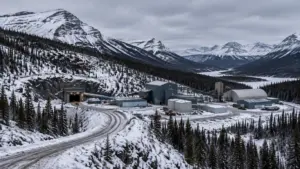
Mining news confirms that NexGen Energy Ltd. has officially commenced site preparation and construction on its flagship Rook I project in northern Saskatchewan, setting the stage for what is projected to become the world’s largest tier-one uranium mine.

Located on the Patterson Lake peninsula in the southwestern Athabasca Basin: approximately 155 kilometers north of La Loche: the development marks a pivotal milestone for both Canadian resource development and international nuclear fuel supply chains. Following the receipt of its federal Licence to Prepare Site and Construct from the Canadian Nuclear Safety Commission (CNSC) and prior provincial environmental approvals, project execution is ramping up with a projected four-year construction timeline and a capital investment estimated between C$1.3 billion and C$2.2 billion.
Strategic Importance of the Arrow Deposit
The Rook I project is anchored by the high-grade Arrow deposit, discovered by NexGen in 2014. According to technical reports and regulatory filings, the underground mine and mill complex is designed to produce up to 14 million kilograms of uranium trioxide ($U_3O_8$) annually over an initial 24-year operating life.
The facility will process approximately 1,400 tonnes of ore per day utilizing advanced underground extraction techniques and state-of-the-art milling technology designed to minimize surface footprint and environmental impact. For a broader perspective on how critical minerals and energy transition commodities are reshaping global markets, see our coverage on the critical minerals supply chain.
"The initiation of construction at Rook I represents a generational leap forward for the global nuclear energy sector," said industry analysts tracking the Athabasca Basin. "With structural deficits projected in global uranium markets as utilities rush to secure long-term fuel supplies for reactor life extensions and new builds, bringing a high-grade asset of this scale into development is both timely and essential."


Regulatory Roadmap and Compliance
The path to construction has been subject to rigorous federal and provincial scrutiny. The CNSC’s licensing decision followed a comprehensive environmental assessment process that evaluated potential impacts on aquatic ecosystems, wildlife, traditional Indigenous land use, and long-term waste management.
The current federal construction licence remains valid until March 31, 2036. Regulatory authorities emphasized that the licence authorizes site preparation and construction only under the Nuclear Safety and Control Act. Commercial operation of the underground mine and mill cannot commence until NexGen submits a separate operating licence application, which will trigger an independent public hearing and a subsequent Commission determination.
Provincial environmental clearance was granted by the Government of Saskatchewan in November 2023, accompanied by tailored surface lease agreements and municipal cooperation frameworks with northern communities.
Economic and Employment Impact
Beyond its significance to international energy markets, Rook I is poised to become a dominant economic driver in Saskatchewan and across Canada.
CNSC hearing data and company economic impact models indicate that the project will support an average of approximately 1,400 jobs annually in Saskatchewan during construction and production, scaling to roughly 2,600 jobs nationwide when accounting for indirect supply chain beneficiaries. Over the life of the mine, cumulative economic output is projected to contribute C$32 billion to the provincial economy and C$37.3 billion to Canada's gross domestic product.
Local Indigenous communities and regional municipalities have partnered with NexGen through structured participation agreements, ensuring employment training, equity ownership opportunities, and regional procurement preferences.

Construction Logistics and Engineering Execution
With physical construction underway, NexGen’s engineering teams are mobilizing heavy civil infrastructure, establishing worker accommodation facilities, and sinking the primary production and ventilation shafts. The Athabasca Basin's remote geography requires precise logistical choreography, particularly for transporting specialized heavy equipment and construction materials during seasonal weather windows.
The underground architecture relies on high-capacity diesel and battery-electric mobile fleets, paste backfill systems for mined-out stopes, and advanced water treatment facilities designed to discharge treated effluent meeting strict environmental standards.
| Project Metric | Specification |
|---|---|
| Location | Athabasca Basin, Saskatchewan, Canada |
| Deposit | Arrow Deposit |
| Project Type | Underground Uranium Mine & Mill |
| Target Production | Up to 14 million kg $U_3O_8$ annually |
| Estimated Mine Life | 24 years |
| Processing Capacity | ~1,400 tonnes of ore per day |
| Capital Investment | C$1.3B to C$2.2B over 4-year build |
Market Context and Future Outlook
The launch of construction at Rook I coincides with a structural tightening of the global uranium market. Utility procurement cycles have intensified as governments worldwide reaffirm commitments to nuclear energy as a baseload, zero-carbon power source. Recent geopolitical shifts and trade realignments have further heightened Western utility focus on secure, tier-one jurisdictions.
As NexGen advances concrete pouring and headframe erection over the coming months, industry observers will closely monitor construction milestones, capital expenditure tracking, and subsequent regulatory filings regarding operating licence hearings.

For ongoing analysis of commodity markets, regulatory developments, and project timelines across the resource sector, readers can reference our recent daily mining market wrap.
By Penny Langford