Myriad Uranium Corp. signed a definitive merger agreement on February 13, 2026, to acquire 100% of Rush Rare Metals Corp. in an all-stock transaction valued at an 18% premium to Rush’s January 6 closing price.

The deal consolidates ownership of Wyoming’s Copper Mountain Uranium Project. It’s also the latest signal that uranium market outlook is driving aggressive mining M&A across North America’s nuclear fuel supply chain.
The Exchange Ratio and Premium
Rush shareholders will receive 0.5405 Myriad common shares for each Rush share held. That’s equivalent to one Myriad share for every 1.85 Rush shares outstanding.
Based on January 6, 2026 closing prices, the exchange ratio represents an 18% premium. Using the 20-day volume weighted average price, the premium climbs to 22%.
All of Rush’s convertible securities will be replaced with equivalent Myriad convertible securities, adjusted for the exchange ratio. Myriad will also assume Rush’s outstanding convertible debentures.
More Read

The structure is standard for uranium sector consolidation deals. But the premium suggests Myriad sees real strategic value in eliminating split ownership of Copper Mountain.


Why Copper Mountain Matters
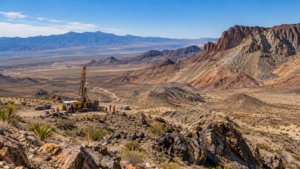
Copper Mountain sits at the center of this transaction. Myriad currently holds a 75% interest. Rush holds the remaining 25%.
More Read

The Wyoming project contains seven historic uranium deposits and 15 additional exploration targets. A 1982 estimate suggested the property could host as much as 650 million pounds of U3O8.
That number hasn’t been updated to modern resource classification standards. But even a fraction of that tonnage would make Copper Mountain a significant domestic uranium asset at a time when U.S. nuclear fuel supply chains are under intense scrutiny.
Myriad CEO Thomas Lamb framed the merger as eliminating “the structural discount of split ownership.” Translation: joint ventures complicate operations, dilute returns, and create decision-making bottlenecks.
In a rising uranium price environment, unified ownership means faster permitting decisions, streamlined capital allocation, and cleaner financials for investors evaluating mining stocks.
The Rush Spinco Structure
Rush shareholders won’t just receive Myriad shares. They’ll also get one Rush Spinco share for every four Rush shares held.
Rush incorporated this subsidiary to separate its Boxi Property in Quebec from the Wyoming uranium project. After the merger closes, Rush Spinco will operate as an independent entity focused on the Canadian asset.
This split allows Rush shareholders to retain exposure to Quebec exploration upside while consolidating the Wyoming uranium play under Myriad’s control. It’s a common structure in mining M&A when target companies hold geographically diverse assets.
The Spinco mechanism also reduces deal complexity. Myriad isn’t forced to manage a Quebec property outside its core Wyoming focus. Rush shareholders aren’t forced to sell an early-stage exploration asset at potentially unfavorable valuations.

Timeline and Regulatory Path
A special meeting of Rush shareholders is expected before May 2026. All directors, officers, and certain Rush shareholders have agreed or will agree to vote in favor of the arrangement.
Following shareholder approval, the parties will seek British Columbia Supreme Court approval and clearance from the Canadian Securities Exchange.
The 180-day timeline from agreement signing to expected close is standard for Canadian arrangement transactions involving TSX Venture or CSE-listed entities. Absent regulatory complications, the deal should close in Q2 2026.
Uranium Sector Consolidation Context
This transaction isn’t happening in a vacuum. Uranium market outlook has shifted dramatically since 2023, driven by nuclear energy’s role in decarbonization, AI data center power demands, and geopolitical supply chain concerns.
Spot uranium prices hit multi-year highs in 2024 and have remained elevated through early 2026. Long-term contract prices are rising as utilities seek supply security ahead of new reactor construction in North America, Europe, and Asia.
That pricing environment is triggering consolidation across the uranium mining sector. Companies with complementary assets are merging to achieve scale, reduce per-pound production costs, and simplify ownership structures that previously made sense in a low-price environment.
Myriad’s acquisition of Rush follows similar logic to other recent uranium sector deals. Fragmented ownership works when uranium is trading at $30 per pound and capital is scarce. At $80-plus per pound with strong contract demand, unified ownership unlocks value.

What This Means for Mining Stocks
Investors tracking uranium mining stocks should note three dynamics at play.
First, the 18-22% premium signals that uranium developers are willing to pay up for quality assets. Rush wasn’t distressed. Myriad offered a premium because Copper Mountain’s scale and domestic location justify it.
Second, the deal removes a structural discount. Split ownership typically trades at a 10-20% discount to equivalent single-operator assets due to decision-making complexity and capital allocation inefficiencies. That discount disappears post-merger.
Third, the Spinco structure shows that Quebec and Wyoming uranium assets are being valued differently by the market. Myriad wants Wyoming. Rush shareholders want optionality on Quebec. The split satisfies both.
For broader mining M&A trends, this transaction reinforces that consolidation is accelerating in commodities with strong demand fundamentals and limited near-term supply growth. Uranium fits that profile. So does copper, nickel, and lithium.
The 0.5405 exchange ratio will be tested as Myriad and Rush shares trade between now and deal close. If Myriad’s stock outperforms, Rush shareholders benefit. If it underperforms, the premium erodes.
Strategic Rationale: Wyoming vs. Canada
Myriad’s focus on consolidating Copper Mountain reflects broader jurisdictional preferences in uranium development.
Wyoming offers established regulatory frameworks for uranium mining, proximity to existing mill infrastructure, and fewer permitting challenges compared to starting greenfield projects in politically uncertain jurisdictions.
Quebec, by contrast, presents exploration upside but longer development timelines and different regulatory requirements. Rush Spinco allows that optionality to continue separately while Myriad accelerates Copper Mountain.
This jurisdictional specialization is becoming common in mining M&A. Companies are narrowing geographic focus to reduce execution risk and concentrate capital on assets with clearer paths to production.
What Happens Next
Between now and May 2026, Rush shareholders will receive voting materials and proxy statements detailing the merger terms, fairness opinions, and potential risks.
Myriad will continue operating Copper Mountain under the existing joint venture structure until the deal closes. No material changes to exploration or development timelines are expected during the interim period.
If shareholders approve and regulators clear the transaction, Myriad will issue new shares to Rush shareholders and assume the convertible debentures. Rush Spinco will begin trading separately, and the Copper Mountain consolidation will be complete.
The real test comes after close. Myriad will need to demonstrate that unified ownership translates to faster permitting, improved economics, and a clearer path to production.
In a strong uranium market, that thesis should hold. If uranium prices correct or permitting delays emerge, the premium Myriad paid will face scrutiny.
For now, the deal reflects confidence that uranium market outlook justifies paying up for quality domestic assets. And it signals that mining M&A in the nuclear fuel supply chain is far from over.