By Penny Langford

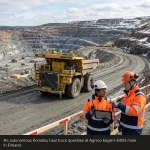
New Found Gold Corp. has finalized a $205 million capital injection designed to accelerate the development of its flagship Queensway project in Newfoundland. The financing, which includes significant participation from long-term backers Eric Sprott and EdgePoint Wealth Management, arrives as the company transitions from an aggressive exploration phase toward active mine construction and production planning.
The funding package: a combination of equity and strategic credit facilities: is earmarked for the completion of a definitive feasibility study (DFS), expanded site infrastructure, and a continuation of the massive drilling campaign that has defined the project since 2019. By securing this liquidity, New Found Gold aims to de-risk its path toward commercial production, currently targeted for the late 2027 window.
Strategic Backing from Sprott and EdgePoint
The $205 million total reflects a deepening of the relationship between the Vancouver-based explorer and its primary institutional supporters. Eric Sprott, whose early investments in the Queensway project helped spark a modern gold rush in Atlantic Canada, continues to maintain a significant equity stake. His participation in this round underscores a long-held thesis that the central Newfoundland gold belt represents a rare, high-grade orogenic system comparable to the Fosterville mine in Australia.
EdgePoint Wealth Management has also reinforced its position. The presence of such heavy-weight institutional capital is a rarity for junior explorers in the current market, providing a layer of stability as the company navigates the capital-intensive transition from “drill-and-discover” to “build-and-operate.”
More Read
For the broader market, this capital raise serves as a litmus test for mining investment sentiment in 2026. While some sectors have struggled to secure favorable terms, New Found Gold’s ability to pull in $205 million suggests that high-grade assets in Tier-1 jurisdictions remain the primary target for sophisticated capital. For insights on how these types of deals are valued, industry analysts often look toward mining investments valuation metrics and M&A trends in the copper and uranium sectors to find parallels in capital allocation.

Infrastructure and the Pine Cove Mill Advantage
One of the key drivers behind the $205 million budget is the integration of the Pine Cove Mill. Unlike many greenfield projects that require years of permitting for new processing facilities, New Found Gold has optimized its capital expenditure by leveraging existing regional infrastructure.
The strategy involves trucking high-grade ore from the Queensway site to established processing hubs, significantly reducing the initial “build-from-scratch” risk. This “hub-and-spoke” model is becoming increasingly common in the mining industry as companies seek to minimize environmental footprints and bypass the lengthy timelines associated with tailing storage facility (TSF) permits for new sites.
More Read


The capital will also support the deployment of advanced automation and sorting technologies at the site. Management has indicated that pre-sorting technology could significantly increase the grade of the feed entering the mill, a move that aligns with broader industry trends toward operational efficiency. For more on how these tools are being integrated across the sector, see our report on modern open-pit mining technologies changing the game in 2026.
Drilling Targets: Keats, Lotto, and Beyond
New Found Gold has already completed hundreds of thousands of meters of drilling, yet the $205 million budget includes a fresh 70,000-meter allocation for 2026. The focus is twofold: infill drilling to convert inferred resources into the “measured and indicated” categories required for the DFS, and step-out drilling to test the depth of known high-grade zones.
The Keats Zone remains the heart of the project, having delivered some of the highest-grade intercepts in Canadian history. However, recent exploration at the “Dropkick” and “Lotto” zones has suggested that the mineralization is part of a much larger, interconnected system. Geologists are particularly interested in the “Golden Joint,” where multiple fault lines intersect, creating the structural traps necessary for significant gold deposition.
The 2026 drilling program is not just about finding more gold; it is about defining the boundaries of the open-pit potential. By solidifying the resource estimate, the company can provide more accurate guidance on “Life of Mine” (LOM) economics, which are critical for the final investment decision (FID).
Economic and Regional Impact in Newfoundland
The expansion of the Queensway project is a major economic driver for the Gander region. The $205 million investment is expected to create several hundred direct and indirect jobs as site preparation ramps up. As the project grows, the company is facing increased scrutiny regarding ESG (Environmental, Social, and Governance) compliance and workforce compensation.
Newfoundland’s provincial government has been supportive of the mining sector, viewing it as a cornerstone of the province’s post-oil economic diversification. However, the competition for skilled labor in 2026 remains fierce, with multiple projects in the “Central Gold Belt” vying for the same pool of geologists and heavy equipment operators. This has put upward pressure on wages, a factor that New Found Gold will need to manage as it moves toward steady-state operations. You can read more about the rising costs of ESG compliance and mining jobs workforce pay here.

Key Risks and Timeline to 2027
While the $205 million financing provides a massive runway, the project is not without its risks. The transition from exploration to production is historically the most dangerous period for junior mining stocks: a phase often referred to as the “Orphan Period” in the Lassonde Curve where excitement over discoveries fades and the reality of construction costs sets in.
- Metallurgical Recovery: While the gold is high-grade, the consistency of recovery rates across different zones (Keats vs. Lotto) must be proven at scale.
- Permitting and Regulatory Hurdles: Although the Pine Cove Mill offers a shortcut, the transportation of ore and the expansion of the open-pit footprint still require rigorous provincial and federal approvals.
- Gold Price Volatility: The project’s economics are robust at current prices, but a significant downturn in the gold market could squeeze the margins needed to service any debt components of the $205 million package.
The current timeline sees the company completing its DFS by early 2027, with the first gold pour tentatively scheduled for the fourth quarter of the same year.
Market Outlook: The Newfoundland Gold Rush
The success of New Found Gold has acted as a catalyst for dozens of other juniors in the region. The central Newfoundland gold belt is now being compared to the Abitibi Greenstone Belt in terms of its long-term potential. However, New Found Gold remains the leader of the pack, both in terms of market capitalization and the scale of its exploration efforts.
The $205 million funding round essentially ensures that the Queensway project will remain the “anchor” of this new mining district. For investors and operators, the project represents a rare combination of high-grade potential and a secure, stable jurisdiction.
As the company moves into its most critical year of development, the mining community will be watching closely to see if the “Sprott-backed” vision of a world-class gold mine in Gander can be successfully translated from a drill-hole spreadsheet into a profitable, producing reality.