The company had originally planned to access the mine from the north side via Ogoki Road as the Ministry of Natural Resources and Forestry (MNRF) decommissioned two bridges in 2023 that were previously used to access the drilling site from the south side of the mine.

However, an unusually warm winter has delayed ice-up and current conditions prevent us from arriving on site with scheduled drilling equipment. The company originally planned to use a drilling rig with a depth of up to 1,500m, but the rig was too heavy to be transported by helicopter.
As a result, the company will focus its drilling efforts on combined conductors, where it will be able to use smaller drill rigs that can be transported to the site by helicopter and target depths likely to be less than 500m.
Accompanying geophysical images indicate that the stacked conductors are a continuation of the eastward extension of the MT conductors.
Related News
- Slow EV sales are proving problematic for Australia’s lithium miners
- Altilium and NGM enter into nickel processing partnership
- Atlantic Lithium completes first stage of offtake partnering process
- QC Copper employs AI to target drill program
- Pilbara Minerals bolstered by lithium production
MT Survey Interpretation
The magnetotelluric (MT) method is a geophysical technique that uses naturally occurring electromagnetic fields (EM) to measure the Earth’s electrical conductivity. Metallic sulfide deposits are reflected from MT conductors at depths up to 1,000 m, which is well below the depths of previous geophysical surveys at Marshall Lake. In July 2021, Delta, British Columbia-based SJ Geophysical Ltd. completed the MT survey.
More Read

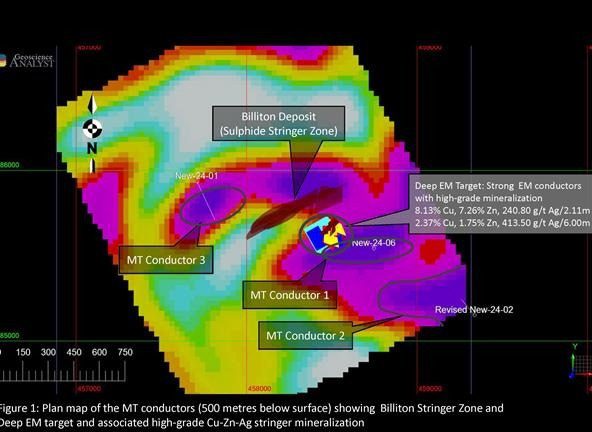
To identify deep drilling targets, the company recently interpreted and modeled MT data. The survey was completed near Deep EM targets drilled by the company in 2021 and 2022, and returned high-grade intercepts including:

2.37% Cu, 1.75% Zn, 413.15 g/t Ag and 0.37 g/t Au in 6.00 m
8.13% Cu, 7.26% Zn, 240.80 g/t Ag and 0.33 g/t Au over 2.11 m
5.81% Cu, 7.32% Zn, 171.20 g/t Ag and 0.02 g/t Au over 1.95 m
This type of stringer mineralization occurs approximately 300 m below the surface. The MT survey was completed with the objective of identifying conductors to a depth of 1,000 m, well below the stringer mineralization associated with previously reported deep electromagnetic targets.
More Read

Three strong conductors were identified through 3D modeling, two of which are centered about 500 m below the surface. These conductors are high-grade stringers or feeder areas located adjacent to the Deep EM targets and Billiton deposits. Therefore, we believe that there is a high probability that substantial sulfide deposits exist in the vicinity of all three geodetic MT conductors. Diamond drilling testing was not performed on any MT conductors.
In close proximity to the deep electromagnetic targets, MT Conductors 1 and 2 are associated with high-grade stringer mineralization that may exhibit downdip or downdip extension. The two conductors are rugged and can reach depths of 1,000 m and 400 m respectively below the surface.
The top of MT Ladder 3 is a shallower target located 250 m below surface and may indicate a downdip extension of the Billiton deposit to the west of its known extent. It may also be an example of stacked or parallel mineralized zones. It is unclear whether historic drilling at MT Conductor 3 has been completed.
Construction manager
Abitibi Geophysicals conducted a large-scale electromagnetic (EM) survey in winter 2023. Approximately 2 kilometers east of the MT Conductors and Billiton deposits, investigations have uncovered a strong accumulation leader zone. The conductor is believed to exist in younger rocks that stratigraphically overlie rocks associated with the MT Conductor and Billiton deposits.
In particular, if MT conductors 1, 2, and 3 were extended eastward, their apparent east-west orientation would nearly coincide with the position of the stacked conductors. In addition, as shown on the official map, synvolcanic faults and magnetic high lines intersect conductors, improving the outlook for the target.
Geophysical contractors will be on site within a week to conduct further large-scale electromagnetic surveys and precisely define the size, strength and orientation of the superstructure conductors. The survey will take four to five days to complete, with results expected soon.