The U.S. Department of Energy (DOE) has launched its Mine of the Future initiative — a landmark step toward revitalizing domestic mining and securing America’s critical mineral supply chain. The DOE’s Office of Fossil Energy and Carbon Management (FECM) will invest up to US $95 million, including US $80 million for mining technology proving grounds and US $15 million for national laboratory research. For mining companies, engineers, and analysts, the Mine of the Future marks a turning point — one designed to modernize extraction, accelerate commercialization, and reduce reliance on foreign mineral sources.

Why the Mine of the Future Matters for U.S. Mining
The DOE’s Mine of the Future program is designed to strengthen the U.S. critical minerals supply chain, improve mining efficiency, and expand workforce capability. According to the DOE’s official announcement, the initiative will fund high-impact projects that integrate automation, artificial intelligence, advanced sensing, and low-impact extraction technologies.
For the U.S. mining industry, this represents both a challenge and an opportunity. While legacy operations will face mounting pressure to modernize, technology-forward companies that embrace the Mine of the Future framework stand to gain preferential access to government funding, cross-sector partnerships, and long-term domestic supply contracts.
$80 Million for Mining Technology Proving Grounds
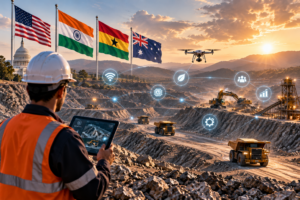
At the heart of the Mine of the Future initiative is the Mining Technology Proving Grounds program, with an intended funding pool of US $80 million. The DOE expects to issue its Notice of Funding Opportunity (NOFO) in Q4 2025. These proving grounds will serve as real-world testing environments for next-generation technologies — from autonomous haulage and electric vehicle fleets to sensor-driven ore sorting and AI-based environmental monitoring.
By creating these large-scale field sites, the DOE aims to de-risk new technology adoption and accelerate commercialization. The proving grounds will also function as training centers for a new generation of skilled American miners equipped to operate in Mine of the Future environments.
More Read
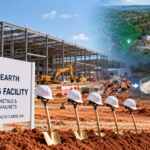
As Assistant Secretary of Fossil Energy Kyle Haustveit stated, “DOE is committed to fostering a new generation of miners and equipping them with the tools to lead the world in mineral production and processing technology.”

$15 Million for National Laboratory R&D
In parallel, the DOE has allocated US $15 million under its Mine of the Future Research, Development, and Demonstration initiative, inviting proposals from national laboratories for breakthrough technologies that bridge the gap between bench-scale innovation and commercial deployment.
Three key focus areas dominate the lab call:
More Read

- Mining Innovation — technologies that modernize extraction and improve operational efficiency.
- Beneficiation — site-level concentration and separation techniques that reduce waste and environmental footprint.
- In-situ Extraction — advanced in-place recovery methods with minimal surface disturbance.
Letters of intent are due October 27, 2025, with full proposals expected by January 2026. Successful projects will play a pivotal role in shaping the next wave of Mine of the Future technologies.
National Security, ESG, and Supply-Chain Implications
The Mine of the Future aligns directly with national policy priorities. With the U.S. Geological Survey’s 2025 Critical Minerals List expanding to 54 commodities, the DOE’s investment underscores growing concerns about import dependence—especially for rare earths, lithium, and graphite.
For mining companies, aligning projects with Mine of the Future standards could open doors to defense contracts, ESG-driven funding, and export-credit incentives. At the same time, environmental compliance will tighten. Companies will be expected to demonstrate sustainable beneficiation, low-emission operations, and community engagement.
This policy shift mirrors broader global trends seen in Canada, Australia, and the EU, where government-industry collaboration is driving mineral resilience and low-carbon production standards.
Skillings Analysis
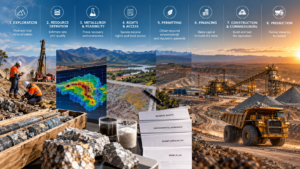
- Pipeline Creation: The Mine of the Future initiative forms a cradle-to-deployment pipeline — from lab R&D to full-scale mine demonstration. Firms engaging early may gain a decisive technology and policy advantage.
- Competitive Realignment: Miners reliant on conventional equipment and legacy processes risk falling behind. Investors should track which companies position themselves as DOE-recognized technology hosts.
- Innovation Magnet: Expect a rise in public-private partnerships between mining operators, academic institutions, and automation or AI startups — reshaping how the sector innovates.
Related coverage: U.S. DOE’s $100 Million Push for Coal Plant Refurbishment Signals a Strategic Power Shift, Alaska Mining 2025: Pentagon Investments Fuel New Frontier Growth, and Simandou Infrastructure Risk: Execution Challenges Mount in Guinea.
What Comes Next for the Mine of the Future
The next milestone will be the Q4 2025 release of the $80 million funding opportunity, followed by consortium formation among miners, technology developers, and universities. Selected proving-ground sites will be announced in 2026, followed by pilot demonstrations that could redefine productivity and ESG performance benchmarks.
As the Mine of the Future framework unfolds, U.S. mining will increasingly merge engineering, data science, and automation — building not just mines that produce more, but mines that produce smarter.