By Penny Laneford | January 19, 2026

Look, if you’re just waking up and reaching for coffee before checking your screens, here’s the quick hit: commodities are ripping higher, the Fed’s rate cut signals are doing exactly what everyone thought they’d do, and the metals complex is partying like it’s 2011. Gold’s flirting with levels that would’ve gotten you laughed out of the room two years ago. Copper’s supply situation is getting genuinely ugly. And lithium? Well, that one’s complicated.
This mining market report breaks down what’s actually happening and what it means for your Monday morning.
The Morning Summary: What You Need to Know Right Now
Spot gold is at $4,629.94 and yes, the market is openly talking about $5,000 like it’s not a joke anymore (MINING.COM). Silver still looks frothy, but the whole precious complex is being dragged higher by the same mix of safe-haven flows and rate-cut math.
Copper is doing what copper does when supply gets tight and the world won’t stop electrifying: LME copper prints a record $13,310 per ton (MINING.COM). The deficit narrative is still the core problem, and nobody has a quick fix because new mines don’t appear on command.
More Read

Meanwhile, the Fed’s expected 50 basis points of cuts this year is the tailwind that’s pushing everything higher. Lower rates mean cheaper money, weaker dollar, and commodities priced in dollars suddenly look a lot more attractive to everyone outside the US.

That’s your actionable summary. Now let’s dig into why this is happening and what it actually means.

More Read
Gold and Silver: The Safe Haven Trade on Steroids
Central banks won’t stop buying gold. That’s the story that keeps repeating, and it’s the foundation under this entire precious metals rally. With spot gold at $4,629.94 and traders watching the $5,000 handle, this is no longer a “maybe someday” level—it’s an active conversation in the market (MINING.COM). Between geopolitical risk, currency volatility, and general uncertainty about where the global economy is actually headed, gold’s doing what gold always does: acting as the ultimate “I don’t trust anybody” trade.
The technical picture is increasingly bullish. Gold secured a close above a trendline that’s been capping price action for months. Silver’s outperforming on a percentage basis, which is classic late-cycle precious metals behavior. When silver starts leading, it usually means the rally has legs.
Here’s the weird part though: December’s core inflation print came in soft. 0.2% month-over-month versus the 0.3% expected. You’d think that would take some heat out of the inflation hedge trade. Instead, commodities basically shrugged and kept climbing.
JPMorgan CEO Jamie Dimon called it: inflation’s going to stay “sticky.” And the commodity complex seems to agree. Industrial metals are screaming that input costs aren’t going anywhere. Aluminum’s up 50% since April. Nickel’s been on a tear. These are the raw materials that go into everything from cars to data centers to the electrical grid.
The market’s telling you something that the headline CPI number isn’t capturing.
Copper: The Squeeze Everyone Saw Coming
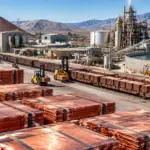
This is the one that should have every mining executive and investor paying attention. Copper supply is facing what can only be described as acute long-term pressure, and the price is reflecting it—$13,310 per ton on the LME, a record (MINING.COM). The math simply doesn’t work.
Demand side: Data centers are exploding. AI infrastructure requires obscene amounts of copper. Electrification across transport, grid, and industrial applications keeps accelerating. Every new EV needs roughly three times the copper of a conventional vehicle. Every solar installation, every wind turbine, every battery storage project: copper, copper, copper.
Supply side: Mine disruptions continue hitting major producing regions. Permitting timelines in the US, Canada, and Europe remain measured in decades, not years. Grade decline at existing operations means you need to move more rock to get the same metal output. Capex for new projects has ballooned to the point where greenfield development economics barely pencil out.
The result? A projected 1-million-ton deficit this year. That’s not a rounding error. That’s a structural problem that creates real price risk and genuine supply-chain constraints for anyone trying to build electrification projects.
For the mining sector, this is simultaneously the biggest opportunity and the biggest execution challenge in a generation. The companies that can actually deliver copper into this market are going to be rewarded handsomely. The question is who can actually do it.

Lithium: The Complicated One
Lithium doesn’t fit the same narrative as copper and gold right now. The battery metal had its own boom-bust cycle over the past few years, and pricing remains volatile and sentiment-driven—but the tape is getting loud again. In China, lithium is at 158,000 CNY/tonne, up about 62% over the past month (Trading Economics).
But here’s what’s worth watching: the long-term demand story hasn’t changed. EV adoption continues globally. Battery manufacturing capacity keeps expanding. Grid-scale storage projects are multiplying.
The supply side has caught up in the near term: that’s why prices corrected so hard from their 2022-2023 peaks. But the market’s forward-looking, and the infrastructure buildout required for energy transition means lithium demand is going one direction over the next decade. And right now, supply anxiety is back in the mix after China moved to cancel 27 mining permits in Jiangxi, which traders are reading as another constraint on the pipeline (Trading Economics; additional context via Mining Technology).
Major discoveries continue generating M&A speculation. Western Australia remains the epicenter of hard-rock lithium development, and any significant new find immediately draws corporate interest from major producers looking to secure supply.
The smart money is watching lithium less for immediate price action and more for strategic positioning. Who’s locking up the resources that’ll matter in 2028, 2030, 2035?
The Rate Cut Playbook
Let’s be clear about what Fed rate cuts actually mean for commodities.
When interest rates fall, the opportunity cost of holding non-yielding assets drops. Gold doesn’t pay dividends. Copper sitting in a warehouse doesn’t generate income. At higher rates, you’re giving up yield to hold these assets. At lower rates, that tradeoff gets more attractive.
Simultaneously, rate cuts typically weaken the dollar. Commodities are priced in dollars globally. A weaker dollar means international buyers get more metal for their money, which supports demand.
Goldman Sachs Research’s base case calls for 50 basis points of cuts in 2026, and they’re explicitly saying this is supportive of commodity returns. This isn’t speculation: it’s the fundamental macro backdrop that’s pushing institutional money into the space.
The zero-carbon mining push continues reshaping equipment markets and creating new capital requirements across the sector. Rate cuts make that capex more affordable for operators trying to modernize.
What’s Not Working
Not everything in commodities is celebrating.
Grain markets face serious headwinds. Unprecedented wheat stocks and record corn crops are creating storage nightmares for US farmers. Prices remain under pressure with no obvious catalyst for recovery.
LNG is approaching glut territory. Something like 29 million metric tons of new supply capacity comes online this year from projects across the US, Qatar, Australia, Mexico, and Africa. That’s a lot of molecules chasing buyers.
Oil markets remain oversupplied despite all the geopolitical noise. Pricing has stayed softer than many expected given the Middle East situation and Russia-Ukraine ongoing.
The commodity complex isn’t a monolith. You have to pick your spots.
The Week Ahead
Here’s what matters for the next few sessions:
Watch gold’s relationship to that trendline. If it holds above, the technical case for continuation strengthens considerably. A break back below would suggest the rally needs more consolidation before resuming.
Copper futures positioning will be instructive. The physical market’s tight, but paper markets can move ahead of fundamentals. Track warehouse stocks and regional premiums for real-time demand signals.
Any Fed commentary this week will move everything. We’re in a period where monetary policy expectations are driving asset prices across the board. A hawkish surprise would take heat out of commodities quickly.
For mining equities specifically, the divergence between commodity prices and company valuations remains a theme. Many producers are trading at discounts to underlying metal prices that look increasingly disconnected.
Bottom Line for This Mining Market Report
The commodity surge has fundamental support. Rate cuts are coming. Supply constraints in key metals are real and getting worse. The safe-haven bid for precious metals isn’t going anywhere given the global uncertainty backdrop.
That said, positioning is getting crowded in some names. The easy money in this cycle may already be behind us. From here, you need to be more surgical: owning the right assets in the right commodities with the right operators.
The macro tailwind is real. But execution and asset quality matter more than ever.
Stay sharp out there.