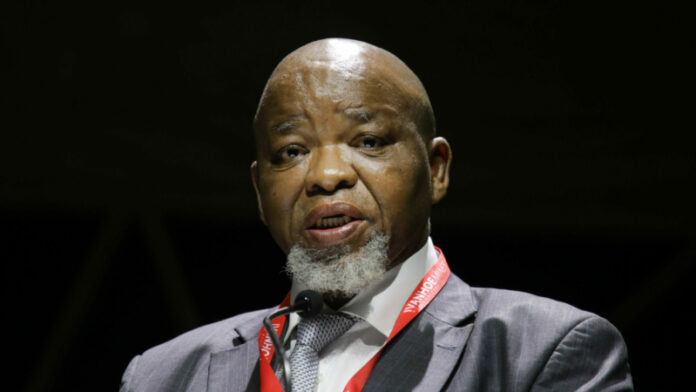
“If all goes to plan, the winning bidder to deliver South Africa’s long-awaited mining cadastral system will be announced at the end of October,” Mines Minister Gwede Mantashe said.
In his closing address after a two-day mining conference in Johannesburg, Mantashe said the Department of Mineral Resources and Energy had “done its part” by selecting the preferred bidder for the cadastral development. It now goes to the State IT Agency (SITA), which must review the department’s decision before it is officially announced. “We hope to achieve this by the end of October,” Mantashe said.
Mining companies have been calling for a new, modern and transparent online cadastral for years to stop corruption in the issuance of licenses and provide much-needed investment in exploration in the industry.
Appearing in good spirits, Mantashe said the lively discussions during the two-day conference had reinforced the key role of the mining industry in South Africa’s economy. “Every time tax authorities are in trouble, the mining industry comes to their rescue. Even during Covid-19, when we make unpopular decisions, the mining industry is able to lead the rebuilding and recovery process.”
He acknowledged that the country is going through difficult times due to rising costs and other reasons, and called on the mining industry to “continue to save the country” and “not to lay off workers.”
It comes after several mining companies said they would have no choice to cut jobs in the coming months as falling commodity prices and Transnet’s logistical inefficiencies prevented them from exporting sufficient volumes to international markets.
He acknowledged that mine managers faced further problems due to “inconsistent performance” from Eskom and Transnet.
“You’re used to dealing with the cyclical behavior of mineral [prices] rather than the strange challenges Eskom and Transnet throw at you,” he said.
Defend Coal
Mantashe once again defended the continued use of coal and other fossil fuels in the economy. He said developed countries cannot expect South Africa to “remain silent” on fossil fuels while they are allowed to restart the use of fossil fuels in their economies.
He also harshly criticized potential oil and gas exploration by the NGO sector and major international players, which was quick to take legal action against the government. “We kicked these companies out and they went to Namibia and Cote d’Ivoire and increased the GDP of those countries.”
Mantashe said it was time for NGOs, often based abroad, to disclose the sources of their funding, just as political parties must disclose. “They don’t want us to drill for oil and gas, but if their own countries did, they wouldn’t do anything about it. Instead, they stand in the way of our development.”
Speaking about South Africa’s Just Energy Transition plan, Mantashe said it was about more than just “turning off coal and moving to renewables”.
“People describe the just energy transition as a ‘journey from old to new’. Be careful though. Never take apart an old product before testing the reliability of the new one. That’s a misnomer. First, check resilience. We have to test the effectiveness of each technology.”