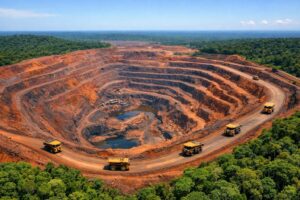
The uncomfortable truth about world-class gold mines is that we often treat silver like the loose change found in a couch cushion. It’s there, it has value, but it isn’t the reason you’re in the room. At Fruta del Norte (FDN) in Ecuador, silver represents a mere 1% to 2% of total revenue. In the grand scheme of a multi-billion-dollar gold operation, that is a rounding error.

Or at least, it was.
Lundin Gold (TSX: LUG) just proved that even the “loose change” can be leveraged into a half-billion-dollar strategic powerhouse. By selling a silver stream on FDN to LunR Royalties for C$670 million (approximately $490 million) in equity, Lundin isn’t just offloading a byproduct. They are re-engineering their balance sheet and taking a massive stake in what is set to become the world’s 6th largest precious metals royalty company.
This isn’t just a sale. It’s a transformation.
The C$670 Million Math: Not Your Average Byproduct Deal
To understand why this matters, you have to look at the numbers. Lundin Gold is receiving roughly 50.5 million newly issued shares of LunR Royalties. This makes Lundin a primary stakeholder in its own royalty partner.
More Read
The transaction, expected to close in Q2 2026 with an effective date of March 1, is a masterclass in capital efficiency. While other miners are out there diluting their shareholders to fund expansion or taking on high-interest debt in a volatile rate environment, Lundin is using its “minor” silver production as a currency.


The tiered structure of the deal is particularly savvy. Here is the breakdown:
More Read
- Tier 1: LunR receives 100% of payable silver production until 12.2 million ounces are delivered.
- Tier 2: Coverage drops to 50% until an additional 7.8 million ounces are delivered.
- Tier 3: Coverage settles at 7.5% for the remainder of the mine’s life.
For 2026, Lundin estimates payable silver production at 500,000 to 600,000 ounces. At current market valuations, that silver is a footnote on a P&L statement. In a streaming agreement, it becomes $490 million in immediate strategic equity. That is how you unlock value in a stagnant market.
Why LunR? The Rise of a New Royalty Giant
The beneficiary of this stream, LunR Royalties, is effectively being catapulted into the big leagues. With this deal, they gain immediate, high-margin cash flow from one of the lowest-cost, highest-grade gold mines on the planet.
This move mirrors broader trends we’ve seen in the sector where consolidation isn’t just happening at the producer level, but at the royalty level as well. We recently covered how Loncor Gold completed its going-private transaction, signaling a shift toward more aggressive consolidation. LunR is following a similar path by scaling up rapidly to compete with the likes of Franco-Nevada or Wheaton Precious Metals.
By becoming the 6th largest precious metals royalty company, LunR now has the “heft” to participate in even larger transactions. For Lundin Gold shareholders, this is a double win: they keep the gold, and they get a massive slice of a growing royalty business that will benefit from other mines besides their own.
Fruta del Norte: The Golden Goose Still Has Room to Grow
None of this works if the underlying asset isn’t a beast. Fortunately, Fruta del Norte is exactly that.
Located in the Zamora-Chinchipe province of Ecuador, FDN is a geological anomaly. We’re talking about Proven and Probable Reserves of 5.8 million ounces of gold at a staggering grade of 7.09 grams per tonne (g/t). To put that in perspective, many modern mines are lucky to see 1.0 or 2.0 g/t.

But the real kicker isn’t just what’s in the reserves; it’s what’s in the ground surrounding them. Lundin has committed to a massive $100 million exploration program this year. They aren’t just sitting on their hands. With 100,000 meters of drilling planned, the goal is simple: find more gold and extend the current 12-year mine life.
If they find more gold, they almost certainly find more silver. And because of the tiered structure of the LunR deal, as the mine life extends into the later years, Lundin keeps a larger and larger share of that silver byproduct (moving from 100% delivery down to 7.5%). It’s a “tails-I-win, heads-you-win-too” scenario.
The 2026 Strategic Pivot: Discipline Over Hype
In early 2026, the mining industry is at a crossroads. We’ve seen M&A mania take hold, with some companies arguably overpaying for growth just to keep their reserve numbers from shrinking.
Lundin Gold is taking a different path: one defined by what we call “the luxury of discipline.” This is a strategy we’ve seen successfully employed by majors like BHP, who have shunned M&A mania in favor of their own sector-leading pipelines.
Instead of buying someone else’s problems, Lundin is optimizing its own house. They are monetizing a byproduct that the market doesn’t give them credit for and using that capital to fund an exploration blitz that could redefine the company’s valuation by 2027.

Contextualizing the Silver Market in 2026
Why stream silver now? The timing isn’t accidental. The silver market in 2026 is increasingly tight, driven by industrial demand in solar and electronics, alongside its traditional role as a monetary metal. While gold often gets the headlines: especially with central bank gold reserves hitting record highs: silver is the “workhorse” metal that provides the leverage.
By locking in a $490 million valuation for its silver stream today, Lundin is effectively hedging against the inherent volatility of byproduct pricing. They are taking “maybe” money and turning it into “definitely” equity.
This transaction also highlights the shifting landscape of mining finance. As traditional bank debt remains expensive and ESG reporting requirements become more stringent (see our analysis on how ESG reporting is changing capital access), streaming and royalty deals have become the preferred tool for smart operators.
Risk Factors: The Ecuador Factor and Technical Execution
Of course, no deal is without risk. Operating in Ecuador has historically come with a specific set of geopolitical “flavors.” While the current administration has been supportive of mining as a pillar of economic growth, the long-term stability of the region is always a variable in the NPV calculation.
Furthermore, the $100 million exploration program is a high-stakes bet. While FDN’s geology is world-class, the “drill bit” is the ultimate truth-teller. If the 100,000-meter program fails to deliver significant reserve expansion, the long-term value of the LunR equity stake might be capped.
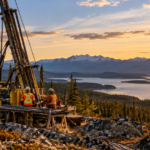
However, given the current reserve grades and the success of near-mine drilling over the last 24 months, the odds are heavily in Lundin’s favor. They are drilling in the shadow of a headframe that sits on top of 7 g/t gold. That’s a good place to be.
What This Means for Investors
For the institutional investor, the message is clear: Lundin Gold is no longer just a single-asset producer. It is now a gold producer with a massive venture-capital-style stake in the royalty sector.
This provides a layer of diversification that is rare for a mid-tier producer. If LunR goes on to acquire streams on other world-class assets: perhaps in the copper-gold space where we see Eldorado making big moves: Lundin Gold shareholders stand to benefit from assets they don’t even have to operate.
2026 Outlook: The Road Ahead
As we move through the first half of 2026, expect the following milestones:
- Q2 2026: Closing of the LunR transaction and the formal issuance of the 50.5 million shares.
- Ongoing: Results from the $100 million exploration program. Look for high-grade intercepts outside the current mine plan.
- Macro: Watch the gold/silver ratio. If silver outperforms gold in the back half of the year, the value of Lundin’s stake in LunR could appreciate significantly, providing a secondary catalyst for LUG shares.
The strategic calculus here isn’t subtle. Lundin Gold identified a part of their business that was being ignored by the market and weaponized it. They didn’t need to find a new mine to add $490 million in value; they just needed to look at their own “waste” stream with a more creative eye.
In a sector where growth is getting harder to find and more expensive to buy, that kind of internal engineering is what separates the operators from the speculators. The clock is already ticking on the Q2 close, and if the drill results match the ambition of the balance sheet, 2026 will be the year Lundin Gold stopped being just a mine and started being a major strategic player.
The market might have treated silver as loose change, but Lundin Gold just used that change to buy a seat at the head of the table. That’s not a typo. That’s a total shift in the game.