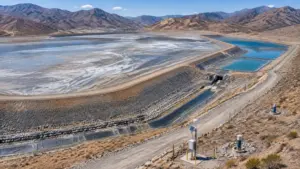
Kinross Gold Chile has officially initiated the environmental permitting process for its $1.5 billion Lobo-Marte gold project, a move that signals a significant expansion of the company’s footprint in the Atacama region. By submitting the necessary documentation to Chile’s Environmental Assessment System (SEIA), the Toronto-based miner is advancing a project designed to serve as a long-life, high-margin cornerstone for its South American operations.

The decision to trigger permitting comes at a pivotal moment for the precious metals sector. With gold testing historic breakout levels in April 2026, the economics of large-scale, low-cost projects have become increasingly attractive to major producers looking to replace depleted reserves. For Kinross, Lobo-Marte is not just a standalone mine; it is the linchpin of a "sequential mining" strategy that leverages the proximity of its recently restarted La Coipa operation.
Project Economics and Sequential Development
The Lobo-Marte project is centered on the extraction of two primary deposits: Marte and Lobo: to be mined sequentially. According to the feasibility study, the project supports a 16-year operating life with a processing capacity of approximately 35,000 tonnes per day.
The production profile is robust. Over its lifespan, the mine is expected to produce approximately 4.7 million ounces of gold. Perhaps most critical for investors is the projected all-in sustaining cost (AISC) of $680 per ounce. At 2026 gold prices, these margins position Lobo-Marte as one of the most competitive undeveloped gold assets in the world. The average gold content is estimated at 1.29 g/t, a respectable grade for an open-pit operation of this scale.

More Read

Under the current development plan, construction is slated to take 3.5 years following the receipt of all necessary environmental and sector-specific permits. The sequential nature of the project allows Kinross to manage capital expenditures more fluidly, focusing on the Marte pit before transitioning to the larger Lobo deposit.

The La Coipa Synergy Strategy
The strategic rationale for Lobo-Marte is inextricably linked to the La Coipa mine, located roughly 50 kilometers away. Kinross restarted production at La Coipa in February 2026, targeting an annual output of approximately 250,000 ounces by mid-year.
By treating La Coipa and Lobo-Marte as a combined operational hub, Kinross expects to realize significant cost savings. The "synergy focus" includes:
More Read

- Infrastructure Sharing: Utilizing existing water supply networks and regional operational camps.
- Process Optimization: Sharing technical expertise and potentially modular processing components between the two sites.
- Logistics: Streamlining supply chains for consumables and heavy equipment across the Atacama corridor.
This hub-and-spoke model is a response to the rising costs of remote mining. By building on the foundation of La Coipa, Kinross effectively de-risks the capital-heavy entry into Lobo-Marte.

Permitting and Regulatory Landscape in Chile
While the submission to the SEIA is a milestone, the path to production remains complex. Chile’s regulatory environment has faced scrutiny in recent years as the country balances its mining heritage with increasingly stringent environmental and social requirements. While Chile remains a primary destination for mining capital, resource nationalism and shifting environmental standards remain high on the risk register for major operators.
The environmental permit application for Lobo-Marte is the official start of a multi-year assessment. This process will scrutinize the project's impact on high-altitude ecosystems, water usage in the arid Atacama, and the concerns of local indigenous communities. Kinross has stated that environmental and community considerations were integrated into the project design from the outset, a move intended to streamline the approval process.
| Key Project Metric | Feasibility Data (Est. 2026) |
|---|---|
| Initial Capital Investment | $1.5 Billion |
| Total Gold Production | 4.7 Million Ounces |
| Mine Life | 16 Years |
| Average Grade | 1.29 g/t Au |
| AISC | $680/oz |
| Processing Capacity | 35,000 tpd |
Technical Challenges: High Altitude and Logistics
Operating at 4,200 meters above sea level presents a unique set of technical hurdles. At these altitudes, equipment efficiency can drop, and the physical toll on the workforce necessitates rigorous safety and health protocols. The project will require a specialized fleet of heavy machinery capable of performing in low-oxygen environments.

Furthermore, the regional geography of the Atacama requires robust water management strategies. Kinross plans to leverage its experience at La Coipa to navigate these challenges, but the scale of Lobo-Marte: with its twin-pit sequential design: adds a layer of logistical complexity that will test the company's operational execution.
Strategic Timeline and Risks
The 3.5-year construction timeline is an ambitious target that depends entirely on a smooth permitting phase. Industry analysts suggest that any delays in environmental approvals could push the first gold pour toward the end of the decade.
Key risks include:
- Permitting Delays: Chile's SEIA process can be lengthy, with potential for judicial challenges from environmental groups.
- Water Scarcity: Securing sustainable water rights in the Atacama remains a perennial challenge for all miners in the region.
- Capital Allocation: While Lobo-Marte is a priority, Kinross must balance its global portfolio, including its strategic interests in North America and Africa.
Despite these risks, the Lobo-Marte project represents a massive vote of confidence in the Chilean mining sector. For a detailed look at how this fits into the broader 2026 mining landscape, see the Skillings Mining Review April 2026 edition.

Market Impact and Investor Sentiment
The market has reacted cautiously but positively to the permitting news. Investors are increasingly looking for "brownfield-plus" opportunities: projects that, while significant in scale, benefit from existing regional infrastructure. Lobo-Marte fits this description perfectly through its synergy with La Coipa.
The project’s low AISC is particularly compelling. If Kinross can deliver gold at $680/oz, Lobo-Marte will be a cash-flow engine even in a bearish gold environment. In the current high-price environment, the project's Net Present Value (NPV) is expected to significantly exceed original feasibility estimates.
Conclusion: A High-Stakes Bet on the Atacama
Kinross Gold’s move to trigger permitting at Lobo-Marte is a calculated bet on the long-term value of the Atacama’s gold reserves. By focusing on sequential development and operational synergies, the company is attempting to build a sustainable, multi-decade production hub. The next 24 months will be critical as the project moves through the SEIA gauntlet and Kinross firms up its final investment decision.
For operators and investors, Lobo-Marte serves as a case study in modern mining strategy: scale is important, but synergy and regulatory navigation are the true keys to unlocking value in 2026.
Shareable Social Media Snippet (LinkedIn/X):
Kinross Gold Chile has officially triggered the environmental permitting process for the $1.5B Lobo-Marte project. With an expected AISC of $680/oz and 4.7M oz of gold production, this sequential project is set to leverage massive synergies with the nearby La Coipa mine. A major move for the Atacama mining hub. #MiningNews #GoldMining #KinrossGold #ChileMining #LoboMarte #GoldPrice2026
Salini Krishnan is the lead analyst for Skillings Mining Intelligence, covering global precious metals and South American resource development.