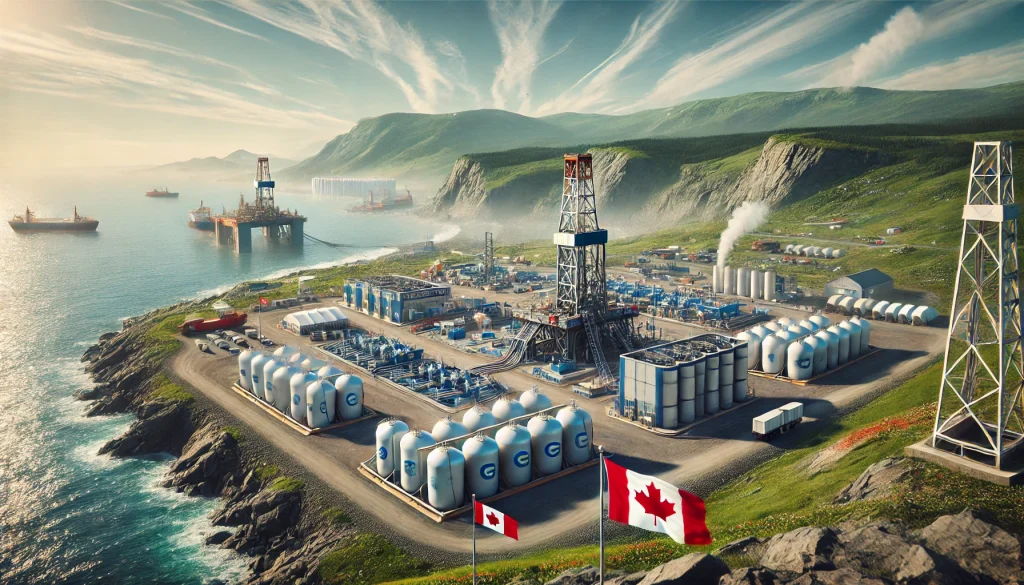
Quebec Innovative Materials Corp. (CSE: QIMC) has announced the establishment of a New Hydrogen Exploration Camp in Nova Scotia’s Cumberland Basin, signaling a strategic expansion of its clean hydrogen and helium portfolio into Canada’s Atlantic region. The move positions QIMC to tap into international hydrogen export markets via established port infrastructure, while leveraging the province’s favorable geology for large-scale natural hydrogen generation and storage.

A Bold Expansion Into Atlantic Canada
The launch of QIMC’s New Hydrogen Exploration Camp involves staking 2,645 exploration claims across approximately 428.5 km² of the Cumberland Basin, a region marked by complex sedimentary structures, deep-seated faults, and high geothermal gradients. These geological features mirror those of other globally recognized hydrogen-producing basins, including France’s Lorraine and Rhine grabens.
“Our expansion into Nova Scotia marks a transformative step forward,” said John Karagiannidis, CEO of QIMC. “By harnessing the favorable geological features of the Cumberland Basin and utilizing our proven exploration methodologies, we are poised to unlock substantial new natural clean hydrogen and helium resources.”
Related News
- European Bismuth Prices Soar to Record Highs Amid China Export Curbs
- South African Phosphate Mine Faces New Environmental Lawsuit
- Metals Markets and the Impact of Tariff Policies on Precious Metals
- Mining Operators: Securing a Stake in the EV Future
Geology Designed for Hydrogen Generation
The Cumberland Basin’s unique geology presents optimal conditions for natural hydrogen formation. Characterized by over 7 kilometers of sedimentary rock, the region includes formations from the Carboniferous era—such as the Cumberland, Windsor, and Mabou Groups—alongside deeper Neoproterozoic granites and mafic volcanic rocks.

Central to QIMC’s hydrogen strategy is the Cobequid-Chedabucto fault system, a major crustal structure that facilitates the flow of groundwater through biotite-rich granitoids and olivine-bearing rocks. These mineral-water interactions, under high geothermal conditions, can produce significant volumes of natural hydrogen. Research in analogous regions, like the Rhine graben, has shown biotite can generate up to 102 kilotonnes of hydrogen per cubic kilometer of granite.
“Nova Scotia frequently hosts biotite-rich potassic granitoids,” explained Prof. Marc Richer-Laflèche, a geological advisor to QIMC. “Under appropriate thermal conditions, these rocks produce hydrogen through oxidation processes, which our exploration model in the Cumberland Basin aims to confirm.”
Proven Methodology, New Frontier
QIMC plans to replicate its successful exploration strategy developed in Quebec’s St-Bruno-de-Guigues property, where previous campaigns revealed strong natural hydrogen signals. That model involves identifying structural traps formed by salt diapirs, leveraging geothermal gradients for water-rock interaction, and mapping radiogenic helium zones—a co-product of natural hydrogen accumulation.
The New Hydrogen Exploration Camp will benefit from the thick sequence of permeable and impermeable rock layers in Cumberland. These sedimentary conditions support the formation of gas accumulations and may offer storage potential through salt formations in the Windsor Group. The basin’s geothermal gradient also supports hydrogen generation at realistic depths—another critical factor in scalable production.
A Gateway to Global Hydrogen Markets
QIMC’s expansion into Nova Scotia is not only about geology. It’s also about logistics. The proximity of the Cumberland Basin to Atlantic ports gives the company a pathway to international hydrogen markets—an increasingly attractive proposition as countries like Germany, Japan, and South Korea ramp up clean hydrogen imports.
“The integrated nature of our approach—from resource identification to potential export—positions QIMC at the forefront of natural hydrogen development in North America,” Karagiannidis said.
Strengthening a North American Hydrogen Leader
With its New Hydrogen Exploration Camp in Nova Scotia, QIMC is asserting itself as a leader in a nascent but fast-growing sector. Natural hydrogen, often dubbed “gold hydrogen,” is gaining attention for its low carbon footprint, especially compared to hydrogen produced through electrolysis or fossil fuels.
Nova Scotia’s subsurface is not only rich in hydrogen-bearing minerals but also in helium, particularly radiogenic helium derived from uranium- and thorium-rich granites. The dual potential for hydrogen and helium production gives QIMC’s Cumberland project added strategic depth.
As demand for low-emission energy sources intensifies, QIMC’s early move into Atlantic Canada may serve as a blueprint for future hydrogen development across the continent.
The establishment of a New Hydrogen Exploration Camp in Nova Scotia marks a pivotal moment for Quebec Innovative Materials Corp., expanding its clean energy frontier while reinforcing its exploration leadership. By combining cutting-edge geology, strategic logistics, and proven methodologies, QIMC is positioning itself to meet both regional energy needs and international demand for natural hydrogen—paving the way for a cleaner, more sustainable energy landscape.