By Charles Pitts

The global mining sector has entered a transformative period where the balance of power is shifting from discovery to consolidation. As of May 2026, the gold market is navigating a paradoxical landscape: record-high commodity prices paired with a critical shortage of proven reserves. While headline-grabbing gold prices: hovering above $4,800 per ounce: suggest an era of unprecedented prosperity, the internal reality for major producers is one of structural urgency.
The current “buyout wave” is not merely a trend of opportunistic growth; it is a defensive necessity. Years of underinvestment in greenfield exploration have left the industry’s top tier with thinning pipelines. Consequently, the industry is seeing a surge in mergers and acquisitions (M&A) as majors scramble to replace depleted ounces with de-risked, near-production assets.
The Reserve Replacement Crisis: Why Discovery is No Longer Enough
For over a decade, the global mining industry has focused on capital discipline and debt reduction. While this strengthened balance sheets, it came at the cost of the “drill bit.” The success rate of greenfield exploration has declined steadily, and the timeline from initial discovery to first gold pour now averages between 12 and 15 years due to tightening environmental regulations and permitting complexities.
For a senior producer, waiting 15 years to bring a new mine online is no longer a viable strategy when current reserves are being exhausted at today’s high production rates. This has created a “buy-over-build” mentality. In the current market, it is often more cost-effective to pay a significant premium for an existing deposit than to risk capital on early-stage exploration.
More Read
Experts often point to the “reserve replacement ratio” as the most critical metric for the 2026 outlook. If a company produces 2 million ounces a year but only discovers or acquires 1 million, it is effectively a melting ice cube. To combat this, majors are utilizing their record free cash flows to acquire junior and mid-tier companies that have already navigated the most difficult stages of discovery and permitting.

Analyzing the $600/oz Benchmark and Record Premiums
The financial metrics of 2026 transactions have set new, aggressive benchmarks for the industry. A pivotal moment occurred with G Mining’s acquisition of G2 Goldfields, a deal valued at approximately $3 billion CAD. This transaction established a valuation benchmark of roughly $600 CAD per ounce of gold in the ground: a figure that represents an 80% premium over the target’s previous trading price.
These premiums are among the highest seen in recent mining history. While critics suggest that some majors are overpaying, proponents argue that the scarcity of high-quality assets in “Tier-1” jurisdictions justifies the cost. When gold is priced at $4,800 per ounce, a $600/oz acquisition cost leaves significant room for operational margin, provided the project can be brought into production efficiently.
More Read

The drive for scale is also evident in the Australasian markets. The merger between Regis Resources and Vault Minerals, valued at A$10.7 billion ($7.7 billion), created the third-largest gold producer on the ASX. This deal highlights the trend of regional consolidation, where companies combine assets to share infrastructure, such as mills and tailings facilities, to drive down all-in sustaining costs (AISC).
Key M&A Transactions Snapshot (May 2026)
| Acquirer | Target | Value (Approx.) | Key Asset/Location |
|---|---|---|---|
| Regis Resources | Vault Minerals | $7.7 Billion (USD) | Western Australia |
| G Mining | G2 Goldfields | $3 Billion (CAD) | Guyana/Suriname |
| Agnico Eagle | Minority Stakes (Various) | Undisclosed | Canada/Finland |
| Global Business | Amex GBT Unit | $6.3 Billion (USD) | Corporate Services |
Data compiled from recent mining review reports and market filings.
Geopolitics and the “Tier-1” Obsession
The 2026 buyout wave is heavily influenced by jurisdictional risk. While vast deposits exist in emerging markets, the majority of M&A capital is flowing toward stable, mining-friendly regions. Canada, Australia, and parts of Northern Europe (such as Finland) are the primary targets for majors looking to de-risk their portfolios.
The risk of “resource nationalism”: where governments change tax codes or revoke permits: has made assets in certain regions less attractive, regardless of their grade. We have seen similar supply shocks in other sectors, such as the Southern Copper permit revocation in Peru, which has made gold investors increasingly wary of geopolitical instability.
As a result, a premium is being placed on projects within the “Silicon-Lithium Nexus” and established gold belts. Companies are willing to pay more for the certainty of Western legal frameworks. This has created a bifurcated market where juniors in “safe” regions are seeing massive bidding wars, while high-grade projects in high-risk areas struggle to find suitors.

The Role of Technology and Synergies
One aspect of the 2026 wave that experts rarely emphasize is the role of operational technology in justifying acquisition costs. Modern majors are no longer just looking at the ounces; they are looking at how their existing technological infrastructure can optimize a target’s operations.
Artificial intelligence, autonomous haulage, and remote operation centers are now standard for top-tier producers. When a major like Agnico Eagle or Newmont acquires a mid-tier project, they aren’t just buying the rock: they are applying a sophisticated technological overlay that can potentially lower the AISC by 10-15%. These “hidden” synergies often explain why a major is willing to pay an 80% premium that seems irrational to outside observers.
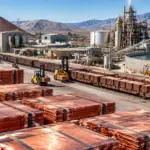
The integration of advanced logistics and telemetry, as seen in modern open-pit mining facilities, allows for more precise extraction, reducing waste and increasing the total recoverable metal over the life of the mine.
Risks to the Buyout Wave: The Barrick Caution
Not everyone in the industry is convinced that the current pace of M&A is sustainable. Mark Bristow, CEO of Barrick Gold, has historically remained cautious, often describing some industry deals as “over the top.” The primary risk is that in the rush to secure reserves, companies may overleverage themselves or acquire assets with hidden technical flaws.
If the price of gold were to experience a significant correction: perhaps falling back toward $3,500/oz: the high-premium deals of 2026 could become a burden on balance sheets. Furthermore, regulatory scrutiny is increasing. Antitrust concerns in Australia and Canada are beginning to slow down the pace of “mega-mergers,” as governments seek to ensure that consolidation does not stifle competition or lead to job losses in local mining communities.
2026 Outlook: Bull, Base, and Bear Cases for Gold M&A
As we look toward the second half of 2026, the trajectory of gold M&A will likely follow one of three paths:
- The Bull Case: Gold stays above $4,800/oz. Cash-rich majors continue to compete for the remaining independent mid-tiers, pushing valuations toward $700/oz in the ground. Consolidation moves into the junior sector as majors seek to control entire geological belts.
- The Base Case: Gold stabilizes. M&A activity continues but becomes more targeted. The focus shifts toward “bolt-on” acquisitions: smaller projects that are adjacent to existing infrastructure. Jurisdictional safety remains the priority, as detailed in our mining by regions analysis.
- The Bear Case: Global economic shifts lead to a gold price correction. The M&A wave halts abruptly as companies pivot back to cash preservation. High-debt companies that overpaid for assets in early 2026 face restructuring or forced divestments.

Conclusion
The 2026 gold M&A wave is a clear signal that the industry is entering a new phase of maturity. The “secrets” of this wave are found in the structural necessity of reserve replacement and the massive premiums being paid for jurisdictional certainty. While the headline figures are staggering, they reflect a rational response to a market where the cost of discovery has become prohibitively high and the time to production has become prohibitively long.
For investors and operators, the focus must remain on the quality of the assets and the ability of the acquirer to integrate new projects into their technological ecosystem. As the industry consolidates, the gap between the “haves” (those with reserves and Tier-1 access) and the “have-nots” will only continue to widen.
For more in-depth analysis on commodity trends and market forecasts, visit our Uranium Forecast 2026-2030 or explore our Editor’s Picks for the latest on critical minerals.