By Charles Pitts

Generation Mining Limited (TSX: GENM) has cleared a significant financial hurdle for its flagship Marathon Copper-Palladium Project in northwestern Ontario, securing senior lender credit approval for a US$310 million (approximately C$424 million) project finance facility. This development, announced in mid-2026, marks the cornerstone of a broader C$769 million funding package aimed at bringing one of North America’s few shovel-ready critical mineral projects into production.
The credit approval was granted by a syndicate of mandated lead arrangers including Export Development Canada (EDC), ING Capital, and Société Générale. The facility is a senior secured project finance debt instrument dedicated to the construction and development of the Marathon deposit, which is strategically positioned to meet the growing global demand for copper and platinum group metals (PGMs).
Breaking Down the C$769 Million Funding Stack
The US$310 million senior credit facility represents the largest single component of Generation Mining’s current capital stack. However, the total committed funding reached C$769 million when combined with existing arrangements. This package is designed to de-risk the project for potential equity partners and subordinate debt providers as the company moves toward a final construction decision.
The financing package currently consists of three primary pillars:
More Read
- Senior Secured Debt: The US$310 million facility (C$424 million) from EDC, ING, and Société Générale.
- Metals Streaming Agreement: An undrawn C$200 million agreement with Wheaton Precious Metals.
- Equipment Leasing: Approximately C$145 million in facilities earmarked for the acquisition of the primary mining fleet and processing equipment.
While the C$769 million in committed capital is a substantial milestone, it currently sits below the C$992 million in initial capital (pre-production capex) outlined in the company’s 2025 Updated Feasibility Study. This leaves a funding gap of approximately C$223 million. Generation Mining has indicated that it is actively pursuing subordinate debt, surety providers, and equity investments to bridge this remainder.


Strategic Significance of the Marathon Project
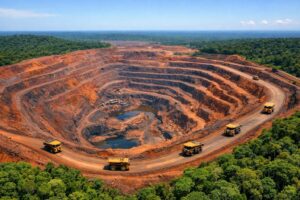
Located near the town of Marathon, Ontario, the project is situated in a tier-one mining jurisdiction with established infrastructure, including power, rail, and road access. In an era where geopolitical stability and supply chain security are paramount, the Marathon Project is being framed as a vital domestic source of critical minerals for North American markets.
More Read

The project’s focus on copper and palladium aligns with two major industrial shifts: the transition to renewable energy and the ongoing requirements of the automotive industry. Copper remains a foundational element for the energy transition, while palladium and platinum are essential for catalytic converters and emerging hydrogen technologies.
According to the 2025 Feasibility Study, the Marathon Project is expected to have an initial 13-year mine life, with the potential for expansion through satellite deposits. The economic profile of the project remains robust even amidst fluctuating commodity prices.
Marathon Project Key Metrics (2025 Feasibility Study)
| Metric | Value |
|---|---|
| Annual Copper Production | 42 million lbs |
| Annual Palladium Production | 168,000 oz |
| Annual Platinum Production | 38,000 oz |
| After-Tax NPV (5%) | C$1.07 billion |
| After-Tax IRR | 28% |
| Payback Period | 1.9 years |
| Initial Capital Cost | C$992 million |
Operational Readiness and Construction Timeline
With the senior debt approvals in place, Generation Mining is targeting a construction start in late 2026. The project is already “shovel-ready,” meaning all major environmental and operational permits are secured. This status is increasingly rare in the North American mining sector, where permitting timelines can often span a decade or more.
The company has already begun preliminary site preparation and is coordinating with local First Nations communities and stakeholders. The project is expected to create over 1,000 jobs during the peak of construction and approximately 400 permanent positions during the operational phase, providing a significant economic boost to northwestern Ontario.

Market Dynamics: Copper and Palladium in 2026
The timing of the Marathon Project’s development coincides with a projected tightening in the global copper market. As discussed in recent copper supply forecasts, the demand from AI data centers and electrical grid modernization is outstripping new mine supply. By 2026, the market is expected to face a structural deficit that could support elevated price floors for copper.
On the PGM side, palladium remains a critical metal for internal combustion engine (ICE) and hybrid vehicles. While the long-term outlook for palladium is often debated in the context of electric vehicle (EV) adoption, the medium-term demand remains resilient as hybrid technologies gain market share as a bridge to full electrification. Furthermore, the concentration of palladium production in Russia and South Africa makes a North American source like Marathon highly attractive to Western manufacturers seeking to diversify their supply chains.
Risk Factors and Execution Challenges
Despite the positive financing news, Generation Mining faces several hurdles common to large-scale greenfield developments. The C$223 million funding gap remains the most immediate priority. While the presence of EDC and international banks like ING and Société Générale provides a “seal of approval,” the remaining equity or subordinate debt may come at a higher cost of capital if market conditions shift.
Inflationary pressures on labor and materials also remain a concern. Although the 2025 Feasibility Study updated the capital cost estimates to C$992 million, any further delays in the late-2026 construction start could expose the project to further cost escalations.
Furthermore, as an open-pit operation, the project must maintain rigorous ESG standards to ensure continued support from local communities and investors. The company’s ability to manage its environmental footprint: particularly regarding tailings management and water usage: will be closely monitored by the senior lenders throughout the life of the loan.

Conclusion: A Major Step for Ontario Mining
The credit approval for the US$310 million facility is more than just a financial transaction; it is a validation of the Marathon Project’s viability and strategic importance. For Generation Mining, it represents the transition from an exploration and permitting story to a development and construction narrative.
As the company works to close the final funding gap, the industry will be watching closely. If successful, the Marathon Project will become a primary example of how collaborative financing between government agencies (EDC), private banks, and streaming companies can bring critical mineral assets to life in high-ranking jurisdictions like Ontario.
For investors and operators, the Marathon Project serves as a bellwether for the “shovel-ready” segment of the market. Its success or failure in reaching first production by the late 2020s will offer significant insights into the feasibility of rapidly scaling North American critical mineral supply.