The mining industry’s 2026 reset is becoming clearer: scale alone is no longer enough. After a period when markets rewarded acreage, narrative, and long-dated optionality, operators are being judged more directly on permitting progress, development discipline, drill execution, cost control, and the credibility of production pathways. For producers, developers, and investors alike, the sector’s center of gravity has shifted from speculation to delivery.

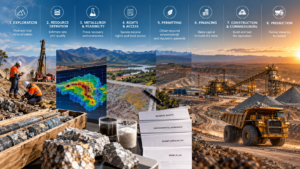
That change is visible across exploration, mine development, and supply-chain strategy. In gold, G2 Goldfields’ 100,000-metre drilling program stands out as a strong signal that parts of the market still support aggressive exploration spending when management teams believe geology, continuity, and development potential can justify it. Large drill campaigns do not guarantee mine builds, but they do indicate confidence in resource conversion and district-scale upside at a time when capital is more selective.
West Red Lake Gold offers a related example from the production side. Its target of 100,000 ounces by 2028 reflects a broader mid-tier ambition now shaping the sector: build toward attainable operating milestones rather than rely on distant blue-sky scenarios. In the current market, that kind of target matters because it can be measured against staffing plans, mill readiness, underground development, permitting status, and unit-cost performance. Investors have become more willing to reward milestones that can be tracked quarter by quarter.

Caption: Mining operations control rooms are increasingly central to productivity, safety, and cost management.
Execution now carries a geopolitical premium
The pressure to deliver is not coming from capital markets alone. Regulatory volatility has become a material operating variable, particularly in South America, where permit suspensions, revocations, legal challenges, and shifting political priorities have introduced new uncertainty into project timelines. For lithium and copper in particular, disruptions in one jurisdiction can ripple quickly through downstream processing plans, battery supply chains, and procurement strategies in North America, Europe, and Asia.
More Read

This matters because mine supply is not easily replaced on short notice. A revoked permit, delayed environmental approval, or contested consultation process can tighten concentrate availability, change trade flows, and alter development sequencing for refiners and manufacturers. In practical terms, supply-chain resilience in 2026 is increasingly tied to jurisdictional reliability, not just orebody quality.

Smart mines move from concept to cost response
At the same time, operators are under pressure from inflation, labor constraints, energy costs, and declining grades in some mature districts. That is accelerating the move toward “Smart Mines” built around automation, digital dispatch, predictive maintenance, remote operations centers, and tighter data integration between geology, planning, and processing.
For operators, the case for automation is becoming less about innovation branding and more about margin defense. Autonomous haulage, AI-assisted orebody modelling, fleet analytics, and real-time process control can improve equipment utilization, reduce downtime, and support more consistent throughput. In brownfield operations especially, technology adoption is increasingly being framed as a practical response to rising sustaining costs rather than a long-term experimental upgrade.
More Read


What the G2 and West Red Lake signals mean
Taken together, G2 Goldfields’ large-scale drill commitment and West Red Lake Gold’s production target highlight how the market is distinguishing between credible execution stories and narrative-heavy growth models. The common thread is not simply the “100K” figure. It is the operational logic behind it.
For exploration companies, large programs suggest management sees enough confidence in structure, grade continuity, and follow-up potential to justify substantial spending. For emerging producers, production targets need to be supported by mine plans, financing capacity, engineering readiness, and permitting progress. In both cases, markets are asking a more disciplined question in 2026: what is the path from target to delivered output?
Market snapshot: commodity trends in 2026
Current commodity signals also support the shift toward execution-focused strategies.
| Commodity | 2026 Trend | What operators are watching |
|---|---|---|
| Lithium | Weak pricing, selective project advancement | Oversupply pressure, capital discipline, and jurisdictional risk |
| Uranium | Constructive long-term outlook with policy support | Contracting activity, restocking, and Western supply security |
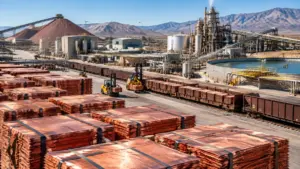
| Copper | Tight medium-term fundamentals | Permitting risk, project delays, and energy-transition demand |
| Gold | Supportive backdrop amid macro uncertainty | Safe-haven buying, central bank demand, and operating cost inflation |
Lithium remains under pressure from oversupply and weaker margins, forcing companies to prioritize low-cost assets, downstream optionality, and execution discipline over expansion narratives. Uranium continues to benefit from long-term policy support tied to energy security and nuclear restarts, though delivery credibility remains crucial as buyers look for dependable non-Russian supply. Copper fundamentals remain constructive, but new supply faces persistent obstacles from permitting delays, community opposition, and capital intensity. Gold continues to hold strategic appeal in an uncertain macro environment, but producers still face scrutiny on all-in sustaining costs, reserve replacement, and development execution.
A more demanding market for miners
The industry’s 2026 shift is not a retreat from growth. It is a repricing of what kind of growth matters. Mid-tiers and emerging producers are still expanding, explorers are still drilling aggressively, and technology investment remains active. But the premium has moved toward companies that can convert plans into metres drilled, permits secured, tonnes mined, recoveries improved, and ounces or pounds produced.
That makes execution the defining mining theme of 2026. In a market shaped by volatile regulation, uneven commodity pricing, and persistent cost pressure, credibility is being built less through presentation decks and more through operational proof.

Caption: Underground mining productivity is increasingly tied to equipment efficiency, development rates, and data-led planning.