Copper Industry Must Bridge Massive Investment Gap to Power Global Green Transition
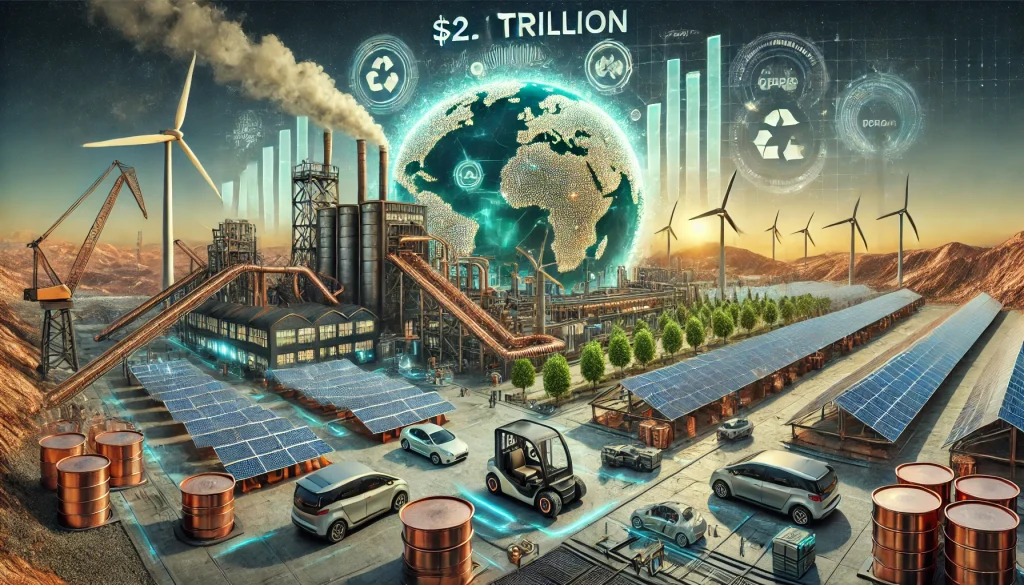
The copper industry is at the center of the global green transition, but a staggering $2.1 trillion investment is required by 2050 to meet skyrocketing demand. As the world accelerates toward decarbonization, demand for copper — essential in renewable energy, electric vehicles (EVs), and modern power grids — is surging faster than supply can keep up, according to BloombergNEF’s latest Transition Metals Outlook.

Copper Industry Demand Expected to Surge 70% by 2050
Copper’s unmatched conductivity makes it indispensable for clean energy technologies and modern infrastructure. According to BHP’s Chief Commercial Officer, Rag Udd, global copper demand is projected to rise 70% by 2050, reaching an estimated 50 million tonnes annually. This sharp increase highlights copper’s critical role in electrification, solar and wind power, and large-scale energy storage — all key to achieving global climate targets.
However, current copper supply growth is lagging far behind demand projections. Despite over a decade of production expansion, BloombergNEF warns that copper shortages could emerge as early as 2025. Other essential transition metals, including lithium and aluminum, also face potential supply deficits.
Related News
- Trade Shifts Reshape Transatlantic Copper Pricing Trends
- China’s Copper Demand Stabilizes Global Markets Amid Renewable Energy Boom
- Clean Copper Extraction: The Race to Reinvent a Vital Industry
- Copper Supply Gap Fuels M&A Frenzy in Mining Sector Amid Energy Transition
China’s Economic Growth and Copper Overconsumption Risks
China, the world’s largest copper consumer, adds further uncertainty to global copper industry outlooks. In September, Beijing launched its most aggressive economic stimulus package since the pandemic — a $325 billion program targeting construction and infrastructure development, both heavy copper consumers.
However, analysts at Goehring & Rozencwajg caution that China’s copper consumption may already be in overconsumption territory — surpassing actual economic needs by about 40 pounds per capita in 2023, with this trend projected to worsen by an additional 45 pounds in 2024. Overconsumption could lead to stockpiling, triggering short-term price drops in global copper markets.
More Read

Global Supply Challenges and Geopolitical Instability Threaten Copper Industry Growth
As demand soars, the copper industry faces serious supply-side challenges. Chile, the world’s top copper producer, recently cut its 2034 production outlook by nearly 1 million tonnes due to declining ore grades and operational disruptions. In Peru, the second-largest producer, political unrest and strikes have already dented output from major mines like Las Bambas.

In Africa, the Democratic Republic of Congo’s (DRC) Kamoa-Kakula mine, a crucial new source of copper, saw production dip 6.5% last year due to unreliable power supplies. Meanwhile, ongoing conflict, human rights violations, and disease outbreaks further cloud the DRC’s long-term production outlook.
Clean Energy, AI Boom, and Electrification Drive Long-Term Copper Industry Demand
The copper industry’s importance will only grow in the coming decades. The International Energy Agency (IEA) projects that copper demand from clean energy technologies will soar 81% by 2035, driven by expanded use of solar panels, wind turbines, and electric vehicles.
Additionally, the rapid expansion of AI-powered data centers, which consume up to 10 times more electricity than traditional centers, will create another substantial demand driver. Man Group estimates that U.S. data center power demand could double by 2030, adding about 500,000 tonnes of copper demand globally — equivalent to 2% of the total market.
Infrastructure Investment and Resource Nationalism Challenge Copper Industry Expansion
Closing the supply gap will require unprecedented investment in new mines and processing infrastructure. Visual Capitalist estimates that the world will need 61 new copper mines by 2030 just to meet battery sector demand. However, with most mining projects requiring 10+ years to develop, and years of underinvestment in exploration, the current pipeline remains critically thin.
Another rising risk for the copper industry is resource nationalism. In 2023, Panama ordered the closure of First Quantum’s Cobre Panama mine, removing 350,000 tonnes of annual copper supply. As more governments seek to tighten control over mineral wealth, mining companies face escalating regulatory uncertainty.
Copper Prices Poised for Long-Term Strength
Despite short-term volatility risks, including Chinese overconsumption, analysts remain bullish on copper prices over the next decade. Bank of America projects copper prices could reach $10,750 per tonne ($4.87 per pound) by 2025, driven by structural supply deficits and robust demand. Chile’s Cochilco similarly expects copper prices to remain above $4 per pound through at least 2035.
With supply lagging far behind surging demand — and the clean energy revolution accelerating — the copper industry will remain a strategic cornerstone of the global economy. Investors, miners, and policymakers face mounting pressure to close the investment gap or risk derailing both economic growth and climate goals.