By Penny Langford

The global copper market is entering a period of structural imbalance that many industry analysts are calling the "trade of the decade." As we move through 2026, the convergence of three massive demand drivers: artificial intelligence (AI) data centers, the accelerating energy transition, and global grid modernization: is meeting a supply side hampered by decades of declining ore grades and a lack of major new project starts.
According to a January 2026 S&P Global study, the current trajectory of the copper market suggests a potential supply deficit that could reach 10 million metric tons by 2040. However, the immediate horizon of 2026 is where the "pinch" is becoming operationally visible for miners and investors alike. With demand projected to grow at a consistent 2% annually while existing capacity plateaus, the 2026 outlook remains fundamentally tight.
The New Demand Pillar: AI and Data Centers
While the energy transition has long been the primary narrative for copper, 2026 has solidified a second, equally critical pillar: the physical infrastructure of artificial intelligence. High-performance computing requires a density of power distribution and cooling infrastructure that is significantly more copper-intensive than traditional cloud storage.
J.P. Morgan estimates that data centers alone will consume approximately 475,000 metric tons of copper in 2026. To put this in perspective, a single hyperscale AI facility can require between 5,000 and 15,000 tons of the red metal for cabling, busbars, and power systems.
More Read


Industrial-scale copper infrastructure within a hyperscale data center.

"We are seeing a step-change in demand intensity," notes a recent report from the Copper Development Association. "AI training workloads require GPU-dense systems that pull massive amounts of power, requiring thicker copper conductors and more complex liquid cooling systems, which in turn use copper heat exchangers."
Electrification and the Grid Expansion
Beyond the digital realm, the physical electrification of the global economy continues to strain supply. Copper remains the "indispensable metal" for the energy transition due to its superior conductivity and reliability.
More Read
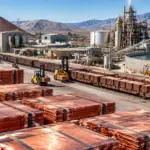
- Grid Modernization: Major economies are currently overhaulling aging electrical grids to support decentralized renewable energy. This requires massive amounts of copper for transformers and long-distance transmission lines.
- Electric Vehicles (EVs): While EV sales growth has seen periods of volatility, the metal intensity remains high. An average battery electric vehicle (BEV) uses roughly four times as much copper as a traditional internal combustion engine (ICE) vehicle.
- Renewable Infrastructure: Wind and solar installations are significantly more copper-intensive per megawatt of capacity than fossil-fuel power plants.
The Supply Challenge: Declining Ore Grades
The most significant hurdle to meeting this demand isn't a lack of copper in the ground, but the increasing difficulty and cost of extracting it. The global mining industry is grappling with a multi-decade decline in ore grades.
Average copper ore grades have fallen by approximately 40% since 1991. In Chile, the world's leading producer, average grades dropped nearly 29% in the last decade alone. This means that for every ton of copper produced, miners must move and process significantly more rock, leading to higher energy consumption, increased water usage, and rising operational costs.

Modern haulage logistics are required to move increasing volumes of low-grade ore.
Our coverage of base metal mining highlights that this "triple challenge": higher carbon footprints, rising costs, and tightening supply: is making it harder for projects to reach Final Investment Decisions (FID). The lack of "tier-one" discoveries over the last decade means the pipeline of new projects remains insufficient to bridge the gap.
2026 Market Analysis: Copper Intensity by Sector
To understand the scale of the deficit, we can look at the estimated copper intensity across key growth sectors for 2026.
| Sector | Estimated 2026 Copper Consumption (Metric Tons) | Key Drivers |
|---|---|---|
| Traditional Industrial | 15,200,000 | Global manufacturing and construction |
| Electric Vehicles | 3,100,000 | BEV/PHEV adoption and charging infra |
| Grid & Renewables | 4,800,000 | Solar/Wind build-out and grid upgrades |
| AI Data Centers | 475,000 | Hyperscale GPU clusters and cooling |
| Total Demand | ~24,575,000 | Total market remains in structural deficit |
Operational Oversight and Productivity
As supply tightens, existing operators are turning to technology to squeeze every ounce of productivity from their assets. Real-time data integration and autonomous hauling are no longer luxuries but necessities for maintaining margins in a low-grade environment.

Digital twins and real-time monitoring are critical for managing modern, low-grade copper assets.
For mining professionals, the focus has shifted toward brownfield expansions and operational efficiency. "The easiest ton of copper to find is the one you already have in your tailings or through better recovery at an existing pit," says one operations manager in Peru.
Price Forecast 2026: Drivers and Risks
Goldman Sachs has maintained a constructive outlook for copper through 2026, forecasting prices to trade in the $10,000 to $11,000 per metric ton range. While this is below the extreme spikes seen in previous cycles, it represents a high "floor" supported by structural deficits.
The Bull Case:
- Faster-than-expected AI infrastructure build-out.
- Geopolitical disruptions in major producing regions like Africa or South America.
- Slower-than-expected recycling rates.
The Bear Case:
- Wider adoption of aluminum substitution in cabling (though technical limits exist).
- Global recession dampening traditional construction and industrial demand.
- A sudden breakthrough in copper-free battery chemistries.
Strategic Outlook for Investors
The copper deficit of 2026 is not a temporary spike but the beginning of a long-term structural shift. Investors positioned in producers with low-cost, long-life assets are likely to benefit from a sustained high-price environment. Furthermore, companies specializing in mining technology and copper recovery are becoming increasingly vital to the supply chain.

High-resolution view of modern underground mineral extraction methods.
As we look toward the end of the decade, the gap between what the world needs for its digital and green ambitions and what the earth can readily provide is widening. For those in the mining and finance sectors, 2026 represents a critical inflection point where the physical reality of mineral supply meets the exponential demand of the modern age.
Shareable Social Snippet
LinkedIn/X:
The copper deficit of 2026 is no longer a forecast: it's a physical reality. With AI data centers alone projected to consume 475k tons and global ore grades down 40%, the "red metal" is the trade of the decade. Is the industry ready for a 10M ton shortfall?
Read the full analysis: [Link] #Copper #Mining #AI #EnergyTransition #SkillingsMining