By Charles Pitts

The global mining landscape in 2026 is no longer defined by incremental growth, but by aggressive, high-stakes consolidation. As the structural deficits in copper, lithium, and other transition metals move from theoretical forecasts to operational realities, the industry’s “Big Four” and diversified majors have shifted their strategies from internal exploration to external acquisition.
The mantra across boardrooms in London, Melbourne, and Toronto is clear: consolidate or die. This is not the opportunistic M&A of previous cycles driven by peak commodity prices. Instead, the mining M&A deals 2026 are tactical strikes aimed at securing critical mineral pipelines that are otherwise impossible to build within the necessary timeframes for the global energy transition.
The Speed-to-Market Imperative
The primary driver behind the 2026 M&A frenzy is the widening gap between mineral demand and the speed of greenfield development. In 2024 and 2025, the industry saw permitting timelines for new mines stretch beyond 15 years in many Tier-1 jurisdictions. By 2026, majors realized they could no longer wait for their own exploration pipelines to deliver.
“Buying a mid-tier with an active, permitted asset is no longer a luxury; it’s a prerequisite for staying relevant in the copper and lithium markets,” says a senior analyst at Skillings Mining Intelligence.
More Read
According to recent data, the capital expenditure required to bring a greenfield copper project online has risen by 35% since 2022, largely due to inflation, deeper deposits, and more stringent ESG requirements. In contrast, acquiring an established mid-tier producer allows majors to bypass the “valley of death” associated with permitting and initial construction.


Large-scale extraction remains the primary target for majors looking to fill supply gaps by 2035.
The Copper Deficit and the $13,000 Milestone
The strategic focus of 2026 M&A is overwhelmingly tilted toward copper. With the metal crossing the $13,000 per tonne milestone earlier this year, the structural deficit has become a wake-up call for the entire sector. The looming copper deficit is projected to reach 15% by 2035, leaving majors with little choice but to swallow mid-tiers that hold high-grade Andean or African assets.
More Read
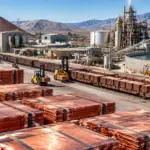
The landmark Anglo-Teck merger, which set the benchmark for $50 billion+ deals, demonstrated how majors are willing to overpay for copper exposure to rebalance their portfolios away from high-carbon iron ore and thermal coal assets.
Mid-Tiers: The “Regional Hub” Survival Strategy
For mid-tier companies, the 2026 environment is one of extreme vulnerability and strategic pivot. To avoid being swallowed, many mid-tiers have adopted a “regional hub” model, consolidating clusters of adjacent assets to achieve operational leverage that rivals the majors.
By sharing processing plants, logistics, and technical teams across multiple nearby sites, mid-tiers are lowering their unit costs and extending mine lives. However, even these optimized “hubs” are becoming prime targets for majors looking for “plug-and-play” acquisitions.

Operational efficiency and digital integration are now key metrics in M&A valuations.
Lithium: From Hype to Industrial Logic
Unlike the speculative lithium rush of the early 2020s, the 2026 lithium M&A landscape is defined by industrial logic. Majors are no longer chasing every spodumene outcrop; they are targeting critical minerals projects with clear paths to midstream integration.
We are seeing a trend of “tri-party deals” involving a mining major, a mid-tier producer, and an automotive OEM or battery manufacturer. These partnerships share the massive capex burden while securing long-term offtake. The focus has shifted toward low-cost brine operations in the Lithium Triangle and high-scale hard-rock projects in Western Australia and Quebec.

Lithium M&A in 2026 focuses on low-cost, long-life assets with established infrastructure.
Jurisdictional Shifts and Risk Appetite
As Tier-1 jurisdictions like Canada and Australia become increasingly crowded and expensive, the 2026 M&A wave is pushing majors back into frontier markets. However, the approach is different than in previous decades.
Instead of full buyouts in high-risk regions, companies are utilizing joint ventures and minority stakes to mitigate geopolitical exposure. The infrastructure developments at Simandou and various copper belt projects in Zambia and the DRC have shown that majors are willing to accept higher operational risks if the geology is world-class and the regulatory framework is clear.
Mining M&A 2026: The Outlook
As we move toward 2027, the M&A frenzy shows no signs of slowing. The industry is currently in the “base case” of a multi-year commodities upcycle, where undervalued mid-tiers are being re-rated as strategic assets rather than mere mineral producers.
| Scenario | M&A Driver | Expected Outcome |
|---|---|---|
| Bull Case | Copper exceeds $15,000; lithium stabilization. | Hostile takeovers of top 10 mid-tiers by diversified majors. |
| Base Case | Sustained structural deficits; ESG pressures. | Continued regional consolidation and “hub” creation. |
| Bear Case | Global recession; slowing EV adoption. | Retreat to Tier-1 jurisdictions and divestment of non-core assets. |

Underground expertise is a highly valued “intangible asset” in the 2026 merger cycle.
Conclusion
The 2026 M&A frenzy is a symptom of a larger structural shift in the global economy. As the world moves toward electrification, the mining industry is being forced to modernize its portfolio at a speed that organic growth cannot match. For mid-tiers, the choice is increasingly binary: build enough scale to become a predator, or optimize your assets to become the most attractive prey.
For the majors, the risk is no longer the price they pay for an acquisition, but the price of doing nothing while their competitors secure the minerals of the future.