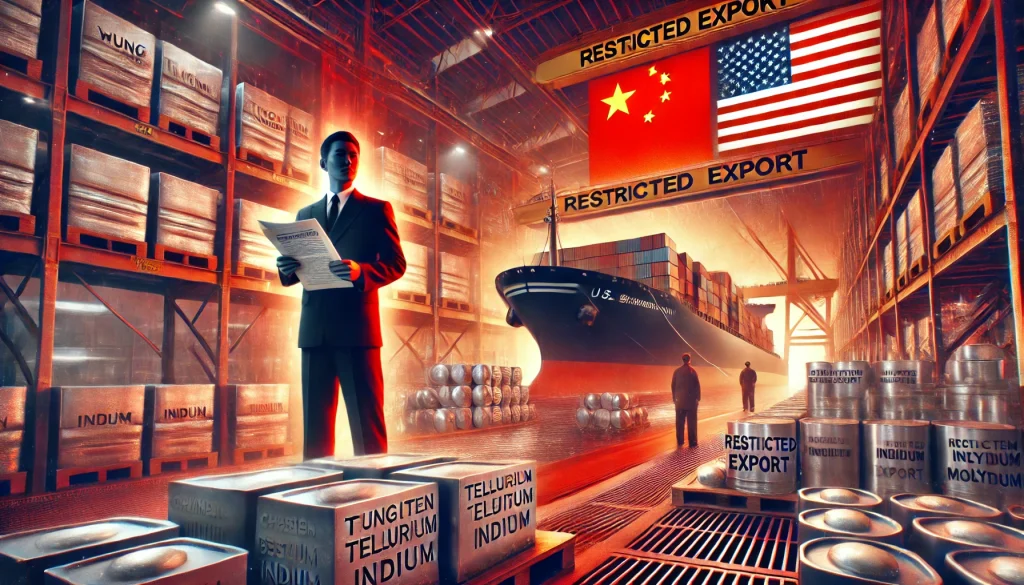
China has introduced new export restrictions on five critical metals—tungsten, tellurium, bismuth, indium, and molybdenum—in its latest countermeasure in the ongoing China-US trade war. The decision follows President Donald Trump’s announcement of a sweeping 10% tariff on all Chinese imports, further intensifying economic tensions between the world’s two largest economies.

Beijing’s new regulations, disclosed on Tuesday, will require exporters to obtain government licenses to ship these minerals abroad. However, officials have not yet clarified the approval criteria. These restrictions add to a growing list of mineral supply chain disruptions, challenging Washington’s efforts to reduce dependence on Chinese resources.
Related News
- Ukraine Rare Earth Mining: Strategic Deals and U.S. Interest
- What Space Debris and Deep-Sea Mining Can Teach Us About Cleaning Up Earth’s Orbit
- Capricorn Metals Expands WA Exploration with Mummaloo Acquisition
U.S. Industries Face Selective Risks
While some of the newly restricted metals may have a limited impact on U.S. industries, others pose significant supply chain vulnerabilities.
Molybdenum, widely used in high-strength steel and corrosion-resistant alloys, is unlikely to face major disruptions since U.S. mines produce a substantial domestic supply. Similarly, American companies have diversified away from Chinese sources of indium and tungsten, instead relying more on suppliers from South Korea, Japan, and Canada.
However, the U.S. remains highly dependent on China for tungsten and bismuth—two materials critical for aerospace, defense, and electronics manufacturing. The U.S. ceased domestic tungsten mining in 2015 and has not produced refined bismuth since 1997, making any disruption in Chinese exports a potential bottleneck for key industries.
More Read

China’s Strategic Play in the China-US Trade War
This latest move follows more aggressive mineral restrictions imposed in December when China effectively cut off U.S. access to gallium, germanium, and antimony—three critical elements used in semiconductors, military equipment, and energy technologies.

China dominates the global rare metals supply chain, controlling over 70% of rare earth mining and nearly 90% of refining capacity. By leveraging its hold on these strategic resources, Beijing is exerting pressure on Washington as the U.S. accelerates efforts to decouple from Chinese supply chains.
Can the U.S. Secure Alternative Supplies?
In response to escalating tensions in the China-US trade war, the U.S. has been working to insulate itself from China’s mineral restrictions by investing in domestic production and strengthening partnerships with allies such as Canada and Australia. The Biden administration’s Inflation Reduction Act and the CHIPS and Science Act both include provisions aimed at bolstering critical mineral development.
More Read

However, experts warn that building self-sufficient supply chains takes time. Even with new investments in U.S. tungsten processing and the reopening of idled mines, short-term disruptions could create significant challenges for manufacturers relying on these metals.
A High-Stakes Trade Standoff
With tensions escalating in the China-US trade war, China’s latest export restrictions are unlikely to be its last move. The Biden administration has already signaled its intent to counteract China’s dominance in critical supply chains, while Trump’s return to power has only intensified protectionist policies.
For now, the U.S. must navigate an increasingly volatile market for essential industrial metals—one where Beijing continues to wield significant leverage.