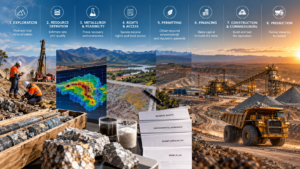
Century Lithium’s updated feasibility study for its Angel Island project in Nevada delivers the kind of numbers that make investors take notice. The after-tax net present value jumped to $4.01 billion, a one-third increase from the previous 2024 study. Initial capital costs dropped 35% to $997 million.

That’s not a minor tweak. That’s a fundamental reshaping of project economics.
The updated 2026 feasibility study, released this week, assumes a lithium carbonate price of $24,000 per tonne at an 8% discount rate. The after-tax internal rate of return improved to 27.4%, with a profitability index hitting 4.0. By any measure, those are tier-one development economics in an industry where many projects struggle to pencil out above 15% IRR.
What Changed Between Studies
The improvement stems from a simplified development approach. Century Lithium stripped out a third expansion phase that was contemplated in 2024, streamlining the project into a two-phase buildout that reduces execution risk and capital intensity.
Stage one will process 7,500 tonnes per day. Stage two, starting in year five, doubles throughput to 15,000 tonnes per day. The phased approach allows the company to generate cash flow from operations before committing to the full-scale expansion.
More Read



That sequencing matters. Lithium projects have a nasty habit of consuming capital during construction while prices swing wildly. A smaller initial footprint means faster payback and less exposure to commodity price volatility during the critical ramp-up period.
The mine life extends to 40 years, providing long-duration production that appeals to automakers and battery manufacturers looking for stable domestic supply chains. In an industry increasingly focused on resource nationalism and supply security, longevity translates to strategic value beyond just NPV calculations.
Direct Lithium Extraction Technology
Angel Island will deploy direct lithium extraction technology, incorporating hydrochloric acid leaching, solid-liquid separation, lithium carbonate precipitation, and an integrated chlor-alkali plant. The facility produces battery-grade lithium carbonate on-site, eliminating transportation and processing steps that add cost and carbon intensity.
The integrated chlor-alkali process produces surplus sodium hydroxide as a co-product. That’s not incidental revenue. The study projects $5,393 per tonne in additional income from NaOH sales, potentially driving net operating costs below zero on a co-product credit basis.
Per tonne. That’s a structural advantage that compounds over a 40-year mine life.
DLE technology remains less proven at commercial scale than conventional hard-rock lithium processing, but the Nevada brine deposits are well-suited to the approach. The chemistry is straightforward: pump lithium-rich brine to the surface, extract lithium selectively, reject the brine back to the aquifer. No massive evaporation ponds, no multi-year pond cycles, no water loss to evaporation in a desert environment.

The environmental permitting advantages are real. Century Lithium’s project received transparency status under the federal FAST-41 fast-track approval program, making it one of only three lithium projects to achieve that designation. FAST-41 status doesn’t guarantee approval, but it establishes a coordinated federal review timeline that reduces regulatory uncertainty.
Strategic Positioning in U.S. Market
Angel Island ranks second among U.S. lithium development projects by NPV, trailing only Lithium Americas’ Thacker Pass project at $5.9 billion. That comparison matters. Thacker Pass has secured a $2.26 billion conditional loan commitment from the Department of Energy and a strategic investment from General Motors.
The U.S. has exactly two domestic lithium production facilities operating today. Demand for battery-grade lithium carbonate is growing at double-digit rates annually, driven by electric vehicle adoption and grid-scale energy storage deployment. The domestic supply deficit isn’t measured in thousands of tonnes. It’s measured in hundreds of thousands of tonnes.
Angel Island’s Nevada location provides proximity to battery manufacturing facilities planned or under construction in the Southwest. Transportation costs and lead times matter when customers are building just-in-time supply chains to support multi-billion-dollar gigafactory investments.
The project also positions Century Lithium to capture value from Section 30D clean vehicle tax credits and Inflation Reduction Act incentives that favor domestic and North American sourcing. Those policy tailwinds add margin that doesn’t appear in base-case feasibility economics but significantly impacts real-world project returns.
Capital and Development Timeline
The $997 million initial capital estimate reflects current engineering and procurement assumptions. That number will move. It always does between feasibility and first production. The question is magnitude and direction.
Century Lithium hasn’t announced a final investment decision timeline or detailed financing strategy. Securing nearly $1 billion in project capital for a mid-tier lithium developer requires strategic partnerships, offtake agreements with volume commitments, or government loan support through programs like the Department of Energy’s Loan Programs Office.
The company is likely pursuing all three simultaneously.
Offtake agreements with automakers or battery manufacturers provide demand certainty and can unlock project financing from commercial lenders. Government loans reduce the cost of capital and signal federal support that reassures private investors. Strategic equity investments from established mining companies or downstream players bring operating expertise and balance sheet strength.
Construction timelines for DLE projects remain uncertain given limited commercial precedents. Century Lithium will need to prove the technology works at design capacity and that operating costs align with feasibility assumptions. That’s where many mining projects stumble, the gap between engineering studies and operational reality.
Market Context and Risks
Lithium carbonate prices have fluctuated dramatically over the past three years, ranging from below $15,000 per tonne to above $80,000 per tonne during the 2022 supply squeeze. The current price environment sits closer to the bottom of that range, putting pressure on marginal producers and delaying investment decisions across the industry.
Angel Island’s economics at $24,000 per tonne lithium carbonate provide cushion against price volatility, but no project is immune to sustained low prices. If lithium stays below $20,000 per tonne through 2027-2028, financing conversations get harder even for high-quality assets.
The counterargument: long-term supply-demand fundamentals remain constructive. Global lithium production needs to triple by 2030 to meet projected battery demand. New supply takes five to seven years to bring online from discovery to production. The projects that secure financing and reach construction in 2026-2027 will hit the market during the next supply deficit cycle.
Timing matters. Angel Island’s development schedule positions first production for the late 2020s, when the gap between lithium demand growth and new supply delivery widens significantly. That’s the window where projects with tier-one economics and domestic strategic value capture premium pricing and policy support.
The risks are standard for development-stage mining projects: permitting delays, capital cost overruns, technology performance shortfalls, commodity price weakness, financing gaps. Century Lithium has de-risked portions of that profile through the FAST-41 designation and by simplifying the development plan, but execution remains everything.
What It Means
Angel Island represents one of the strongest lithium development assets in the U.S. by the numbers. A $4 billion NPV with a 27% IRR and sub-$1 billion initial capex puts the project in rarefied territory for undeveloped lithium deposits globally.
The updated feasibility study delivers exactly what investors want to see: better economics, lower capital intensity, simplified execution plan, and long mine life. Whether that translates to construction depends on factors beyond the study: lithium prices, financing availability, permitting timelines, and management execution.
But the fundamentals are there. Domestic lithium production will expand dramatically over the next decade because it has to. The projects with the best economics and strategic positioning will attract capital first. Angel Island checks those boxes.
The question isn’t whether this project makes sense. The question is whether Century Lithium can navigate the financing and development process to get it built on schedule and on budget. That’s where feasibility studies end and real mining begins.