Dominic LeBlanc Leads Canada–US Trade Fight
Veteran east-coast MP Dominic LeBlanc remains Canada’s point man on trade relations with the United States. As Minister of Canada–US Trade, LeBlanc has already been tested, engaging with Trump administration officials following the 2024 reelection. He is expected to be Carney’s chief negotiator on tariffs and the revision of the North American Free Trade Agreement (NAFTA) framework.

LeBlanc’s tenure under Trudeau was marked by deft negotiations with conservative provincial leaders. His skillset will now be applied to the international stage, especially in dealings with U.S. Commerce Secretary Howard Lutnick, a known trade hawk.
Joly, Freeland, and Anand Anchor Domestic Front
Melanie Joly, once Canada’s foreign affairs lead, now takes over as Industry Minister, tasked with drawing new investment and managing key regulatory files in telecommunications and innovation. Her Quebec roots add another layer of regional reinforcement to Carney’s cabinet.
Chrystia Freeland, a former rival turned cabinet ally, takes on Transport and Internal Trade, a role crucial to removing barriers between provinces—an early priority for Carney’s legislative agenda. Though sidelined from U.S.-facing responsibilities, Freeland remains influential.
Anita Anand, previously Canada’s defense and procurement minister during the pandemic, becomes Foreign Affairs Minister, bringing governance and legal expertise to a role that now includes managing relationships beyond North America, especially in Asia and the Arctic.
More Read
Robertson Tackles Housing Crisis
Newly elected MP Gregor Robertson, former Vancouver mayor, takes charge of the Housing Ministry. He will oversee the creation of a national developer agency, an ambitious plan aimed at scaling up affordable housing on public land—an echo of Carney’s goal to create long-term economic infrastructure.

Carney’s Strategic Coalition
The composition of Carney’s cabinet reflects a deliberate alignment of economic technocracy and political calculus. Champagne and Hodgson symbolize the duality of insider trust and external expertise. Freeland and Joly serve as nods to political continuity, while appointments like Robertson signal a generational and policy reset.
Carney’s challenge will be to translate this talent pool into tangible policy wins. His early moves—tax reform, internal trade deregulation, and infrastructure planning—will test the cohesion and capability of his team as they navigate global instability and domestic discontent.
More Read

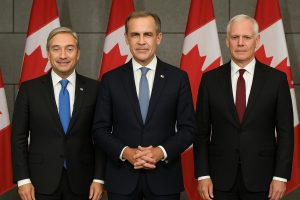
Canadian Prime Minister Mark Carney has appointed former Goldman Sachs executive Timothy Hodgson and Quebec heavyweight François-Philippe Champagne to lead the economic charge as his government seeks to reshape trade, energy, and internal commerce.
In the weeks following his April 28 election victory, Carney has unveiled a cabinet calibrated to execute his ambitious economic platform—one defined by a potential trade standoff with the U.S., sweeping domestic reforms, and a reorientation of Canada’s industrial base.
The new lineup includes 29 ministers and 10 junior officials, combining seasoned political operatives with newcomers drawn from the private sector. At its core, Carney’s team is anchored by loyalty, technical proficiency, and geographic balance, particularly with heavy representation from Quebec.
Quebec Loyalist Champagne Retains Finance
François-Philippe Champagne, 54, continues as finance minister, signaling continuity in Carney’s fiscal strategy. The former industry minister under Justin Trudeau has proven adept at landing major foreign investment—most notably helping to secure a multi-billion-dollar commitment from Volkswagen AG for battery manufacturing in Canada.
A skilled communicator from Quebec, Champagne was instrumental in securing Liberal gains in the province, delivering results that earned him a reputation as Carney’s most politically valuable Quebec ally. Known as “Frankie Bubbles” for his energetic persona, Champagne has deep private-sector experience, having worked in engineering and consulting before entering politics.
Hodgson Brings Wall Street Expertise to Resources Portfolio
Carney’s most high-profile outsider appointment is Timothy Hodgson, a former Goldman Sachs managing director who will lead the Natural Resources Ministry. Hodgson ran Goldman’s Canadian operations from 2005 to 2010 before joining the Bank of Canada as a special adviser while Carney was governor.
In recent years, Hodgson chaired the board of Hydro One and served on the boards of the Ontario Teachers’ Pension Plan and Canadian Investment Regulatory Organization. His private-sector acumen and alignment with Carney’s economic worldview make him a critical player in the effort to unlock value in Canada’s energy and mining sectors amid global supply chain reconfigurations
Related News:
- Sanatana Resources Secures Gold Strike Two in Yukon Mining Project Expansion
- Peru Suspends Mining After Pataz Gold Mining Massacre Leaves 13 Dead
- Fury Gold Mines Acquisition Puts Sakami Gold Project in the Spotlight
- Adapt or Decline: The Future of Mining Organizations Is Being Forged Now.
Dominic LeBlanc Leads Canada–US Trade Fight
Veteran east-coast MP Dominic LeBlanc remains Canada’s point man on trade relations with the United States. As Minister of Canada–US Trade, LeBlanc has already been tested, engaging with Trump administration officials following the 2024 reelection. He is expected to be Carney’s chief negotiator on tariffs and the revision of the North American Free Trade Agreement (NAFTA) framework.
LeBlanc’s tenure under Trudeau was marked by deft negotiations with conservative provincial leaders. His skillset will now be applied to the international stage, especially in dealings with U.S. Commerce Secretary Howard Lutnick, a known trade hawk.
Joly, Freeland, and Anand Anchor Domestic Front
Melanie Joly, once Canada’s foreign affairs lead, now takes over as Industry Minister, tasked with drawing new investment and managing key regulatory files in telecommunications and innovation. Her Quebec roots add another layer of regional reinforcement to Carney’s cabinet.
Chrystia Freeland, a former rival turned cabinet ally, takes on Transport and Internal Trade, a role crucial to removing barriers between provinces—an early priority for Carney’s legislative agenda. Though sidelined from U.S.-facing responsibilities, Freeland remains influential.
Anita Anand, previously Canada’s defense and procurement minister during the pandemic, becomes Foreign Affairs Minister, bringing governance and legal expertise to a role that now includes managing relationships beyond North America, especially in Asia and the Arctic.
Robertson Tackles Housing Crisis
Newly elected MP Gregor Robertson, former Vancouver mayor, takes charge of the Housing Ministry. He will oversee the creation of a national developer agency, an ambitious plan aimed at scaling up affordable housing on public land—an echo of Carney’s goal to create long-term economic infrastructure.
Carney’s Strategic Coalition
The composition of Carney’s cabinet reflects a deliberate alignment of economic technocracy and political calculus. Champagne and Hodgson symbolize the duality of insider trust and external expertise. Freeland and Joly serve as nods to political continuity, while appointments like Robertson signal a generational and policy reset.
Carney’s challenge will be to translate this talent pool into tangible policy wins. His early moves—tax reform, internal trade deregulation, and infrastructure planning—will test the cohesion and capability of his team as they navigate global instability and domestic discontent.