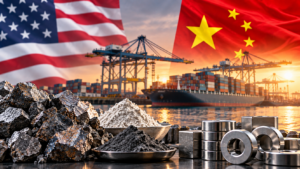
For decades, the narrative surrounding critical minerals has been one of managed decline and strategic vulnerability. We’ve heard the same warning on repeat: China owns the rare earth supply chain, and the West is just a spectator. But narratives are built on status quos, and status quos are meant to be broken.

Energy Fuels (NYSE American: UUUU, TSX: EFR) just shattered a significant piece of that monopoly.
In a quiet corner of San Juan County, Utah, at the White Mesa Mill, the company produced its first kilogram of 99.9% pure terbium oxide. This isn’t a pilot plant simulation or a theoretical laboratory success. It is high-purity, commercial-grade heavy rare earth separation on American soil. This follows their successful production of dysprosium oxide in December.
The strategic calculus here isn’t subtle: Terbium and dysprosium are the “heavy” lifting elements of the magnet world. Without them, the high-performance permanent magnets required for electric vehicle motors, wind turbines, and advanced defense systems: like the guidance systems in precision missiles: simply don’t work.
Until now, if you wanted these oxides at this level of purity, you essentially had one phone number to call. And it had a +86 country code.
More Read

The 99.9% Purity Threshold: Why It Matters
In the world of metallurgy, 99% is often considered “good enough.” In the world of rare earth elements (REEs), 99% is a failure.

To be utilized in high-spec magnet alloys, these elements must reach a purity of 99.5% at a minimum. Energy Fuels hitting 99.9% isn’t just a “milestone.” It’s a statement of technical capability. It proves that the White Mesa Mill: originally designed as a uranium and vanadium facility: can handle the complex solvent extraction (SX) required to separate individual rare earth elements from monazite sand.
Separating rare earths is notoriously difficult. They are chemically similar, often described as “fraternal twins” that refuse to leave each other’s side. Separating light rare earths (like Neodymium and Praseodymium) is hard. Separating heavy rare earths (Terbium and Dysprosium) is an industrial nightmare.
More Read
Energy Fuels just proved they have the chemistry figured out. And they’re doing it economically.

White Mesa: The Only Asset of Its Kind
The White Mesa Mill is the only operating conventional uranium mill in the United States. For years, that was its primary identity. But as the energy transition accelerated, leadership recognized that the facility’s existing infrastructure was perfectly suited for a dual-track strategy.
Because the mill already has the licenses and the technical footprint to handle radioactive materials: a necessary byproduct of processing monazite, which contains thorium and uranium: it bypassed the decade-long permitting hurdles that stymie most greenfield rare earth projects.
While other companies are still fighting for “social license” or navigating the EPA’s labyrinthine permitting process, Energy Fuels is actually turning valves and producing oxide.
This operational reality is what drove the market’s reaction. On the news of the terbium milestone, UUUU shares gained 8%. Investors aren’t just buying the commodity price; they are buying the de-risking of the American supply chain. This is a critical component of the global battery revolution where supply security is becoming as important as the technology itself.
The Leadership Hand-Off: Chalmers to Bhappu
This milestone arrives at a pivotal moment for the company’s internal structure. Mark Chalmers, the CEO who steered Energy Fuels through its transformation from a pure-play uranium miner into a diversified critical minerals powerhouse, is retiring in April.
Chalmers isn’t leaving the cupboard bare. He’s handing over the reins to Ross Bhappu, a man with deep roots in private equity and resource development. The timing suggests a transition from “proof of concept” to “commercial scale-up.”
Chalmers’ legacy is defined by the pivot to monazite. It was a contrarian move at the time, but as we see in the Per Geijer rare earths discovery in Sweden, the West is waking up to the fact that light rare earths are only half the battle. Without the “heavies”: terbium and dysprosium: the green transition hits a brick wall.
The ASM Deal: Building the “Mine-to-Metal” Bridge
Producing oxide is a massive win, but Energy Fuels isn’t stopping at the mill gate. The company is in the process of acquiring Australian Strategic Materials (ASM) for $299 million.
Why ASM? Because producing oxide is only Step 2 of a 4-step process. To truly break the Chinese monopoly, you need to turn that oxide into metal, and that metal into magnets. ASM owns the Dubbo Project in Australia and, more importantly, a high-tech “metals plant” in South Korea.
By integrating ASM’s metal-making capabilities with White Mesa’s separation capacity, Energy Fuels is building a fully integrated, non-Chinese supply chain. It’s a “mine-to-metal” strategy that bypasses the traditional bottlenecks.

Geopolitics: The End of the Stranglehold?
The timing of this terbium success couldn’t be more poignant. As trade tensions between Washington and Beijing fluctuate, the threat of export controls on rare earths is the “nuclear option” in the trade war. China has already implemented export permits for certain minerals, signaling their willingness to use their resource dominance as a diplomatic cudgel.
Energy Fuels is positioning itself as the primary insurance policy for the U.S. government. The goal? To become a top-tier producer of separated rare earth oxides outside of China.
The Bankable Feasibility Study (BFS) for Phase 2 at White Mesa highlights the scale of this ambition. The company targets production of:
- 6,000 tonnes per annum of NdPr oxide
- 240 tonnes of dysprosium
- 66 tonnes of terbium
By 2030, this facility could potentially supply up to 45% of total U.S. rare earth requirements, including nearly 100% of the heavy rare earths. That’s not a rounding error. That’s a total shift in the strategic landscape.

Economics vs. Ideology
Critics often argue that U.S.-produced rare earths can’t compete with Chinese prices. Historically, they’ve been right. China’s lower labor costs and less stringent environmental regulations allowed them to flood the market and bankrupt Western competitors (remember Molycorp?).
But Energy Fuels is running a different playbook. By leveraging its existing uranium infrastructure, the “incremental cost” of adding rare earth processing is significantly lower than building a new facility from scratch. Furthermore, the market is beginning to place a “security premium” on non-Chinese material.
Defense contractors and European EV manufacturers are no longer looking for the cheapest possible gram of terbium. They are looking for the gram that won’t be held hostage by a geopolitical whim.
What’s Next for White Mesa?
The production of a single kilogram of terbium is the spark. The next 18 to 24 months will be about the fire.
The company expects to move toward commercial-scale production of these heavy oxides as early as Q4 2026. This timeline aligns with the broader surge in demand for strategic metals. While we often focus on the big names like copper and lithium, even the ruthenium record and the AI-led metal supercycle show that the materials required for modern tech are becoming increasingly specialized.
Energy Fuels is proving that Utah isn’t just for uranium anymore. It’s the frontline of a new industrial revolution.

The Bottom Line
The 8% jump in stock price was a reaction to the technical success, but the long-term value lies in the strategic moat Energy Fuels is digging.
They have the mill. They have the licenses. They have the chemistry. And with the ASM deal, they will have the metal-making capability.
China’s monopoly wasn’t built in a day, and it won’t be dismantled in one either. But with every kilogram of 99.9% pure terbium oxide that comes out of Utah, the stranglehold gets a little looser.
The mining industry has seen its share of “game-changers” that never actually changed the game. But Energy Fuels is delivering physical product to a market that is starving for alternatives.
The era of American rare earth dependence is entering its final chapter. This isn’t just about mining; it’s about sovereignty. And right now, Energy Fuels is holding the pen.